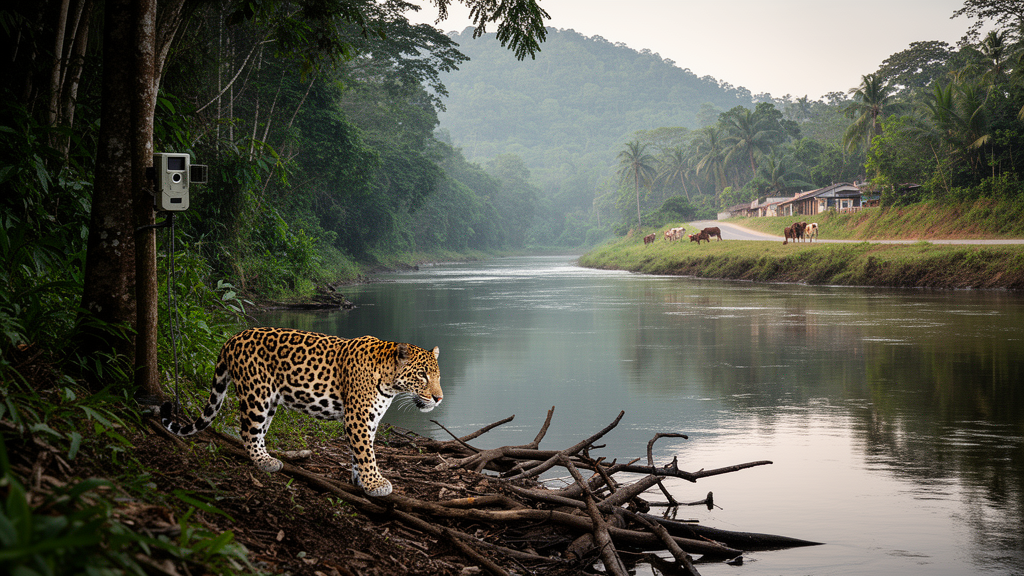
A review of 95 peer-reviewed studies published from 1980 through 2021 found that jaguar occurrence models draw on 39 environmental and anthropogenic predictor types, with prey, vegetation, wildlife and several human-related variables showing the most consistent statistical associations with occurrence. The review also found that the variables were unevenly tested: only one individual predictor, vegetation type, appeared in more than half of the studies, while several frequently used measures, including distance to water, distance to roads, slope and distance to settlements, produced significant results in fewer than half of the papers that included them. The findings characterize the variables used in the existing modelling literature; they do not establish that any one factor consistently controls jaguar populations.
The review began from the difficulty of explaining where jaguars occur in a landscape while accounting for the species’ large home ranges, low population densities, elusive behavior and exposure to an array of human pressures. Jaguars, described in the reviewed literature as the largest felid on the American continent, have been extirpated from parts of their historic range and are classified as Near Threatened. The study focused on peer-reviewed research that either addressed jaguar distribution or correlated it with environmental or anthropogenic factors.
Searches of Web of Science and Google Scholar used the terms “Jaguar,” “Distribution,” “Environmental variables,” “Prey abundance,” “Panthera” and “Occurrence.” For each relevant publication, the authors recorded the data-collection method, analytical approach, geographic scale and predictor variables. Of the 165 peer-reviewed documents retrieved, 95 met the review’s criteria. Almost 98% of this evidence base was published after 2000, and the countries with the largest numbers of included studies were Brazil, with 28 studies; Mexico, with 16; and Belize, with 10.
Researchers used seven categories of occurrence data: telemetry in 16 studies, camera traps in 38, genetics in three, historic records in 21, sign counts in two, interviews in three and geographic information system data in 12. Four analytical categories were distinguished. Basic empirical statistical models accounted for 41 studies, niche or presence-only models for 22, occupancy models for 20 and deductive approaches for 12.
Most studies were local: 62 of the 95 examined a particular landscape or study area, compared with 13 continental, 12 regional and eight country-scale assessments. The review classified 21 anthropogenic variables into four groups: roads, land use, human activities and human population. Environmental variables comprised 18 measures under climate, vegetation, wildlife, topography, water and other categories.
Significance was defined as a variable being reported as having a statistically significant influence on occurrence or distribution in the reviewed study. This approach did not standardize effect sizes, model specifications or thresholds across papers, so the frequency of a significant result cannot be interpreted as a comparable effect magnitude. Road variables appeared in 29 studies, but only eight reported a significant relationship, and distance to roads was the only road metric with more than one significant result.
It was significant in seven of 27 studies that included it; road density and distance to railroads were not significant in the papers that assessed them. Land use was examined in 32 studies. Thirteen reported at least one significant land-use association, and land-cover type was significant in 41% of the 29 papers using it.
Distance to forest appeared in one study, where it was significant, while distance to agriculture appeared in two and was not significant. Human activities were more broadly represented, with 47 papers assessing at least one of 11 metrics. Among the human-activity measures used in at least two models, reported significance ranged from 50% to 67%.
Protection status was significant in five of nine studies, and distance to protected areas was also significant in five of nine, although the latter result does not indicate the direction of the association in the review’s synthesis. Human-population variables were included in 43 studies. Population density was significant in 44% of the 16 papers using it, whereas distance to settlements was significant in 21% of 24 papers.
These mixed findings do not support treating settlement proximity as a uniform barrier to occurrence. They instead show that the measured relationship varied among study areas and modeling approaches. Reviews of the literature describe jaguars as landscape animals whose ranges can cross protected areas and multiple ecosystems, and the analysis notes that a formally protected boundary may not capture enforcement intensity.
Hunting pressure was significant in four of six studies that included it, but the review identifies its measurement and mapping as a continuing difficulty. Environmental predictors also produced variable results. Climate metrics—seasonality, precipitation and temperature—were assessed in 42 studies, of which 14 reported at least one significant climate relationship.
Precipitation was significant in six of 16 studies, temperature in four of 13 and seasonality in four of 13. Vegetation was evaluated more frequently, with 70 studies assessing six related variables. Thirty-seven reported at least one significant association, and vegetation type was significant in 33 papers.
Because vegetation type can simultaneously describe cover, prey habitat and the physical structure of hunting environments, the review treats it as a broad habitat descriptor rather than evidence for one exclusive mechanism. Connectivity was significant in none of the three papers that included it, normalized difference vegetation index in one of four, and tree richness was not significant in the single study that assessed it. Wildlife variables produced the strongest family-level statistical association.
Fifty-four studies assessed prey occurrence or abundance, conspecific occurrence or abundance, or both, and 39 reported a significant influence on jaguar distribution. Prey occurrence or abundance was significant in 23 of 27 studies, or 85%, while the occurrence or abundance of other jaguars was significant in 16 of 27, or 59%. Camera traps offer a practical reason for the availability of these measures: the same surveys can document jaguars, prey and other predators, making their occurrence and abundance comparatively accessible to collect.
Topographic and water variables were less consistent. Forty-four studies examined elevation or slope, and 14 reported a significant relationship. Elevation was significant in 13 of 30 studies, whereas slope was significant in only one of 14.
Elevation can also vary in concert with the distribution of people, protected areas and vegetation, so the review notes that it may represent other conditions rather than a direct influence. Distance to water appeared in 38 studies and was significant in nine, or 24%; runoff was significant in one of three studies. The authors note that water was more often related to occurrence in seasonal ecosystems, but the review does not establish fresh water as a general local-scale driver of jaguar density.
Soil type and geology were not significant in the limited studies that tested them, while distance to the beach was significant in one study where seasonal turtle nesting created a concentrated prey opportunity. Across geographic scales, the review identified 12 variables that were repeatedly reported as important in its synthesis. These were vegetation type, prey occurrence or abundance, conspecific occurrence or abundance, elevation, land-cover type, distance to water, distance to roads, population density, precipitation, distance to protected areas, level of protection and distance to settlements.
At regional and continental scales, the leading set included vegetation type, land cover, distance to roads, population density, precipitation, protection level and prey availability. Local studies more often emphasized prey, conspecifics, elevation, distance to water, distance to protected areas, distance to settlements and finer-scale habitat variables. These differences in variable use underscore the effect of geographic scale, survey methods and data resolution, but they do not prove that a predictor’s influence transfers unchanged between scales.
The central limitation is that occurrence data do not directly establish density, demographic stability or population trends. Even camera-trap photo rates may not correlate well with jaguar density, and studies with small samples may lack the power to detect sex-, age- or behavior-specific influences. The review also notes that available datasets and mapping constraints can determine which predictors enter a model, while coarse geographic layers may not match the ecological processes operating at a local site.
Rather than adding every measurable layer, the authors call for models that identify and quantify specific causal factors affecting jaguar reproduction, survival and dispersal. Connecting habitat use to demographic rates remains difficult and costly, but the review argues that those links are necessary to move beyond mapping where jaguars occur and toward understanding the conditions under which viable populations persist.
Subject of Research: Environmental and anthropogenic predictors used in jaguar occurrence models
Article Title: A review of environmental and anthropogenic variables used to model jaguar occurrence
Article References: Montalvo, V. H., Sáenz-Bolaños, C., Carrillo, E., & Fuller, T. K. (2023). A review of environmental and anthropogenic variables used to model jaguar occurrence. Neotropical Biology and Conservation, 18(1), 31-51. https://doi.org/10.3897/neotropical.18.e98437
Image Credits: AI Generated
DOI: 10.3897/neotropical.18.e98437
Keywords: jaguar occurrence, Panthera onca, species distribution models, habitat modeling, prey abundance, camera trapping, human pressures, land cover, conservation, landscape ecology, review, environmental
News Source: Drew Townsend. (October 20, 2026). A review of environmental and anthropogenic variables used to model jaguar occurrence. Scienmag.