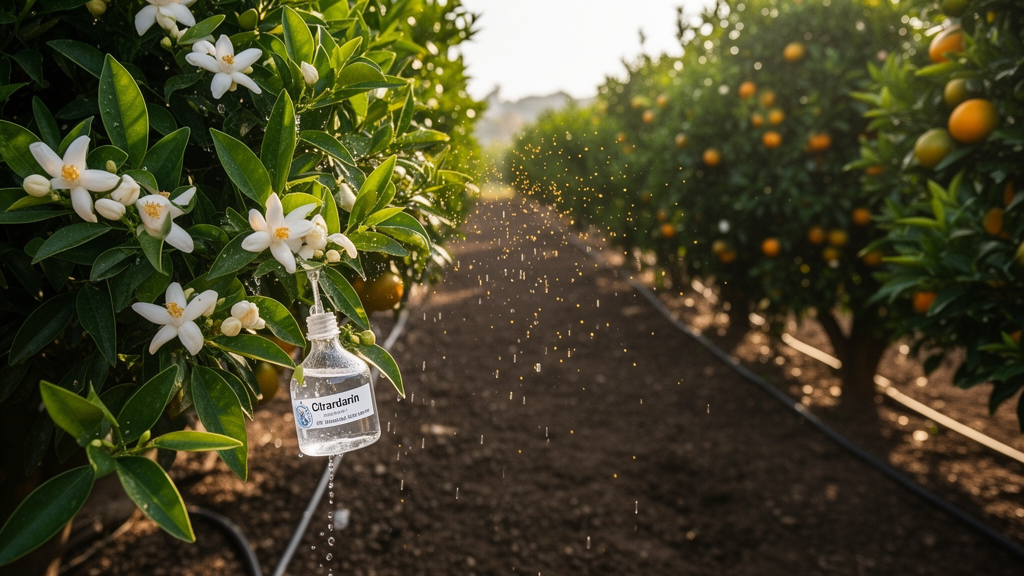
Transgene flow in field trials of genetically modified sweet orange was substantially lower in plants protected by a multi-genotype border containing citrandarin, according to a Brazilian study conducted across four experimental sites and 12 flowering seasons. Researchers examined 29,000 clementine fruits and more than 23,000 clementine seedlings from the borders, finding an average gene-flow frequency of 6.05%. By comparison, clementine control trees growing within the bordered area without the intervening buffer rows averaged 24.09%. In the polyembryonic Pera sweet orange border, only 0.31% of 3,676 germinated seedlings carried the nptII selectable-marker transgene. The results indicate that citrandarin, a highly competitive pollen donor, can mitigate—but not eliminate—pollen-mediated gene flow under the field conditions studied.
The work tested the containment strategy prescribed by Brazil’s National Technical Biosafety Commission for releases of genetically modified citrus. Each trial was surrounded by sequential rows of non-GM plants: citrandarin, selected for its strong ability to compete in pollination; Clemenules clementine, a self-incompatible, monoembryonic variety used as a sensitive pollen receptor and monitoring genotype; and Pera sweet orange, a self-compatible, polyembryonic commercial cultivar used to estimate the frequency of transgenic seedlings. Two rows of each genotype formed the internal and external borders. Because insects, especially bees, are the principal pollinators of citrus, the design tested whether spatial separation and pollen competition could suppress movement of genetically modified pollen toward recipient trees.
The four trials were established from 2013 through 2019 in the state of São Paulo, Brazil, with three irrigated sites in Ibaté and one rain-fed site in Santa Cruz do Rio Pardo. Rows were spaced 6.5 m apart and plants 2.5 m apart within rows. The genetically modified sweet orange carried an nptII gene cassette associated with resistance to aminoglycoside antibiotics, under either the constitutive CaMV35S or NOS promoter. The nptII marker enabled researchers to screen seedlings for evidence of pollen-mediated gene flow. Sampling occurred from 2018 through 2023, generally three to four years after each trial was planted, and included 25 to 100 open-pollinated fruits per sampled plant. Fruits were collected, their seeds extracted under aseptic conditions and germinated in nursery substrate for molecular analysis.
Marker detection was performed by conventional PCR, with confirmed transgenic tissue included as a positive control, non-GM tissue as a negative control, and no-template controls in every run. Reactions targeted nptII, using 35 cycles with denaturation at 94 °C, annealing at 62 °C and extension at 72 °C. Products were separated on 1% agarose gels and visualized under ultraviolet light. Weak or ambiguous bands led to re-extraction and duplicate analysis. Phenotype supplied an additional line of evidence: citrandarin carries a dominant trifoliate leaf trait, so trifoliate clementine seedlings indicate that citrandarin pollen fertilized the recipient flower. Microsatellite genotyping was then used to assign paternity to selected monofoliate clementine offspring that were PCR-negative for the transgene.
Controlled pollinations showed that pollen from Pera, Hamlin, Valencia and Pineapple sweet oranges, as well as Citrandarin 1600, was compatible with Clemenules clementine, producing fruit set and seed formation. In mixed-pollen treatments, however, paternity analysis indicated that citrandarin competed more effectively for fertilization than Pera or Pineapple sweet-orange pollen. Across the two controlled seasons, clementine fruits pollinated with citrandarin averaged 14.34 seeds, while Pera sweet orange averaged 16.61 seeds. These results support a mechanistic basis for the field pattern: when viable pollen is available from nearby citrandarin trees, clementine ovules can be fertilized by a source that does not carry the engineered gene, reducing the proportion of progeny that inherit it.
The field measurements nevertheless showed substantial variation among experiments, years and individual trees. Clementine border gene flow ranged from 0% to 67.24% per plant, while control trees ranged from 0% to 65.02%. Seasonal averages for the clementine border ranged from 1.89% to 19.26%, and control-tree averages ranged from 5.65% to 38.07%. Transgene was detected in progeny from 103 of 106 sampled clementine controls. Distance from the citrandarin border was positively associated with gene flow in control trees, with the overall relationship significant at p = 0.008, although annual correlation coefficients and significance values varied. The researchers linked this pattern to bee foraging, the spatial arrangement of pollen donors and changing pollen-source composition.
Environmental and management changes complicate the comparisons. Weather can affect flowering, pollen viability, nectar availability, bee movement, fruit retention and ovule fertility, while irrigation differed among the experimental areas. The study also began after the plots were planted, and trees removed because of huanglongbing disease altered both the number of recipient plants available for assessment and the relative distribution of transgenic and non-transgenic pollen sources. In one experiment, eradication reached 54.9% among Pera border plants. These shifts help explain why gene flow changed across seasons and why geographic or treatment differences cannot be interpreted as a simple, uniform effect. The central comparison—bordered plants versus clementine controls under the same broader field environment—nevertheless showed lower flow in the bordered treatment.
Pera sweet orange exhibited much lower measured flow than clementine. The transgene was detected in 15 of 3,676 sweet-orange border seedlings, giving an overall frequency of 0.31%, and no significant difference was found between the inner and outer sweet-orange rows or between the two evaluated seasons. Several biological traits may have contributed. Pera is self-compatible, allowing its own pollen to compete with pollen arriving from genetically modified donors. It is also polyembryonic: most seeds produced multiple seedlings, reflecting facultative apomixis in which maternal nucellar embryos develop alongside sexually derived zygotic embryos. Competition within the seed may favor nucellar seedlings, which do not carry transgenes carried by paternal pollen, over a zygotic embryo produced through external fertilization.
Statistical analysis found that both plant position and recipient genotype significantly influenced gene flow. Border position was associated with lower flow than the control position, and sweet orange showed lower flow than clementine. Distance also differed between the recipient groups: Pera border trees were 32.5 or 39.0 m from the nearest genetically modified parcels, whereas clementine border trees were 19.5 or 26.0 m away, so geometry as well as reproductive biology contributed to the contrast. The distance result was consistent with the proposed effect of citrandarin: in a border system, genetically modified pollen must first reach trees whose flowers can also receive abundant pollen from the non-GM superpollinator, whereas control trees were exposed more directly to donors inside the trial.
The findings do not establish a universal containment rate. The study covered specific cultivars, field sites, climates, planting configurations and management conditions, and the transgene assay measured the nptII marker rather than every possible genetic change. Although the buffer was associated with a substantial reduction in measured pollen-mediated gene flow, 15 sweet-orange seedlings and 1,656 clementine seedlings still tested positive. Citrandarin therefore mitigated rather than prevented dispersal. The authors also note that Brazil’s 2020 biosafety resolution changed the regulatory approach by requiring at least three rows of non-GM polyembryonic plants around genetically modified citrus areas, while permitting citrandarin to be omitted. The new study directly addresses the effectiveness of retaining citrandarin, showing that its competitive pollination and strategic placement were associated with substantially lower transgene frequencies under the evaluated Brazilian field conditions.
Subject of Research: Field evaluation of a citrandarin border system for containing pollen-mediated transgene flow in genetically modified sweet orange
Article Title: Field-based validation of a citrandarin buffer system for gene flow containment in genetically modified sweet orange trials
Article References: Julião, M. H. M., Jaciani, F. J., Guimarães, T. M. D. N., Sanches, A. L., Cardamoni, T. M. M., Marques, V. V., Locali, E. C., Peña, L., & Wulff, N. A. (2026). Field-based validation of a citrandarin buffer system for gene flow containment in genetically modified sweet orange trials. Frontiers in Bioengineering and Biotechnology, 14, Article 1929107. https://doi.org/10.3389/fbioe.2026.1929107
Image Credits: AI Generated
DOI: 10.3389/fbioe.2026.1929107
Keywords: citrandarin, gene flow containment, genetically modified citrus, sweet orange, pollen-mediated gene flow, biosafety, nptII marker, field trials, transgenic seedlings, Field-based, validation, buffer
News Source: Juliet Wilcox. (October 20, 2026). Citrandarin buffer sharply reduces transgene flow in sweet orange trials. Scienmag.