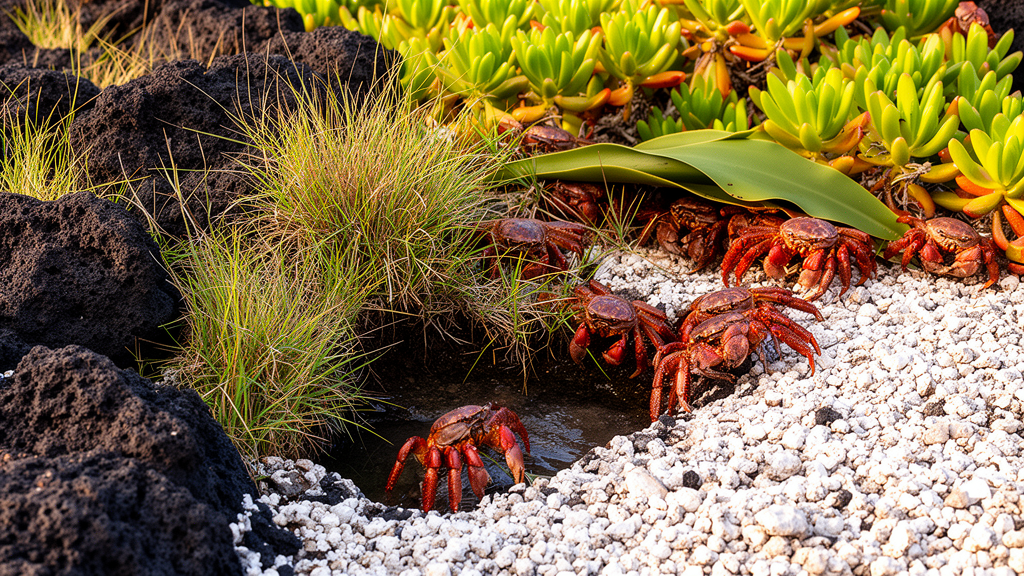
Field observations of the endangered land crab Johngarthia lagostoma on Trindade Island revealed that individuals formed non-breeding groups at four locations below about 40 meters elevation, while scattered crabs were recorded across nearly the island’s sampled elevation range. The groups occurred in places with access to food and conditions that appeared favorable for burrow construction, including a watercourse beside a green turtle nesting area, a heavily grazed patch of endemic grass, a vegetated beach and the island’s oceanographic outpost. The 2015 observations were based on qualitative, nonsystematized sampling rather than a controlled population survey, but they document a patchy distribution and provide the first detailed information on non-breeding groupings at this Brazilian oceanic island.
Trindade Island covers 9.28 square kilometers in the South Atlantic, approximately 1,200 kilometers from Vitória in southeastern Brazil. Its rugged terrain reaches 620 meters, and it is the only Brazilian oceanic island with perennial streams. The island has a tropical oceanic climate, with average annual rainfall of 923 millimeters.
Before human occupation around 1700, forest of Colubrina glandulosa covered about 85 percent of the island. Introduction of herbivorous mammals, including goats, pigs and sheep, subsequently suppressed native vegetation, exposed soil, reduced water availability and intensified erosion, resulting in the loss of much of the island’s organic soil. Present landscapes are comparatively arid, with grasses dominating many areas and cloud forest confined to elevations above 400 meters.
Researchers sampled crabs from April 3 to June 20, 2015, by visually recording them from non-predefined transects along trails and across beaches, watercourses, herbaceous fields, cloud forest and built areas. Some of the most remote western beaches were reached by boat. A group was defined as at least 10 individuals found visually close together.
For every group, investigators recorded location, elevation, vegetation, proximity to watercourses, substrate, food availability and whether the animals were foraging or breeding. Isolated individuals were recorded with more general information about their surroundings. All four groups showed foraging activity, and the researchers found no evidence of reproductive activity during the sampling period.
At Praia dos Cabritos, a group occupied wet rocky substrate beside a watercourse near a green turtle breeding area at approximately 30 meters elevation. At Ponta das Tartarugas, around 34 meters above sea level, a group foraged on unconsolidated ground containing many J. lagostoma burrows and extensive evidence of consumption of the endemic grass Cyperus atlanticus. The affected ground was exposed, with plant rhizomes, accumulations of feces and crabs near burrows.
Close to Praia das Tartarugas, the main turtle spawning beach on Trindade, the researchers also observed J. lagostoma consuming green turtle eggs and hatchlings. These records document the crab as a predator of eggs and newly hatched turtles at a site also used by nesting females. At Praia dos Andradas, a group was observed throughout the sampling period in a herbaceous field dominated by Canavalia obtusifolia and Ipomoea species.
The crabs consumed the plants and occupied numerous burrows beneath sandy and organic soil. This beach is also one of the island’s main green turtle reproduction areas, and turtle eggs and hatchlings were present during the survey. A further aggregation was recorded daily at the Trindade Island Oceanographic Outpost, where cultivated Terminalia catappa trees supplied nuts, leaves and shade.
Human food scraps and discarded waste provided additional food near the buildings. The survey also recorded crabs being captured for human consumption near the outpost, and the animals were observed consuming inert material, including plastic. The locations of the groups differed from the island’s generally arid matrix and contained a mixture of potential food resources, moisture, vegetation and substrate suited to burrows.
These features were associated with the aggregations, although the observational design could not determine which, if any, was responsible for them. Three of the four groups were near major green turtle nesting beaches, linking local crab concentrations with an area where seasonal animal food was available. Plant resources were also present at several sites, including C. atlanticus at Ponta das Tartarugas and vegetation at Praia dos Andradas and the outpost.
The findings therefore identify several resources that can coincide with non-breeding groups without establishing a single causal mechanism. All groups were recorded below 40 meters, whereas isolated individuals were observed through almost the entire sampled elevation range, reaching about 570 meters, including locations above 500 meters. This contrast indicates that low-elevation sites can support conspicuous aggregations while the species also occurs at higher elevations as scattered individuals.
Comparisons with Ascension Island show a similar broad elevational range, with J. lagostoma reported from as high as 859 meters. On both islands, crabs have been associated with favorable enclaves, but the Trindade observations come from qualitative sampling and cannot establish total abundance, density or occupancy across the landscape. They nevertheless show that the crab’s presence over much of an island does not imply a uniform distribution.
Color provided a second major pattern in the study. When these observations were combined with 40 individuals recorded during the 2019–2020 reproductive period, Trindade had 81 yellow or orange crabs and three purple crabs among 84 individuals, or 96.4 and 3.6 percent respectively. The difference between the 2015 and 2019–2020 samples was not statistically significant in the authors’ G-test with Williams’ correction.
The later sample also contained 39 yellow individuals and one purple individual, corresponding to 97.5 and 2.5 percent. Comparisons among the three major island populations showed clear differences. Atol das Rocas had 682 yellow or orange individuals and 868 purple individuals among 1,550 crabs, so purple represented 56 percent of the population.
Ascension Island had 1,551 yellow or orange individuals and 247 purple individuals among 1,798 crabs, making yellow or orange 86.3 percent of the total. The authors found significant differences among the three chromatic patterns and a smaller Euclidean distance between Trindade and Ascension, at 0.629, than between Trindade and Atol das Rocas, at 3.265, or Ascension and Atol das Rocas, at 2.635. The colors nevertheless track the species’ reported genetic structure, and the study presents the founder effect and possible larval dispersal as hypotheses rather than experimentally demonstrated causes of the visible differences.
J. lagostoma is classified as Endangered and occupies less than 5,000 square kilometers in Brazil. Its known pressures include habitat loss, invasive species and illegal consumption, while low connectivity, slow population growth and irregular recruitment may increase vulnerability in isolated populations. On Trindade, the authors emphasize localities that provide natural food resources, native vegetation and substrate for burrows, together with stronger protection against human capture.
They also propose plant restoration and improved management of waste at the oceanographic outpost. The field study did not test the effectiveness of these measures, and it cannot show that restoring vegetation or prohibiting harvesting will cause a population increase. Its immediate contribution is a more detailed account of where non-breeding groups form, what they eat and which conditions accompany their occurrence on an island whose terrestrial habitat has been substantially altered.
Subject of Research: Observed habitat use, non-breeding group formation and color variation in the Trindade Island population of Johngarthia lagostoma.
Article Title: Habitat use, non-breeding groupings and chromatic pattern in Johngarthia lagostoma (H. Milne Edwards, 1837) ( Decapoda , Gecarcinidae ) in Trindade Island, South Atlantic Ocean
Article References: Entringer Jr, H., & Srbek-Araujo, A. C. (2023). Habitat use, non-breeding groupings and chromatic pattern in Johngarthia lagostoma (H. Milne Edwards, 1837) (Decapoda, Gecarcinidae) in Trindade Island, South Atlantic Ocean. Neotropical Biology and Conservation, 18(1), 83-95. https://doi.org/10.3897/neotropical.18.e101409
Image Credits: AI Generated
DOI: 10.3897/neotropical.18.e101409
Keywords: Johngarthia lagostoma, Trindade Island, land crab, non-breeding groups, habitat use, chromatic variation, green turtle predation, island conservation, South Atlantic, Brazil, Habitat, non-breeding
News Source: Gavin Prescott. (October 20, 2026). Trindade Island land crab forms groups in patchy habitat. Scienmag.