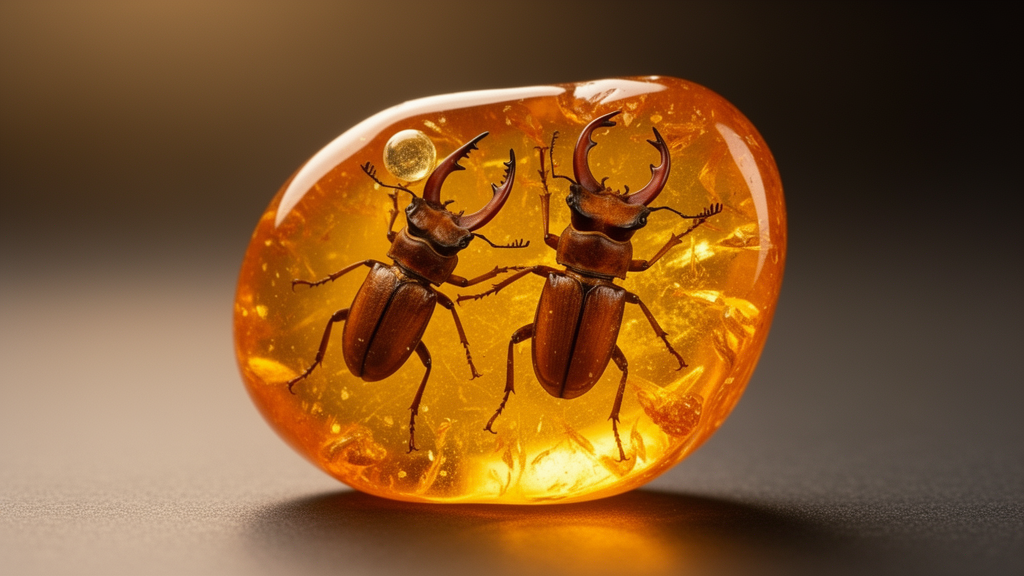
Deep inside a piece of golden amber from northern Myanmar, scientists have found the smallest stag beetles ever discovered — creatures so tiny that three of them measure less than three millimeters from head to wingtip. The four newly described fossils, preserved in mid-Cretaceous Kachin amber dated to roughly 99 million years ago, reveal a hidden world of miniature beetles that lived in the ancient tropical forests of the Burma Terrane. The findings, published in the journal Evolutionary Systematics, double the number of stag beetle species known from this famous amber deposit and offer a rare glimpse into the early evolution of one of the beetle world’s most charismatic families.
Stag beetles, known scientifically as Lucanidae, are among the most recognizable insects on Earth. With roughly 1,800 living species in 145 genera, they are found across all major zoogeographical regions but are especially abundant in the tropics of Southeast Asia. Many adult males sport enormous, antler-like mandibles that they use to wrestle rivals for mates and food — weapons that can push the total body length of the largest species to 120 millimeters. Against that backdrop, the discovery of stag beetles barely three millimeters long is startling. The smallest living aesaline stag beetles reach about three millimeters, but no extinct lucanid of comparable size had ever been reported before now.
The new study, led by a researcher at the Hokkaido University Museum in Sapporo, Japan, describes four lucanid specimens preserved in amber from the Hukawng Valley in Kachin State. All four belong to the primitive subfamily Aesalinae, considered one of the earliest diverging lineages within the stag beetle family tree. One specimen represents a new species of the genus Protonicagus, named Protonicagus mandibularis for its unusual mandible shape. A second represents an entirely new genus and species, Cretognathus minutissimus — the species name is Latin for
The miniature dimensions of these ancient beetles carry real scientific weight. Amber, as a preservation medium, tends to favor small organisms, since larger and stronger insects can often tear themselves free of sticky resin before it engulfs them. Stag beetles, with their robust bodies and powerful musculature, are precisely the kind of insects one would expect to escape entrapment, which helps explain why only nine lucanid species had previously been described from amber deposits anywhere in the world. The fact that the newly reported specimens are so small may therefore reflect both a genuine biological signal — a Cretaceous trend toward miniaturization in several unrelated beetle lineages — and the filtering effect of the fossil record itself. Either way, the discovery suggests that the true diversity of Mesozoic stag beetles is likely underestimated, with tiny species slipping through the net of both preservation and study.
The four specimens also illuminate the biogeographic history of the group. Three of the new fossils belong to the tribe Ceratognathini, a group whose living members are restricted today to Australia and South America — southern landmasses that once formed part of Gondwana. Their presence in mid-Cretaceous amber from northern Myanmar fits a broader pattern in which the Kachin amber fauna contains numerous lineages with Gondwanan affinities. The Burma Terrane, the landmass that carried the Hukawng Valley forests during the Cretaceous, is thought to have drifted as an island arc before colliding with Asia, and its biota preserves traces of these ancient southern connections. The fourth specimen, Protonicagus mandibularis, belongs to the tribe Nicagini, whose modern representatives live in the Northern Hemisphere, adding a contrasting distributional thread to the assemblage.
Amber fossils offer advantages over the compressed impressions that make up most of the stag beetle fossil record. Roughly thirty fossil lucanid species have been described worldwide, but most are known from impression fossils in sedimentary rocks, where fine details of the exoskeleton are crushed or lost. Amber, by contrast, can preserve delicate structures such as antennae, tarsi, and mouthparts in three dimensions, allowing direct comparison with living species. The earliest known stag beetle, Juraesalus atavus, comes from Middle Jurassic deposits of Inner Mongolia dating to around 165 million years ago, and several aesaline impression fossils are known from the Lower and Upper Cretaceous of China and Kazakhstan. But the Kachin amber specimens, preserved near the Albian–Cenomanian boundary about 99 million years ago, now constitute the richest single source of Mesozoic lucanid diversity, with nine species described from this deposit alone.
The systematic placement of the new fossils touches on an unresolved debate in stag beetle classification. Aesalinae, the subfamily to which all four specimens belong, is generally regarded as one of the early diverging branches of Lucanidae, and its members retain several primitive features, including undivided eyes, small mandibles, and partially or non-geniculate antennae. Yet molecular studies have produced conflicting results about whether Aesalinae as currently defined forms a natural group, with some analyses suggesting that the tribe Nicagini lies outside the rest of the subfamily. The elusive phylogenetic position of Nicagini — small beetles whose living relatives inhabit sandy shores and dunes rather than decaying wood — remains one of the puzzles of lucanid evolution, and each new fossil specimen bearing on this lineage is valuable for testing competing hypotheses.
The new species themselves display distinctive anatomy. Protonicagus mandibularis, at 3.78 millimeters including mandibles, joins its previously described congener Protonicagus tani as the second species of a genus otherwise known only from Kachin amber. Cretognathus minutissimus, at just 2.83 millimeters, becomes the smallest known stag beetle of all, edging out two additional Ceratognathini specimens that measure 2.78 and 2.72 millimeters but are too incompletely preserved for confident generic assignment. These measurements place the fossils well below the lower size range of most living aesalines, which typically reach up to ten millimeters, and far below the giant tropical lucanines that dominate the family’s modern diversity.
Miniaturization among Kachin amber beetles is not unique to stag beetles. Several unrelated lineages from the same deposit show similarly reduced body sizes, hinting at ecological pressures in the Cretaceous forests of the Burma Terrane that favored small body plans — perhaps the exploitation of microhabitats within decaying wood, leaf litter, or bark crevices. For saproxylic insects like lucanids, whose larvae feed on deadwood at various stages of decomposition, small size may have opened ecological opportunities unavailable to larger relatives. The pattern also raises questions about how the exaggerated mandibles of male stag beetles, so prominent in modern species, evolved in lineages whose entire bodies were smaller than the mandibles of their living descendants.
The discovery underscores how much of the deep-time diversity of familiar insect groups remains hidden. Stag beetles are among the most intensively collected and studied beetle families, yet a single amber deposit has now doubled the known Mesozoic species count and revealed body sizes never before recorded for the family. As more Kachin amber specimens are examined with modern imaging techniques, further surprises — including additional miniature lineages and clearer resolution of early lucanid relationships — seem likely to emerge from the ancient resin.
Subject of Research: Paleontology
Article Title: The smallest stag beetles ( Coleoptera , Lucanidae ): hidden paleodiversity in mid-Cretaceous Kachin amber from northern Myanmar
Article References: Yamamoto, S. (2023). The smallest stag beetles (Coleoptera, Lucanidae): hidden paleodiversity in mid-Cretaceous Kachin amber from northern Myanmar. Evolutionary Systematics, 7(2), 211-235. https://doi.org/10.3897/evolsyst.7.104597
Image Credits: AI Generated
DOI: 10.3897/evolsyst.7.104597
Keywords: stag beetles, Kachin amber, Cretaceous, paleontology, Lucanidae, miniaturization, Gondwana, Myanmar amber, smallest, stag, beetles, Coleoptera
News Source: Gavin Prescott. (October 19, 2026). Tiny Stag Beetles Trapped in 99-Million-Year-Old Amber Rewrite the Insect’s Family History. Scienmag.