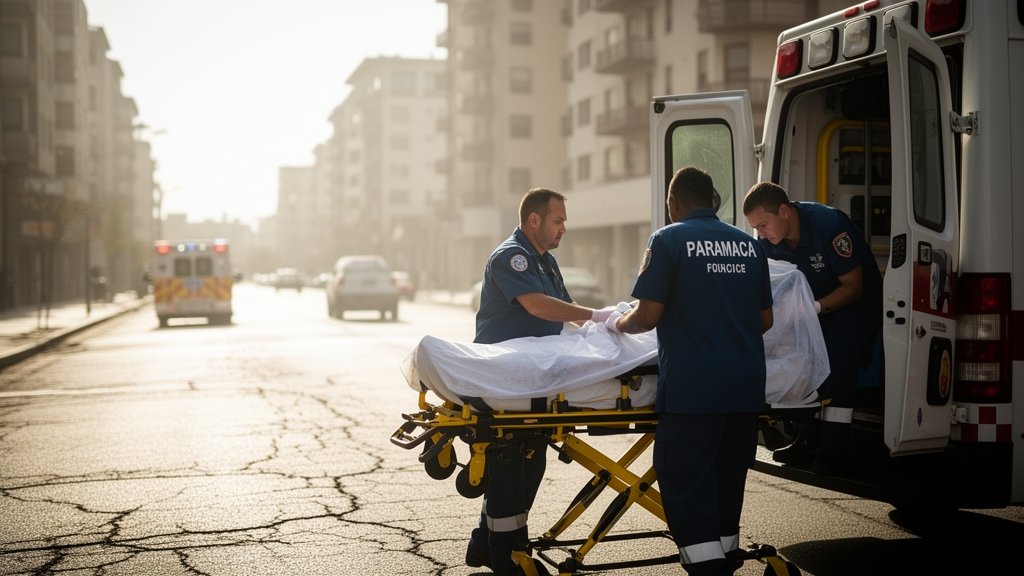
When a heat wave settles over a major city, the consequences are not always visible in melted roads or wilted crops. Some of the most immediate damage unfolds inside the human body, and a new study from Wuhan, China, shows exactly how quickly that damage translates into a surge of ambulance calls. Researchers analyzing more than 43,000 emergency dispatch records found that extreme heat significantly raised the odds of emergency medical services being summoned for hypertension, syncope, stroke, and convulsions, with the effect varying sharply by diagnosis, sex, and age. The findings, published in BMC Health Services Research, offer one of the most granular portraits yet of how hot weather reshapes the daily workload of a metropolitan emergency system, and they arrive at a moment when cities across the world are confronting longer, hotter, and more frequent heat extremes driven by climate change.
The research team, led by investigators at Wuhan University together with clinicians from the Wuhan Medical Emergency Center and two major Wuhan hospitals, assembled a dataset of 43,366 ambulance dispatch records from the citywide EMS system covering January 1, 2018 through November 30, 2019. Rather than simply counting calls on hot days, the team employed a case-crossover design, a technique widely regarded in environmental epidemiology as one of the cleanest ways to isolate short-term triggers of acute health events. In this design, each dispatch record acts as its own control: the temperature on the day of the emergency call is compared with temperatures on nearby days when the same patient would otherwise have faced similar routine risks. By comparing each case with its own counterfactual window, the method automatically cancels out many sources of confounding, such as individual habits, season, and day of the week, that plague simpler observational analyses.
On top of the case-crossover framework, the researchers applied distributed lag nonlinear models, a statistical architecture designed to capture two subtleties that linear methods miss. First, the relationship between temperature and health risk is nonlinear: the danger does not rise steadily with each degree but often accelerates once temperatures cross physiologically meaningful thresholds, such as the 90th or 99th percentile of the local distribution. Second, the effect of heat is delayed and distributed across time; a scorching day may trigger emergencies the same afternoon or continue to influence risk for one or more days afterward. The models, run through conditional logistic regression, produced odds ratios with 95 percent confidence intervals for each diagnostic category, while the analysts adjusted for potential confounders including air pollutants such as fine particulate matter, sulfur dioxide, and ozone, which frequently co-occur with heat and have independent effects on cardiopulmonary health.
The headline result is a striking heterogeneity in heat sensitivity across emergency diagnoses. Extreme heat was associated with an 83 percent increase in the odds of an EMS dispatch for hypertension, the strongest association observed in the study, with an odds ratio of 1.83 and a confidence interval running from 1.33 to 2.52. Syncope, the sudden loss of consciousness commonly known as fainting, came next at an odds ratio of 1.55, followed by stroke at 1.37 and convulsion at 1.33. Dyspnea, or difficulty breathing, showed a weaker but still statistically significant positive association at 1.26. Dispatches coded for heart disease also trended upward, with an odds ratio of 1.18, but the confidence interval of 0.96 to 1.46 crossed the null, meaning the association did not reach conventional thresholds of statistical significance.
To sharpen the clinical interpretation, the team organized the six diagnostic categories into two conceptual groups. Chronic-disease-related emergencies, including heart disease, stroke, and hypertension, represent situations in which extreme heat likely acts as a physiological stressor that destabilizes an existing condition, for example by straining cardiovascular regulation, promoting dehydration, thickening blood, or disrupting vascular control. Symptom-related emergencies, comprising syncope, dyspnea, and convulsion, are defined by acute clinical presentations in which heat may act more directly as the precipitating event, such as through vasodilation and volume depletion that cause fainting. This framing matters for public health planning, because the two categories imply different intervention strategies: chronic-disease-related emergencies call for medication review and preventive outreach to people with known conditions, while symptom-related emergencies argue for rapid cooling, hydration, and public messaging aimed at the broader population during heat alerts.
Perhaps the most consequential findings emerged from the stratified analyses, in which the researchers split the data by sex and age to see who bears the greatest heat burden. For chronic-disease-related emergencies, the point estimates of risk were generally higher among women and among adults aged 65 and older, a pattern consistent with established understanding of thermoregulation in older adults, whose bodies sweat less efficiently and whose cardiovascular systems have less reserve to compensate for heat stress. In contrast, symptom-related emergencies showed higher estimates among men and among working-age adults between 15 and 64 years old, suggesting that occupational exposure, outdoor activity, and behavioral patterns may place younger men squarely in the path of heat-induced fainting, breathing difficulty, and seizures. Formal interaction tests confirmed that these subgroup differences were not statistical noise in at least some cases: sex modified the heat effect significantly for both syncope and convulsion, and age modified it significantly for convulsion.
The implications reach well beyond academic epidemiology. Ambulance dispatch records, the study argues, constitute a real-time, population-scale sensor of heat’s health impact, one that public health agencies can tap long before hospital discharge data become available. Because EMS systems log the time, location, and presenting complaint of every call, they can reveal in near real time which neighborhoods, diagnoses, and demographic groups are being pushed over the edge by a heat event. The authors suggest that citywide EMS data could serve as a foundation for heat-health early warning systems, allowing emergency planners to pre-position ambulances in anticipation of demand surges, prioritize outreach to elderly residents and people with chronic cardiovascular conditions, and tailor warnings by sex and age rather than issuing one-size-fits-all advisories. Adaptive allocation of prehospital resources during heat waves, the study concludes, is a practical and achievable goal supported directly by this kind of surveillance.
Wuhan is a fitting laboratory for this question. The central Chinese metropolis of more than ten million people is famous for its punishing summers, sitting in one of the world’s most intense heat island regions along the Yangtze River, where the combination of high humidity and sustained overnight warmth pushes human thermoregulation to its limits. The study period, 2018 and 2019, predates the record-breaking heat waves that have since scorched China and much of the Northern Hemisphere, which means the associations documented here may represent a conservative baseline rather than a ceiling. As global warming shifts temperature distributions upward, days that once counted as extreme become ordinary, and the tails of the distribution, where the emergency dispatch risk documented in this study concentrates, stretch ever further. Health systems designed around historical weather will find their assumptions quietly invalidated.
The study also carries methodological weight for the field. Previous research on heat and emergency demand has often been limited and inconsistent when it comes to diagnosis-specific effects, and few studies have combined citywide ambulance data with rigorous case-crossover methods and explicit subgroup testing. By grouping diagnoses into chronic-disease-related and symptom-related emergencies and testing interactions formally, the Wuhan team has provided a template that other cities can replicate, enabling cross-city comparisons of heat vulnerability. The use of fully anonymized retrospective records, which did not require individual informed consent or ethics review because no personally identifiable information was accessible, also demonstrates how routinely collected operational data can be converted into public health intelligence without privacy trade-offs.
As heat events intensify worldwide, the study’s message is straightforward: extreme heat is not merely a comfort problem or an infrastructure problem, but an acute medical emergency multiplier whose effects can be measured one ambulance call at a time. Cities that map which residents call for help when temperatures spike, and prepare accordingly, will be better positioned to protect the elderly woman whose blood pressure surges on a 38-degree afternoon and the young outdoor laborer who collapses from heat-induced syncope. The research turns a pile of dispatch logs into a warning system, and in an era of accelerating climate change, that warning is one cities cannot afford to ignore.
Subject of Research: Short-term effects of extreme heat on diagnosis-specific emergency medical services demand in Wuhan, China
Article Title: Higher temperatures, greater demand for emergency medical services: a case-crossover study in a large urban system
Article References: Zhang, T., Zou, Y., Liu, Y., Feng, X., Xu, Y., & Li, G. (2026). Higher temperatures, greater demand for emergency medical services: a case-crossover study in a large urban system. BMC Health Services Research. https://doi.org/10.1186/s12913-026-15611-x
Image Credits: AI Generated
DOI: 10.1186/s12913-026-15611-x
Keywords: extreme heat, emergency medical services, ambulance dispatch, case-crossover study, hypertension, stroke, syncope, convulsion, climate change, public health, Wuhan, vulnerable populations
News Source: Ophelia Keating. (October 19, 2026). Extreme Heat Pushes Ambulance Calls Higher as Cities Face Growing Emergency Strain. Scienmag.