Alpha-1-adrenoceptor antagonists, the so-called alpha-1-blockers, are among the most frequently prescribed drug classes in elderly men, relaxing prostate smooth muscle to relieve the bladder outlet obstruction that underlies troublesome voiding symptoms in benign prostatic hyperplasia. Yet despite decades of clinical use, the efficacy of these drugs remains limited, and the regulation of their molecular targets in the human prostate is surprisingly poorly understood. A new study from researchers at Ludwig Maximilian University in Munich, published in Pharmacology Research & Perspectives, has now tested whether two small-molecule inhibitors of Rab GTPases, proteins that orchestrate the intracellular trafficking of receptors and vesicles, can modulate adrenergic contractions in genuine human prostate tissue. The answer, for the most part, is no, and that negative result carries a pointed message about how preclinical models translate, or fail to translate, to human physiology.
The rationale for the study rested on a well-established body of cell biology. G protein-coupled receptors such as the alpha-1A-adrenoceptor, which drives prostate smooth muscle contraction, do not simply sit at the cell surface. After agonist stimulation they are internalized into endosomal vesicles, and their subsequent fate, whether recycling back to the membrane or degradation in lysosomes, is governed by Rab GTPases. In cell culture systems with stable overexpression of alpha-1A-adrenoceptors, internalized receptors interact with Rab7, which typically directs them toward late endosomes and eventual degradation. Meanwhile, Rab27 is known to regulate exocytosis, including the release of neurotransmitters from synaptic vesicles, a process central to the neurogenic contractions that noradrenaline elicits in prostate smooth muscle. If Rab7-mediated degradation limited receptor availability, or if Rab27-dependent exocytosis limited transmitter release, blocking these GTPases might plausibly amplify or dampen prostate contractions.
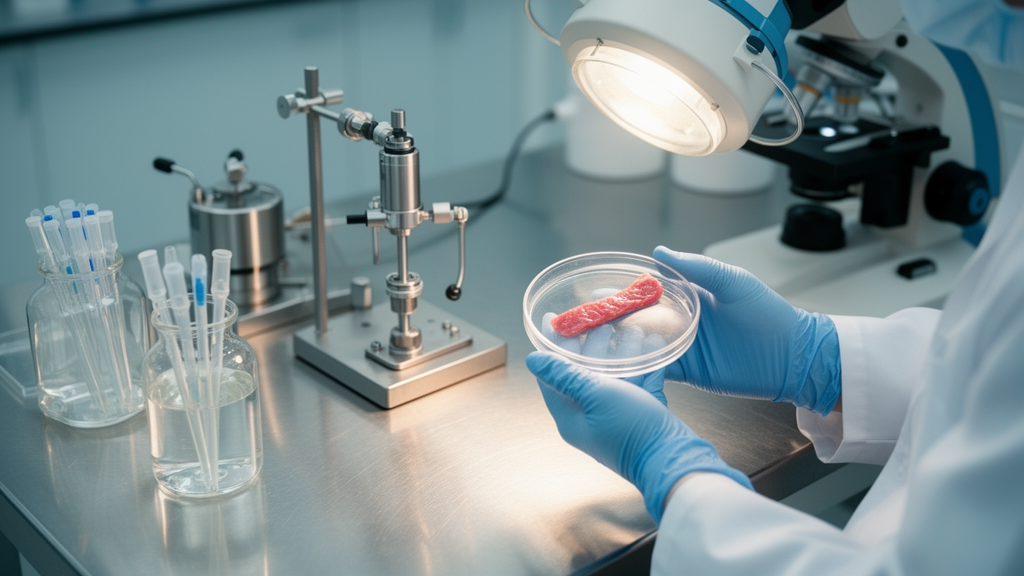
To test this, the team examined tissue strips from two clinically distinct cohorts. The first came from patients undergoing holmium or thulium laser enucleation of the prostate for advanced, medication-refractory benign prostatic hyperplasia, a group characterized by severe symptoms, high postvoid residual urine volumes, prostate volumes around 90 to 95 milliliters and a mean age of 71 years. The second came from men undergoing radical prostatectomy for prostate cancer who had never had surgery for benign prostatic hyperplasia and who generally showed only mild or moderate symptoms, with a mean age of 66 years and prostate volumes of roughly 49 to 56 milliliters. Tissue samples were mounted in myograph chambers within three hours of surgery, equilibrated, and contracted with potassium chloride as a reference stimulus to normalize for differences in strip size and smooth muscle content.
The experimental design was deliberately paired and rigorous. In each experiment, tissue strips from a single prostate were split between inhibitor-treated and vehicle-treated chambers, allowing direct comparison within the same patient and accounting for the considerable histological heterogeneity of benign prostatic hyperplasia, which ranges from stromal to glandular phenotypes with varying fibrosis. After a 30-minute preincubation, concentration response curves were generated for three different alpha-1-selective agonists, phenylephrine, methoxamine and noradrenaline, and frequency response curves were recorded under electric field stimulation, which activates the tissue’s own nerves and mimics neurogenic contraction. The inhibitors used were CID1067700, reported to inhibit Rab7 with a nanomolar affinity, and nexinhib20, developed as an inhibitor of Rab27a-mediated exocytosis, each tested at 1 and 10 micromolar.
The results were strikingly uneventful for CID1067700. In laser-enucleated tissues, neither 1 nor 10 micromolar of the compound produced consistent changes in contractions induced by any of the three agonists or by electric field stimulation. Isolated statistically significant differences appeared, such as a decrease in noradrenaline responses at the lower concentration and an increase in phenylephrine responses at the higher one, but these were never paralleled by consistent changes in area under the curve or maximal contraction, and the other agonists were unaffected. The same pattern held in prostatectomy specimens without prior surgery for benign prostatic hyperplasia. Half-maximal effective concentrations and frequencies were unchanged throughout, indicating that neither the sensitivity nor the maximal capacity of the adrenergic contractile machinery was reproducibly altered.
Nexinhib20 produced similarly null results for agonist-induced contractions in both tissue types, with scattered, agonist-specific and directionally inconsistent changes that the authors attribute to experimental variability in heterogeneous human tissue. The one exception was a reduction of electric field stimulation-induced contractions by 10 micromolar nexinhib20 in laser-enucleated tissues, where the maximal neurogenic contraction fell from 79 percent to 40 percent of the potassium chloride reference response. Because agonist-induced contractions were simultaneously unaffected, this pattern would fit a presynaptic effect on neurotransmitter release, an exocytotic process plausibly involving Rab27, rather than altered postsynaptic adrenoceptor signaling. The authors urge caution, however, noting that the effect was absent in prostatectomy tissues and may reflect variability or chance, and they call for further work to clarify differences in neurogenic responses between the two tissue sources.
Why did a compound with a reported nanomolar affinity for Rab7 fail to touch adrenergic contractions in intact human tissue? The study’s discussion offers a sobering audit of the pharmacological tools themselves. CID1067700 was the first compound with proven inhibition of a Rab GTPase, but follow-up work showed it inhibits BODIPY-GTP binding to Rab7, H-Ras, Cdc42, RhoA and Rac1 with similar nanomolar potencies, making it effectively a pan-GTPase inhibitor in fluorescence-based assays. Critically, RhoA is essential for smooth muscle contraction, and Rac1 and Cdc42 also contribute to prostate smooth muscle tone, so off-target inhibition of these proteins should have reduced contractions, yet nothing of the sort was observed. The authors argue that results from BODIPY-GTP assays may be confounded by allosteric artifacts, and note that in pulldown assays measuring active Rab7, effective concentrations of CID1067700 climb to 40 to 120 micromolar, far above the range tested here. Reported effective concentrations of the compound across different models span from 20 nanomolar to 40 micromolar, an inconsistency that itself questions assay validity.
Nexinhib20’s profile is similarly complicated. Developed to block Rab27a-JFC1-mediated exocytosis of neutrophil granules with an IC50 of 330 nanomolar, it also inhibits Rac1 activation in pulldown assays with an IC50 around 29 micromolar, and its maximum inhibition of the Rab27-effector interaction appears capped at roughly 50 percent. The concentrations used in the prostate study should have produced at least partial inhibition of the intended targets and known off-targets, yet agonist-induced contractions remained intact. Taken together, the findings suggest that posttranslational regulation of endogenous alpha-1-adrenoceptors in the human prostate does not reproducibly depend on pathways sensitive to these two inhibitors, and that this holds across different clinical stages of benign prostatic hyperplasia.
The authors draw a broader conclusion that resonates well beyond urology. Regulatory mechanisms identified in cell culture with receptor overexpression, and affinities measured in biochemical or fluorescence-based assays with recombinant proteins, may simply not transfer to endogenous receptor function in intact human tissue. Previous work had shown Rab7-dependent trafficking of overexpressed alpha-1A-adrenoceptors, and ligand-specific differences in Rab interactions, with noradrenaline and methoxamine directing receptors toward Rab7-mediated degradation while oxymetazoline favored Rab9-associated slow recycling. None of this translated into functional dependence on Rab7 in real prostate strips. Other Rab isoforms, including Rab1, Rab5 and Rab9, remain candidate regulators, but suitable pharmacological tools are scarce, and the field lacks reliable inhibitors for most posttranslational regulators of adrenoceptors.
There may also be unexplored therapeutic angles. Rab7 and Rab27 have been implicated in cellular senescence, chronic inflammation and fibrosis in other tissues, processes increasingly recognized as drivers of medication-refractory benign prostatic hyperplasia, where structural changes rather than smooth muscle tone alone may limit drug response. Whether CID1067700 or nexinhib20 could modulate such processes in the prostate remains unknown. For now, the study’s most valuable contribution is methodological honesty: a carefully controlled, paired examination of living human tissue showing that elegant mechanisms demonstrated in overexpression systems can vanish when confronted with the messy reality of endogenous receptors, heterogeneous patient tissue and physiologically relevant contractile function. Resistance of prostatic alpha-1-adrenoceptors to Rab-mediated degradation, the authors speculate, might even help preserve receptor function and sustain smooth muscle tone in obstruction, a possibility that future studies with better tools will need to address.
Subject of Research: Effects of Rab GTPase inhibitors on adrenergic contraction of human prostate smooth muscle
Article Title: Adrenergic Contraction of Human Prostate Tissues Is Maintained Under the Rab GTPase Inhibitors Nexhinib20 and CID1067700
Article References: Troffer, L., Cen, P., Brandstetter, M., Xu, Y., Keller, P., Stadelmeier, L., Weinhold, P., Tamalunas, A., Stief, C. G., & Hennenberg, M. (2026). Adrenergic Contraction of Human Prostate Tissues Is Maintained Under the Rab GTPase Inhibitors Nexhinib20 and CID1067700. Pharmacology Research & Perspectives, 14(6), Article e70331. https://doi.org/10.1002/prp2.70331
Image Credits: AI Generated
DOI: 10.1002/prp2.70331
Keywords: benign prostatic hyperplasia, alpha-1-adrenoceptors, Rab GTPases, smooth muscle contraction, prostate, organ bath, CID1067700, nexinhib20, receptor trafficking, neurogenic contraction, pharmacology, G protein-coupled receptors
News Source: Ophelia Keating. (October 19, 2026). Rab GTPase Blockers Fail to Dampen Adrenergic Contraction in Human Prostate Tissue. Scienmag.