Bananas have long enjoyed a reputation as a gentle, gut-friendly food, and much of that reputation rests on resistant starch, a carbohydrate that escapes digestion in the small intestine and feeds beneficial microbes in the colon. But a new study published in npj Science of Food suggests that the story is more complicated than the health-food marketing implies. Researchers led by Bing Jiang, Wei Lu and Yapeng Fang at Shanghai Jiao Tong University report that nanoparticles derived from banana starch can actively worsen colitis in mice, damaging the intestinal barrier and disturbing the gut microbiome, while the same starch in its native, non-nanostructured form does the opposite, easing inflammation and strengthening the gut lining.
The finding lands at the intersection of two rapidly growing fields: the study of foodborne nanoparticles and the science of the gut microbiome. Food processing, whether industrial or digestive, can break starch granules down into particles at the nanometer scale, and these particles behave very differently from the bulk material they came from. They have enormous surface areas relative to their mass, they interact strongly with biological surfaces, and they can penetrate mucus layers that would stop larger particles. Previous work by the same team had already shown that banana-derived starch nanoparticles, or BSNs, could disrupt intestinal barrier function and trigger low-grade colitis in healthy mice. The new study pushed the question further: what happens when an animal already has intestinal inflammation is exposed to these particles?
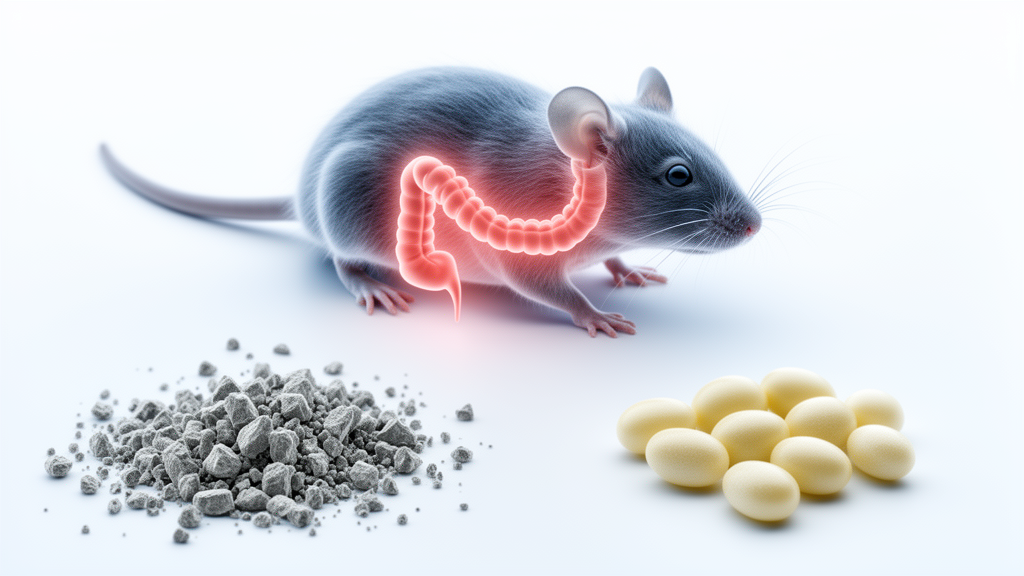
To answer it, the researchers used a well-established mouse model of colitis induced by dextran sulfate sodium, or DSS, a chemical that damages the colonic epithelium and produces inflammation that resembles human ulcerative colitis in several key respects. Mice received oral exposure to BSNs, and the researchers tracked the classic hallmarks of colonic disease. The results were unambiguous. Animals with DSS-induced colitis that were given BSNs fared measurably worse than colitic animals that did not receive the nanoparticles. Their colons were shorter, a standard indicator of more severe inflammation and tissue contraction in this model, and their intestinal tissue showed greater barrier damage.
The chemical signature of the inflammation told the same story. Pro-inflammatory cytokines, the signaling molecules that immune cells release to rally an inflammatory response, were elevated in the BSN-exposed colitic mice. Cytokines such as these drive the self-amplifying loops of inflammation that characterize inflammatory bowel disease, and their elevation indicates that the nanoparticles were not passive passengers in the gut but active participants in the disease process. In practical terms, the particles appeared to pour fuel on an inflammatory fire that was already burning.
The mechanistic heart of the study lies in two intertwined systems: the physical barrier formed by the intestinal epithelium and the microbial ecosystem that lives alongside it. The epithelial cells lining the colon are stitched together by tight junctions, protein complexes that seal the gaps between neighboring cells and decide what passes from the gut lumen into the underlying tissue. When tight junctions loosen, the barrier becomes leaky, and bacterial products that should remain confined to the intestinal contents can slip through, activating immune cells and sustaining inflammation. The researchers found that BSNs exacerbated the impairment of tight junction structure in colitic mice, deepening the barrier failure that DSS had initiated.
At the same time, sequencing-based analysis of the gut microbiota revealed that BSN exposure worsened the imbalance of microbial homeostasis, a state often called dysbiosis. A healthy gut community is diverse and functionally balanced, with microbes that produce short-chain fatty acids and reinforce the mucus layer. In colitis, that balance tips, often with a loss of protective taxa and an expansion of inflammation-associated ones. The nanoparticles pushed this imbalance further in the colitic animals, suggesting a feedback loop in which barrier damage and microbial disruption reinforce each other. Because the microbiome and the epithelium are in constant chemical conversation, an insult to one quickly registers in the other.
Perhaps the most striking result, and the one with the clearest implications for food science, is the contrast with native banana starch. When mice with colitis received the unmodified starch rather than the nanoparticle fraction, their condition improved. The native starch alleviated intestinal barrier damage and mitigated colitis, and the researchers traced this benefit to increases in the relative abundances of two bacterial genera: Akkermansia and Oscillospira. Akkermansia muciniphila in particular has attracted intense scientific interest in recent years as a microbe associated with a healthy, well-maintained mucus layer and improved metabolic health. Oscillospira has likewise been linked to leaner body composition and healthier gut profiles. By feeding these beneficial taxa, native resistant starch appears to strengthen the very barrier that the nanoparticles tear down.
Why would the same molecule behave so differently depending on its physical scale? The answer likely lies in how particles interact with the gut environment. Native starch granules are relatively large, slowly fermented structures that travel through the colon gradually, releasing substrate to microbes along the way and encouraging the growth of organisms that specialize in breaking down resistant carbohydrates. Nanoparticles, by contrast, present their surfaces to the epithelium and the mucus in a far more aggressive way. Their high surface-area-to-mass ratio means that a given quantity of starch presents vastly more contact area for interaction with epithelial membranes, mucus proteins, and immune-sensing cells. Nanoscale particles can also penetrate the mucus gel that normally keeps luminal contents at a respectful distance from the epithelial surface, potentially delivering their effects directly to the tissue. The study does not resolve every detail of this mechanism, but its results are consistent with the broader literature on foodborne nanoparticles, which has repeatedly found that nanosizing can convert benign food components into biologically active ones.
The authors draw a practical conclusion from their data: individuals with colitis or bowel dysfunction should exercise caution when consuming foods rich in resistant starch. That recommendation deserves careful interpretation. The study was conducted in mice, and mouse models of DSS colitis, while valuable, do not capture every feature of human inflammatory bowel disease. The doses and forms of starch used in laboratory settings may not correspond directly to what a person ingests when eating a banana or a slice of slightly green, starch-rich fruit. What the study does establish is a plausible biological mechanism and a warning sign that the physical form of a food component, not just its chemical identity, can determine whether it heals or harms an inflamed gut. For the millions of people worldwide living with ulcerative colitis and Crohn’s disease, who often scrutinize their diets for triggers, the finding adds a new dimension to that scrutiny: particle size and processing history may matter as much as the ingredient list.
The broader significance of the work extends beyond bananas. Resistant starch from many plant sources is added to processed foods as a functional ingredient, and mechanical processing, extrusion, milling, and digestion itself can generate nanoparticulate material. As the food industry embraces nanostructured ingredients for texture, delivery, and shelf life, studies like this one argue for safety testing that goes beyond the bulk material and examines the nanoscale fractions that processing creates. The Shanghai Jiao Tong team’s results, published open access with a permanent DOI, suggest that the gut is a sensitive detector of particle scale, capable of rewarding or punishing the same chemistry depending on how it is packaged. For now, the humble banana keeps its place in a healthy diet for most people, but for those with an inflamed bowel, the research adds a note of caution that science, for once, delivered in particles small enough to matter.
Subject of Research: Effects of banana starch nanoparticles on intestinal barrier integrity and colitis in mice
Article Title: Banana starch nanoparticles exacerbate colitis by impairing intestinal barrier integrity in mice
Article References: Jiang, B., Peng, C., Zalewski, P., Khan, I., He, J., Li, X., Zhao, Y., Sun, C., Cao, Y., Lu, W., & Fang, Y. (2026). Banana starch nanoparticles exacerbate colitis by impairing intestinal barrier integrity in mice. npj Science of Food. https://doi.org/10.1038/s41538-026-01206-7
Image Credits: AI Generated
DOI: 10.1038/s41538-026-01206-7
Keywords: banana starch nanoparticles, colitis, intestinal barrier, tight junctions, gut microbiome, Akkermansia, Oscillospira, resistant starch, foodborne nanoparticles, inflammatory bowel disease, DSS mouse model, food safety
News Source: Daisy Hatcher. (October 19, 2026). Banana Starch Nanoparticles Worsen Colitis in Mice, While Native Starch Helps. Scienmag.