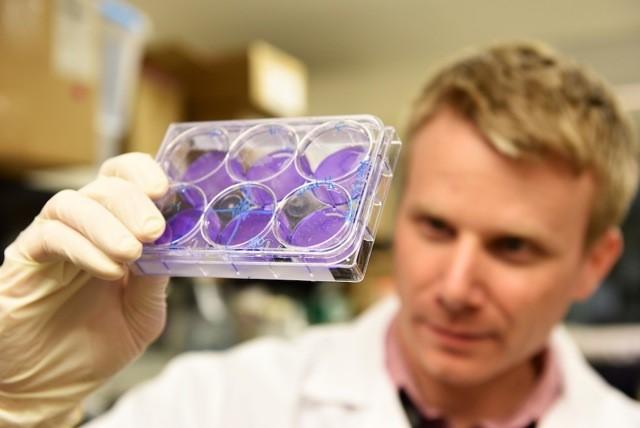
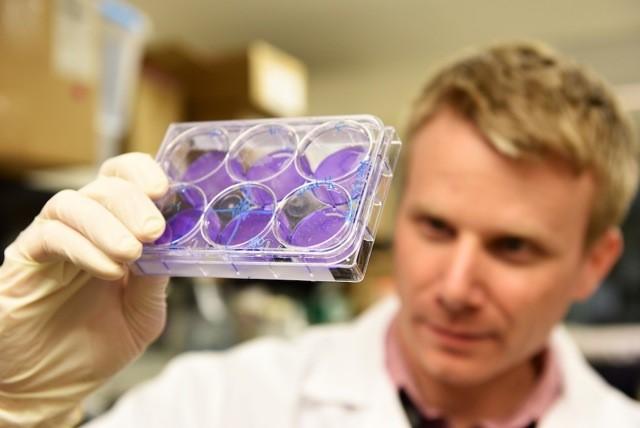
Credit: Photos provided by Doug Mahoney's lab
Immunotherapy is an emerging field in the global fight against cancer, even though scientists and clinicians have been working for decades to find ways to help the body's immune system detect and attack cancerous cells. Doug Mahoney's lab at the University of Calgary recently discovered an immunotherapy that uses existing cancer drugs in a whole new way.
"What we found is a combination of cancer therapies that complement each other in helping the immune system clear the cancer," says Mahoney, PhD, assistant professor in the departments of Microbiology, Immunology and Infectious Diseases, and Biochemistry and Molecular Biology at the Cumming School of Medicine and member of the Arnie Charbonneau Cancer and Alberta Children's Hospital Research Institutes. "Our results suggest that we've been looking at these cancer drugs the wrong way — as tumour-targeting drugs — instead of what we now feel is their most important biological role: as immune stimulating therapy."
Cancer cells are smart; they know how to hide from the body's own immune system. Cancer cells also know how to control certain immune cells. Like a cruel form of mind control, some cancerous tumours can reprogram some immune cells to "block" other immune cells from attacking, leaving the tumour free to grow.
Treatments aimed at revving up the immune system's attack on the cancer may be the most promising approach to cancer therapy since combination chemotherapy. Yet studies have shown single therapies targeting only one part of the immune system have been effective in only a small percentage of patients. Results from Mahoney's research study are consistent with many other recent findings that smart combinations of therapies are even more effective in battling some cancers.
For this study, researchers combined two therapies, each targeting a different part of the immune system. The first is an injection of a man-made virus. That injection puts the "gas on" the immune system followed by a second injection of a drug being developed as a chemotherapy. That drug stops the tumour from reprogramming immune cells.
"The combination of the drugs allowed the immune cells to do what they're supposed to. We were able to cure cancer in 20 to 60 per cent of our animal models," adds Mahoney. "It's a very promising result against two very deadly forms of cancer: an aggressive breast cancer and a rare pediatric muscle cancer."
When the researchers added a third complementary immunotherapy, the cure rate went as high as 80 to 100 per cent. Results of the study are published in Nature Communications.
"These results change a lot," says Mahoney. "What's interesting is that neither drug was developed as an immunotherapy. For nearly two decades they have been studied for their ability to directly kill cancer cells. In viewing these drugs through the lens of immunotherapy, it will impact the way we study them and try to figure out how to make them work better. From a clinical perspective, it changes the way we will try to translate these drugs," says Mahoney.
Mahoney says we'll know more about the impact this study will have on cancer patients in the next five years. His lab is one of three in the world looking at this immunotherapy combination. In the other two locations, clinical trials are about to start based on a similar results.
###
This research study was supported by the Canadian Cancer Society, the Alliance for Cancer Gene Therapy, and the Cancer Research Society. Doug Mahoney's lab, the Trican Childhood Cancer Research Lab, is supported by Trican Well Service, Kids Cancer Care Foundation, Alberta Children's Hospital Foundation and Believe in the Gold Foundation.
Media Contact
Kelly Johnston
[email protected]
403-220-5012
@UCalgary
http://www.ucalgary.ca
Original Source
http://www.ucalgary.ca/utoday/issue/2017-08-28/researchers-discover-new-immunotherapy-combination-effective-killing-cancer-cells http://dx.doi.org/10.1038/s41467-017-00324-x