Deep in the karst mountains of southern China, where limestone bedrock shapes everything from the chemistry of the soil to the survival of the plants rooted in it, researchers have identified a microscopic ally that could reshape how we think about farming in phosphorus-starved landscapes. A team working on the medicinal orchid Bletilla striata has isolated a strain of the bacterium Serratia marcescens, designated BP-2, that shows a remarkable ability to dissolve the insoluble phosphorus compounds that lock away one of the most essential nutrients for plant life. The findings, published in BMC Plant Biology, combine microbiology, metabolomics and transcriptomics to trace a complete chain of evidence from bacterial metabolism to molecular responses inside plant roots.
Phosphorus is a paradoxical nutrient. Although it is abundant in most soils in total terms, the vast majority of it exists in forms that plants cannot absorb. In ordinary agricultural soils this is a persistent constraint, but in karst regions the problem is amplified by geology. Karst landscapes form on soluble carbonate rocks, and the calcium released from these rocks reacts readily with phosphate ions in the soil solution. The result is the precipitation of insoluble calcium phosphate minerals, which effectively immobilize phosphorus and deepen the deficiency that plants already face. For crops and medicinal plants growing on these thin, calcium-rich soils, the available pool of phosphorus can be vanishingly small even when total phosphorus measurements look respectable.
The research team approached this problem from the rhizosphere, the narrow zone of soil that surrounds and is influenced by plant roots. The rhizosphere microbial community is tightly coupled to soil physicochemical properties, and microbes living there have evolved an array of strategies to access nutrients that their plant hosts cannot reach on their own. Among the most important of these nutrient brokers are phosphorus-solubilizing bacteria, or PSB, which secrete compounds capable of converting mineral-bound phosphate into soluble forms that roots can take up. To test whether karst soils harbor particularly rich communities of these bacteria, the researchers used a microbiome transplantation approach, comparing soil microbial communities transplanted from karst mountainous soils with those from agricultural cultivated soil.
The results of the transplantation experiment were striking. When Bletilla striata plants received microbiomes derived from karst soils, they grew significantly better than plants treated with cultivated soil communities. The measured improvements spanned the plant’s development: height increased, biomass accumulated more rapidly, and the tubers, which are the economically valuable organs of this orchid, grew heavier and longer. Crucially, the soil itself changed in parallel. Available phosphorus levels rose in the karst microbiome treatment, and the structure of the soil microbial community shifted in ways that distinguished it from the cultivated soil counterpart. This suggested that the karst rhizosphere contained something special, a microbial assemblage unusually well equipped to mobilize phosphorus under calcium-dominated conditions.
To identify the individual players behind this effect, the researchers cultured and isolated phosphorus-solubilizing bacteria from both treatment groups. In total, 18 PSB strains were obtained, 15 of them from the karst soil microbiome transplant group and only 3 from the cultivated soil group. That imbalance alone was telling: the karst rhizosphere yielded five times as many candidate phosphorus solubilizers, supporting the idea that these specialized habitats select for microbes with enhanced phosphate-mobilizing capabilities. Among the isolates, one strain stood out for its exceptional solubilizing performance: Serratia marcescens BP-2, which demonstrated phosphate-solubilizing capacity that surpassed the other strains recovered from the same soils.
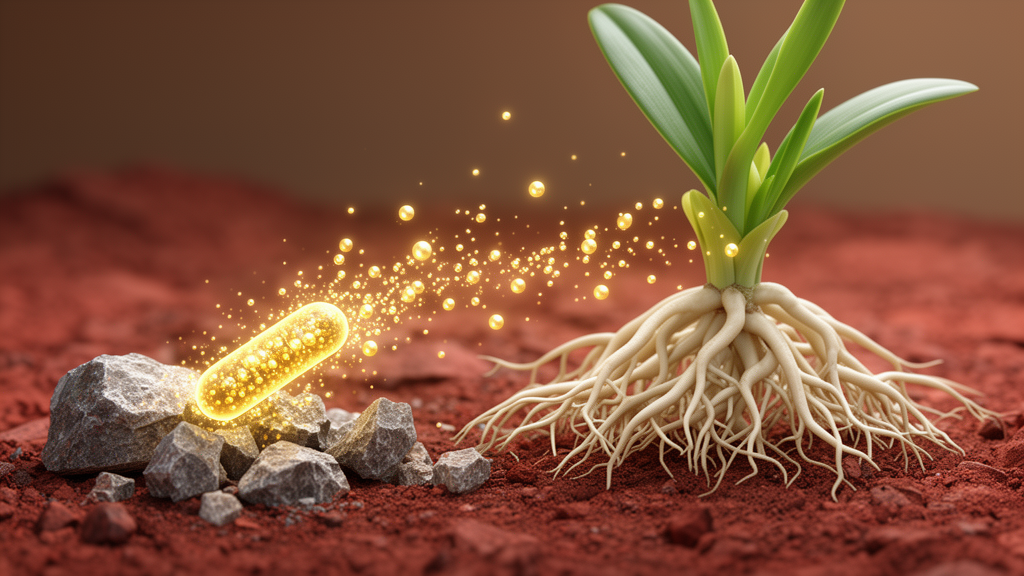
What makes BP-2 so effective? The team turned to metabolomics, the systematic profiling of the small molecules a microbe produces, to answer that question. The analysis revealed that organic acid production lies at the heart of the strain’s phosphate-solubilizing activity, with citric acid and other intermediates of the tricarboxylic acid cycle, the central metabolic pathway that cells use to generate energy, contributing significantly to the effect. The chemistry here is well understood in principle: organic acids can donate protons and chelate metal cations such as calcium, displacing phosphate from insoluble calcium phosphate minerals and releasing it into the soil solution as soluble, plant-available phosphate. In a karst environment where calcium phosphate precipitation is the dominant mechanism of phosphorus lock-up, a bacterium that pumps out citric acid is essentially deploying a targeted solvent against the very compound that traps the nutrient.
With the mechanism on the bacterial side established, the researchers tested whether BP-2 could deliver the same benefits on its own. Inoculation experiments confirmed that it could. Plants treated with S. marcescens BP-2 showed significant enhancements in plant height, leaf number, leaf length and root development compared with uninoculated controls. At the same time, the concentration of bioavailable phosphorus in the culture system increased markedly, tying the growth gains directly to improved phosphorus nutrition rather than to some unrelated growth-promoting effect. The bacterium was not merely a passive companion; it was actively reshaping the nutrient environment of its host.
The most compelling evidence came from the plant’s own genes. Using transcriptomics, the genome-wide profiling of gene expression, the team examined how Bletilla striata roots responded to BP-2 inoculation at the molecular level. They found significant upregulation of the high-affinity phosphate transporter gene PHT1 in the inoculated plants. PHT1 family transporters are the principal molecular machinery by which plant roots acquire phosphate from the soil, and their induction signals that the plant is mounting an enhanced capacity for phosphorus acquisition. In other words, the bacterium and the plant appear to be working in concert: BP-2 liberates phosphate from insoluble reserves, and the orchid responds by upgrading its uptake apparatus to capture the newly available nutrient. The result is a coordinated promotion of morphological development and biomass accumulation.
Beyond its immediate relevance to Bletilla striata, a medicinal orchid whose tubers are prized in traditional Chinese medicine, the study carries broader implications. It provides a theoretical basis for understanding how plants and microorganisms co-adapt in specialized habitats, illustrating a complete loop that runs from geological constraint through microbial metabolism to plant molecular response. For agriculture and cultivation in karst regions, which cover extensive areas of southwestern China and many other parts of the world, the work points toward microbiome-informed strategies that could reduce dependence on phosphate fertilizers. Phosphate rock is a finite resource, and much of the phosphorus applied as fertilizer in calcium-rich soils is quickly immobilized anyway. Harnessing native phosphorus-solubilizing bacteria, whether as inoculants like BP-2 or as components of managed soil microbiomes, offers a way to tap the phosphorus that is already present but biologically unavailable.
The study also underscores the value of the rhizosphere as a reservoir of functional microbial diversity. The fact that karst soils yielded 15 phosphorus-solubilizing isolates against only 3 from adjacent cultivated soils hints that natural, less intensively managed ecosystems may preserve microbial functions that intensive agriculture erodes. As sequencing, metabolomics and cultivation techniques continue to converge, researchers can expect to uncover more of these plant-microbe partnerships and, potentially, to engineer or manage them deliberately. For now, the humble Serratia marcescens BP-2, isolated from the root zone of an orchid clinging to limestone hills, stands as a vivid example of how solving a nutrient crisis at the microbial scale can translate into measurable growth, richer harvests and a deeper understanding of the hidden economy that sustains life in some of the planet’s most chemically challenging soils.
Subject of Research: Phosphorus-solubilizing bacteria from karst rhizosphere soils and their promotion of Bletilla striata growth
Article Title: Insights into phosphorus-solubilizing characteristics of Serratia marcescens BP-2: a key role in promoting Bletilla striata (Thunb.) Reichb. f. growth in karst mountain ecosystems
Article References: Jiang, T., Jiang, X., Xu, Q., Zhang, J., Xiong, Y., Liu, H., Kang, C., Yang, C., Zhou, T., & Xiao, C. (2026). Insights into phosphorus-solubilizing characteristics of Serratia marcescens BP-2: a key role in promoting Bletilla striata (Thunb.) Reichb. f. growth in karst mountain ecosystems. BMC Plant Biology. https://doi.org/10.1186/s12870-026-10059-x
Image Credits: AI Generated
DOI: 10.1186/s12870-026-10059-x
Keywords: phosphorus-solubilizing bacteria, Serratia marcescens BP-2, Bletilla striata, karst ecosystems, rhizosphere microbiome, citric acid, tricarboxylic acid cycle, PHT1 phosphate transporter, soil phosphorus, microbiome transplantation, plant growth promotion, metabolomics
News Source: Morgan Morrow. (October 19, 2026). Karst Soil Bacterium Unlocks Locked Phosphorus to Boost Medicinal Orchid Growth. Scienmag.