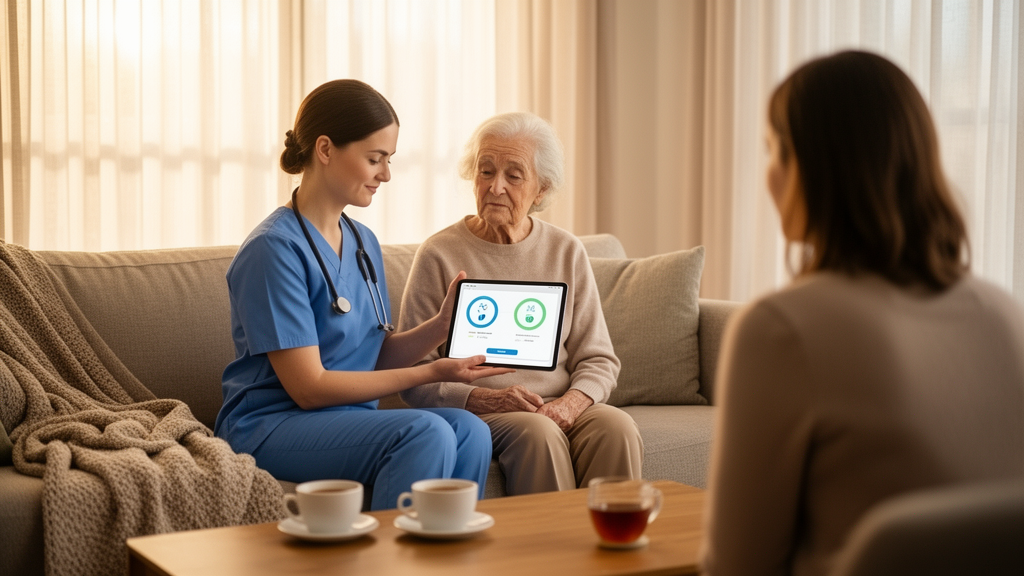
Family caregivers are the invisible backbone of palliative care. Around the world, millions of relatives shoulder the daily work of bathing, feeding, medicating, and emotionally sustaining people with life-limiting illnesses, often with little training and even less respite. A new systematic review and meta-analysis published in BMC Nursing suggests that when nurses harness digital health technologies to support these caregivers, the results are real but selective: caregiver readiness and certain dimensions of burden improve significantly, while deeper psychosocial outcomes such as depression, anxiety, and overall quality of life remain stubbornly resistant to app-based and remote support alone.
The study, led by Tuti Anggriani Utama and colleagues at Universitas Padjadjaran in Bandung, Indonesia, set out to answer a question that has grown urgent as populations age and health systems strain under the weight of chronic and terminal disease. Palliative care, by definition, addresses the holistic needs of patients and their families, yet timely access to that support remains elusive for many households. Digital health interventions, ranging from telehealth consultations to educational platforms and remote monitoring tools, have been proposed as a bridge across this gap, particularly when they are delivered or coordinated by nursing professionals rather than left to generic technology platforms.
To test that proposition rigorously, the research team followed the PRISMA reporting guidelines and searched four major databases, Scopus, Medline via PubMed, CINAHL via EBSCOhost, and the Cochrane Library, from their inception through 18 May 2026. The sweep returned 4,706 records, which the authors screened down to sixteen studies involving family caregivers in palliative care settings. Each study was assessed for methodological quality using the Cochrane Risk of Bias 2.0 tool, a standardized instrument for judging whether randomized trials were conducted in ways that could bias their results. The team then pooled effect sizes as standardized mean differences with 95 percent confidence intervals, using the DerSimonian-Laird random-effects model, a statistical approach that accounts for variability between studies rather than assuming they all estimate the same underlying effect.
The headline finding is striking in its magnitude. Caregiver readiness, a measure of how prepared families feel to take on the demands of caring for a dying relative, improved dramatically in the pooled analysis, with a standardized mean difference of 5.07 and a confidence interval running from 3.90 to 6.25, a result far beyond the threshold of statistical significance at p less than 0.00001. In practical terms, caregivers who received nurse-facilitated digital support reported feeling substantially more equipped for their role than those who did not. Because standardized mean differences express effects in units of pooled standard deviation, a value above five represents an exceptionally large effect, though the authors and readers alike must weigh such figures against the number and quality of the studies contributing to that pooled estimate.
Burden, the emotional and physical weight of caregiving, told a more nuanced story. On the Caregiver Strain Index, a widely used instrument that tallies sources of strain experienced by family members, the interventions produced a modest but significant reduction, with a standardized mean difference of negative 0.60 and a confidence interval of negative 1.20 to negative 0.01, landing at the edge of conventional significance with p equal to 0.05. On the Bakas Caregiver Outcomes Scale, which assesses how caregiving affects life satisfaction and health, the improvement was much larger, with a standardized mean difference of 1.56 and a confidence interval of 1.20 to 1.91 at p less than 0.00001. These divergent results suggest that digital support does not uniformly lighten every form of caregiver burden; it appears most powerful where it builds positive outcomes and preparedness rather than simply removing strain.
Perhaps the most sobering results concern the outcomes that matter most to caregivers themselves. The pooled analysis of randomized controlled trials found no consistent improvement in caregiver self-efficacy, psychological well-being as measured by depression, anxiety, and stress scales, or overall quality of life. Non-randomized studies did show significant quality of life gains, but the authors urge caution, noting that uncontrolled designs are inherently vulnerable to bias, including regression to the mean and the simple fact that motivated participants tend to improve over time regardless of intervention. The distinction matters because quality of life instruments such as the Caregiver Quality of Life-Cancer Scale, the Zarit Caregiver Burden Interview, and the European Quality of Life visual analog scale capture dimensions of existence that a smartphone app or a video call may simply not reach.
Why would digital tools succeed at building readiness yet fail to lift mood? The answer likely lies in what each intervention actually delivers. Educational modules, remote monitoring, and nurse-led coaching can transmit concrete skills, such as how to manage medications, recognize symptoms, and coordinate with hospice teams, and skills translate directly into confidence and preparedness. Psychological distress, by contrast, is rooted in grief, anticipatory loss, financial strain, and social isolation, problems that information technology alone cannot resolve. The authors explicitly highlight the need for hybrid models that combine digital tools with psychological support, pairing the reach and scalability of technology with the human depth of counseling and bereavement care.
The review also underscores the pivotal, often underappreciated role of nurses in this ecosystem. Across the included studies, it was nursing professionals who coordinated, educated, and sustained the digital-based supportive care, interpreting monitoring data, answering questions raised through telehealth channels, and tailoring education to each family’s circumstances. The authors frame this as a matter of nursing-sensitive outcomes, a term for patient and family results that nursing care can directly influence. Their conclusion is that nurses are not merely users of digital health technology but its essential architects in palliative care, designing, implementing, and evaluating systems that would falter without clinical judgment behind the screen.
Methodologically, the study has both strengths and limits that shape how its findings should be read. The comprehensive search across four databases and the use of a validated risk-of-bias tool lend credibility, and the focus on nursing-informed interventions fills a genuine gap, since prior syntheses had not systematically examined these outcomes from a nursing perspective. Yet sixteen studies is a modest evidence base, and the authors’ own reporting indicates heterogeneity across interventions, populations, and outcome measures, which is precisely why a random-effects model was required. The very large effect size for caregiver readiness, while statistically robust, invites scrutiny of the individual trials that contributed to it, and the borderline significance of the Caregiver Strain Index result means it could shift with the addition of new studies.
For health systems confronting demographic reality, the implications are concrete. As more care shifts to homes, the well-being of family caregivers becomes a system-level variable, not a private matter, and caregiver collapse is a common trigger for avoidable hospitalization of patients at the end of life. This review suggests that nurse-led digital palliative care is a worthwhile investment where the goal is to prepare and stabilize families, but it should not be sold as a complete solution to caregiver suffering. The evidence points toward integrated programs in which technology handles education, monitoring, and access, while psychological and social support, delivered by nurses and allied professionals, addresses the grief and exhaustion that no app can touch. The research was funded through Universitas Padjadjaran with support from the Indonesian Endowment Fund for Education, and the article is open access, allowing clinicians and policymakers worldwide to examine the full analysis for themselves.
Subject of Research: Effectiveness of nurse-led digital health interventions integrated into palliative care on family caregiver outcomes
Article Title: Effectiveness of palliative care integrated with digital health interventions on nursing-sensitive outcomes among family caregivers: a systematic review and meta-analysis
Article References: Utama, T. A., Ibrahim, K., Widiasih, R., Arisanti, N., Wardika, I. J., Alhaq, K. F., & Karisa, P. (2026). Effectiveness of palliative care integrated with digital health interventions on nursing-sensitive outcomes among family caregivers: a systematic review and meta-analysis. BMC Nursing. https://doi.org/10.1186/s12912-026-05256-w
Image Credits: AI Generated
DOI: 10.1186/s12912-026-05256-w
Keywords: palliative care, family caregivers, digital health, nurse-led interventions, caregiver burden, caregiver readiness, quality of life, systematic review, meta-analysis, telehealth, nursing research, eHealth
News Source: Ophelia Keating. (October 19, 2026). Digital Tools Run by Nurses Ease Family Caregiver Strain, Major Review Finds. Scienmag.