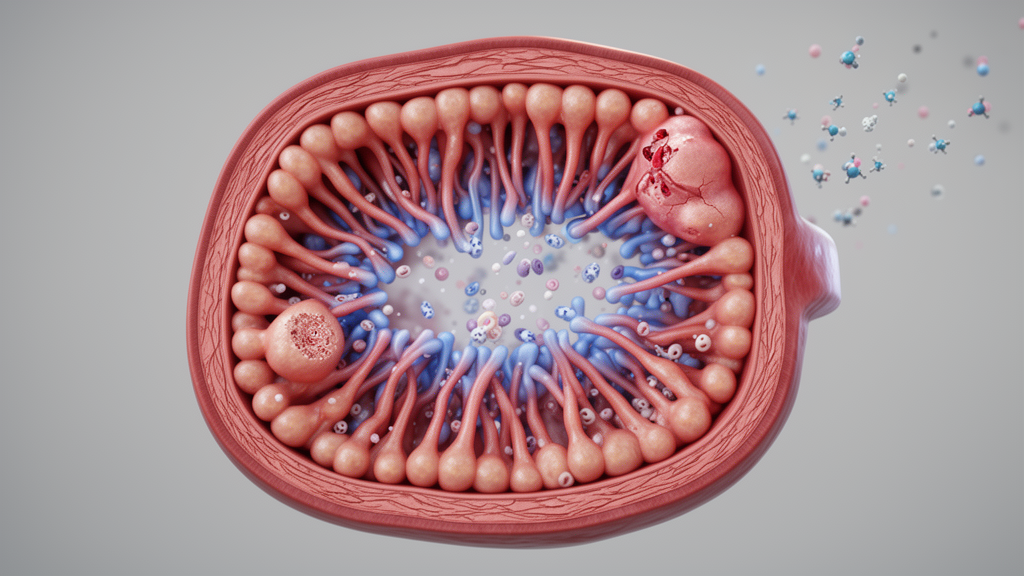
Kidney specialists have long known that a minor infection can send protein spilling into the urine, a phenomenon called transient proteinuria that usually vanishes without a trace. A new study published in Physiological Reports now offers a detailed mechanistic explanation for how that temporary leak might begin at the level of a single cell. Working with cultured mouse podocytes, researchers showed that switching on a single innate immune receptor, Toll-like receptor 4, sets off three distinct cellular consequences that unfold on strikingly different timetables: a rapid and fully reversible increase in the leakiness of the podocyte barrier to albumin, a slower shedding of the key junctional protein nephrin, and, with sustained stimulation, apoptotic cell death.
Podocytes are the elegant, foot-shaped cells that wrap around the kidney’s glomerular capillaries. Their interlocking foot processes are joined by specialized junctions called slit diaphragms, which form the final and most size-selective layer of the blood filtration barrier. When podocytes are stressed, these foot processes retract and broaden in a change known as effacement, initially a protective adaptation that keeps the cells anchored to the glomerular basement membrane. That matters because the body has only a limited capacity to regenerate podocytes once they are lost. Understanding what triggers reversible effacement, as opposed to permanent damage, has been a central question in nephrology.
The new work focuses on TLR4, a pattern-recognition receptor long known to sit on the podocyte surface. TLR4 is the canonical sensor of lipopolysaccharide, the endotoxin shed from the outer membranes of gram-negative bacteria. Injecting LPS into mice is a standard model of sepsis, and it reliably produces proteinuria and foot process effacement within 24 hours, with the glomerular changes fully reversible after a single dose. That reversibility has fueled the provocative hypothesis that proteinuria may, in some circumstances, be a purposeful response, accelerating the clearance of potentially toxic substances from the circulation.
Studying TLR4 in living animals is notoriously messy. The receptor is abundant on monocytes, macrophages, dendritic cells, and epithelia, and its activation floods the bloodstream with inflammatory cytokines that alter hemodynamics across the whole organism. To isolate the podocyte’s own contribution, the team turned to immortalized MPC-5 mouse podocytes, differentiated into a mature phenotype that robustly expresses nephrin and podocin. The cells were grown as confluent monolayers on transwell inserts, where they form nephrin-dependent barriers whose selectivity closely mirrors the living glomerular filter. This reductionist design ensured that every response observed was initiated by TLR4 receptors on podocytes themselves, with no other cell type present.
To activate the receptor cleanly, the researchers used CRX527, a synthetic aminoalkyl glucosaminide 4-phosphate that structurally mimics lipid A, the toxic core of LPS, and acts as a highly selective TLR4 agonist. Its effects were confirmed as TLR4-specific because they were completely abolished by TAK242, a structurally unrelated antagonist that binds only TLR4. At a concentration of 0.7 micromolar, within the middle of the known dose-response range, CRX527 exposures of just one hour significantly increased the flux of fluorescently labeled albumin across the podocyte monolayer. Remarkably, after a 72-hour recovery period in normal media, that permeability increase disappeared entirely, demonstrating that the acute leak is fully reversible.
The researchers then traced which intracellular messages carried that rapid signal. A brief exposure to CRX527 provoked a fast burst of Erk MAP kinase activation, detectable as phosphorylation of Erk1/2 within 30 minutes, followed by a rise in cytosolic reactive oxygen species that persisted through 24 hours of agonist exposure. Pharmacological dissection showed that the one-hour permeability increase was blunted by TEMPOL, a membrane-permeable ROS quencher, and by PD98059, a MEK1 inhibitor that blocks the Erk pathway. In contrast, the permeability effect persisted when NFκB signaling was blocked with JSH-23, consistent with the observation that one hour of agonist exposure is simply not enough to activate the transcription factor at all.
A second response required longer stimulation. After 24 hours of continuous CRX527 exposure, the culture medium accumulated markedly elevated levels of soluble nephrin, measured by ELISA, indicating that the ectodomains of this slit diaphragm protein had been proteolytically cleaved from the cell surface. The shedding was blocked by the broad-spectrum metalloproteinase inhibitor Batimastat, implicating matrix metalloproteinases or related sheddase enzymes in the ADAM family. Critically, one hour of exposure, enough to open the permeability barrier, produced no shedding at all, and the shedding response required Erk activation but, unlike the permeability change, did not depend on ROS and persisted despite NFκB blockade. It also required ongoing protein synthesis, being abolished by cycloheximide.
Importantly, the shedding was not a byproduct of cells dying or detaching. Immunoblot analysis showed that total cellular abundance of nephrin, podocin, and synaptopodin, the core structural proteins of foot processes, was unchanged after 24 hours of CRX527 treatment, which would not be expected if cells had sloughed off the substrate. The team also ruled out TRPC6 calcium channels as essential mediators, since nephrin shedding continued in the presence of SAR7334, a selective TRPC6 inhibitor, even though sustained TRPC6 activation is known to produce similar shedding. One intriguing casualty of prolonged stimulation was WT-1, a transcription factor that maintains the mature podocyte phenotype, which declined significantly after 24 hours, hinting at early dedifferentiation.
The darkest consequence emerged only with the most sustained activation. Seventy-two hours of continuous CRX527 exposure drove a marked increase in cleaved caspase-3, the executioner enzyme of apoptosis, confirmed independently by Annexin V measurement. This cell death program was blocked by TAK242, and pharmacological mapping showed it required both ROS generation and NFκB activation, while remaining insensitive to Erk inhibition. Twenty-four hours, by contrast, was not sufficient to cleave caspase-3. The researchers also connected the pathway through MyD88, the canonical adapter linking TLR4 to downstream transducers, since siRNA knockdown of MyD88 suppressed NFκB activation.
The overall picture is one of a single receptor encoding time: minutes of TLR4 activity transiently loosen the filtration barrier through ROS and Erk, a day of activity strips nephrin from the junction through metalloprotease-dependent shedding, and days of unremitting signaling kill the cell through a ROS- and NFκB-dependent apoptotic route. The findings support the idea that at least part of the proteinuria seen after endotoxin exposure in animals stems from direct podocyte effects rather than systemic inflammation. They also provide a plausible mechanism for benign transient proteinuria after minor infections, fever, or intense exercise, and echo known parallels with angiotensin II signaling, which similarly recruits Erk to promote nephrin internalization and loosens the filter. The authors caution that the work is entirely in vitro and that agonist concentrations may exceed those generated physiologically, but the model now stands as a testable framework for a common and usually harmless clinical phenomenon.
Subject of Research: TLR4 signaling pathways that drive albumin permeability, nephrin shedding, and apoptosis in cultured podocytes
Article Title: TLR4 signaling cascades leading to increases in albumin permeability, nephrin ectodomain shedding, and apoptosis in MPC‐5 podocytes
Article References: Kim, E. Y., & Dryer, S. E. (2026). TLR4 signaling cascades leading to increases in albumin permeability, nephrin ectodomain shedding, and apoptosis in MPC ‐5 podocytes. Physiological Reports, 14(20), Article e71147. https://doi.org/10.14814/phy2.71147
Image Credits: AI Generated
DOI: 10.14814/phy2.71147
Keywords: TLR4, podocytes, nephrin, proteinuria, kidney filtration barrier, lipopolysaccharide, reactive oxygen species, NFκB, Erk MAP kinase, apoptosis, slit diaphragm, metalloproteinases
News Source: Kristina Jarvis. (October 19, 2026). How Infection Signals Push Kidney Filter Cells Into Leaks, Damage, and Cell Death. Scienmag.