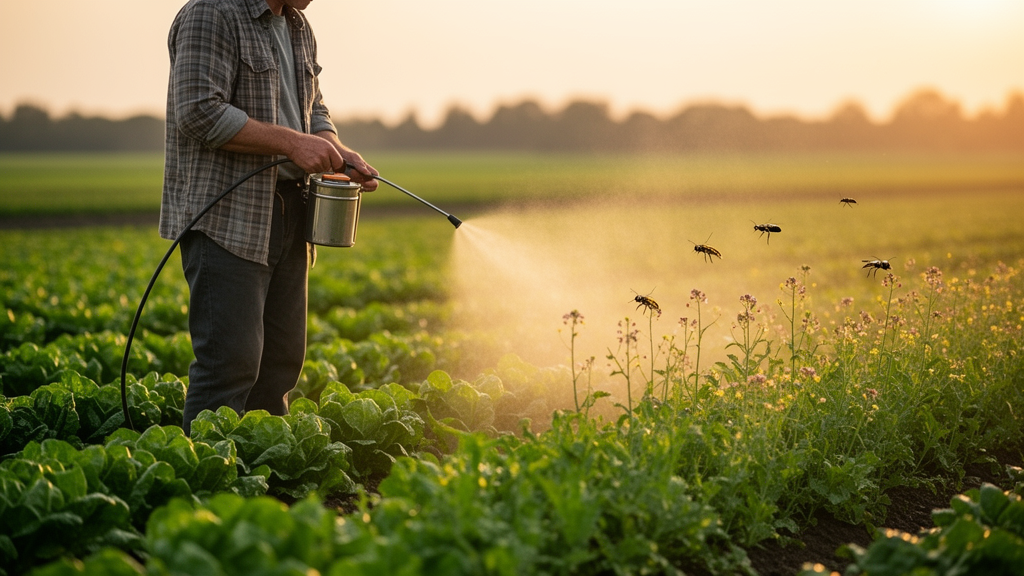
Every field has a smell, and that smell is a language. Plants continuously release clouds of volatile organic compounds, or VOCs, into the air around them, and insects navigate these invisible plumes with extraordinary sensitivity. A new review published in The Science of Nature by Sourav Manna, Ishita Paul and Mousumi Poddar Sarkar of Presidency University in Kolkata argues that this airborne chemical conversation, studied for decades under the banner of chemical ecology, is ready to be scaled up into one of agriculture’s most promising tools: intercropping systems deliberately designed around the olfactory preferences of pest insects. The paper, published on 19 October 2026, synthesises field trials, behavioural studies and laboratory analyses into a framework for what the authors call informed intercropping, in which companion crops are chosen not for tradition or folklore but for the specific volatile molecules and blends they emit.
The logic rests on a simple but powerful observation from decades of research: herbivorous insects locate their hosts largely by smell, responding to characteristic combinations of green leaf volatiles, terpenoids, isothiocyanates and other compounds released by crop foliage. Classic work on Colorado potato beetle and other pests showed that these insects orient to plant volatiles and can be confused when non-host odours mask or distort the host signal. In a monoculture, the odour landscape, or odourscape, is a uniform beacon advertising food to any pest flying downwind. In a mixed crop, the beacon becomes scrambled, a layered mosaic of attractant, repellent and masking odours that can dramatically reduce the ability of a pest to find its target crop.
Intercropping exploits this confusion in several complementary ways. Trap crops act as decoys: a highly attractive plant, placed along field edges or in rows, draws egg-laying females away from the main cash crop. Field examples are numerous and striking, from perimeter plantings that control pepper maggot in the United States to turnip rape trap crops deployed against stem-mining pests in winter oilseed rape. Some trap systems go further, using so-called dead-end trap crops, plants that attract pests but on which their offspring cannot complete development. Sunflower evaluated for the Asian corn borer, Ethiopian mustard tested against cabbage aphid, and firethorn against spotted-wing Drosophila all illustrate how a well-chosen decoy can convert attraction into population decline rather than merely displacement.
A second mechanism is the push-pull strategy, perhaps the most celebrated success of applied chemical ecology in smallholder farming. In East Africa, maize is intercropped with Desmodium legumes, whose volatile emissions repel stemborer moths, while border plantings of Napier grass attract and retain those same pests. The system also suppresses the parasitic weed Striga through root exudates, and field analyses have shown that it simultaneously increases parasitism of pests and improves economic returns for farmers. The review positions push-pull as the template case demonstrating that volatile-mediated pest management can be cost-effective, climate-adaptable and scalable when the underlying chemistry is properly understood.
Yet attraction alone is not the whole story, and the authors emphasise that companion plants can also recruit the crop’s defenders. Herbivore-induced plant volatiles, released when a plant is chewed or pierced, act as distress signals that draw parasitoid wasps and predatory insects to damaged plants. Flowering insectary plants such as buckwheat provide nectar that sustains these beneficial insects, and studies of buckwheat strips in cotton fields and flowering Ocimum in tea plantations document increased parasitism rates and reduced pest densities. The botanical triad of trap crops, insectary plants and main crop, described in organic cabbage systems, illustrates how a designed odourscape can integrate both pest diversion and conservation biological control in a single spatial plan.
The technical underpinnings are anything but trivial. Insects do not respond to single compounds in isolation but to ratios and blends; a mixture that attracts at one concentration may repel at another, and a compound that is behaviourally active in a synthetic blend may lose its effect against the background odour of a diverse field. Wind further complicates the picture: experimental work tracking volatile blends during atmospheric transport has shown that compound ratios change as plumes travel, meaning the blend an insect perceives metres downwind may differ chemically from the blend the plant emitted. Anthropogenic air pollution, including ozone and other reactive pollutants, can degrade olfactory signals before they reach their recipients, adding another layer of environmental variability that field designs must tolerate.
This variability is the central challenge the review confronts. Odourscapes in mixed cropping systems are shaped by species-specific interactions, local climate, soil conditions, tillage and other agricultural practices, and by the developmental stage and health of the plants themselves. Drought stress, for example, can modulate the incidence of pests and the volatile profiles that govern their behaviour. Volatile emission also follows circadian rhythms, with plants releasing different compounds by day and night, so a companion planting that works against a diurnal moth may be ineffective against a nocturnal one. The authors argue that this is precisely why VOC-mediated pest management cannot be prescribed generically: the functional mechanisms of olfactory cues must be examined in localised contexts before they can be relied upon.
Despite these constraints, the evidence base assembled in the review suggests that informed intercropping is economically viable in many settings. Trap cropping requires land but little capital, and where a decoy crop doubles as food, fodder or a secondary cash crop, the land trade-off can be minimal. Semiochemically assisted trap cropping, in which synthetic host volatiles are deployed to concentrate pests on the decoy, has been shown to improve the efficacy of trap systems for Colorado potato beetle and to reduce infestation of faba bean by the broad bean beetle. Banker plant systems, which host harmless alternative prey to sustain predators and parasitoids, add a further VOC-mediated dimension, with recent work characterising the volatile profiles of banker plants and their effects on natural enemy attraction across agroecosystems.
The broader context makes these developments urgent. Pesticide use carries documented costs, from human health impacts to widespread contamination of surface waters, while resistance to both conventional insecticides and Bt transgenic crops continues to evolve. Climate change is reshaping pest pressure, with locust outbreaks and shifting phenologies underscoring the need for adaptive, low-input management tools. At the same time, honey bee colony losses and pollinator declines reveal the fragility of ecosystems that chemical-intensive agriculture has helped to destabilise. A pest control strategy built on manipulating what plants already do, namely emit odours, avoids many of these externalities and can be integrated with organic farming and conventional integrated pest management alike.
The review closes with a note of ecological realism rather than triumph. Fine-tuning volatile interactions for pest control means working with a system whose outcomes depend on weather, landscape context, community composition and evolutionary responses of the insects themselves. The authors’ message is that the next generation of sustainable crop protection will not come from a single molecule or a single crop, but from designing farms as functional odourscapes: mixtures of trap crops, insectary plants, repellent companions and main crops whose combined chemical signatures push pests away, pull natural enemies in, and make the cash crop progressively harder to find. It is, in effect, farming the air itself, and the chemistry that makes it possible has been present in every field all along.
Subject of Research: Airborne volatile chemical ecology and intercropping for sustainable insect pest management in crops
Article Title: Integrating airborne chemical ecology with informed intercropping for sustainable crop protection
Article References: Manna, S., Paul, I., & Poddar Sarkar, M. (2026). Integrating airborne chemical ecology with informed intercropping for sustainable crop protection. The Science of Nature, 113(6), Article 135. https://doi.org/10.1007/s00114-026-02175-3
Image Credits: AI Generated
DOI: 10.1007/s00114-026-02175-3
Keywords: volatile organic compounds, intercropping, trap crops, push-pull strategy, integrated pest management, chemical ecology, odourscape, plant-insect interactions, companion crops, biological control, insectary plants, sustainable agriculture
News Source: Bethany Barker. (October 19, 2026). Fields That Talk in Scents: How Airborne Chemistry Could Reshape Sustainable Pest Control. Scienmag.