Deep in the mountain forests of northwestern Yunnan, China, entomologists have pulled back the bark of decaying logs to reveal a stag beetle so distinctive that its closest relatives look almost identical to it. A new species, Ceruchus ahualuo, has been formally described in the journal ZooKeys, raising the number of Chinese species in the genus Ceruchus to 13 and the global count to 22. The discovery, announced on 14 August 2026, is the product of years of intensified field collecting across the rugged Sino-Himalayan region, where many stag beetle species have long escaped scientific documentation.
The genus Ceruchus MacLeay, 1819 belongs to the stag beetle family Lucanidae, classified in the tribe Ceruchini of the subfamily Syndesinae. Unlike the spectacular oversized mandibles of tropical stag beetles, Ceruchus species are relatively small, mostly reddish-brown or dark brown beetles with mandibles that rarely exceed the combined length of the head and pronotum. Their systematic placement has been unstable for two centuries. The earliest species were originally described under the genus Lucanus Scopoli, 1763, until MacLeay established Ceruchus based on the type species Lucanus chrysomelinus Hochenwarth, 1785. Benesh (1960) placed the genus in the subfamily Aesalinae, but Holloway (1960, 1968), working from adult external morphology and male genitalia, reclassified Ceruchus together with Syndesus, Sinodendron, and Psilodon in Syndesinae.
More recently, molecular phylogenetic analysis has tested the monophyly of Syndesinae and the phylogenetic position of Ceruchini, revealing complex evolutionary relationships that partly challenge traditional morphology-based classifications. The placement of Ceruchini within Lucanidae remains incompletely resolved, which makes each new species description not just a naming exercise but a piece of evidence in an ongoing evolutionary puzzle. At present, 21 species are recognized in the genus, including 19 extant species and two fossil species, of which 12 have been recorded from China before this study.
The new species was discovered during a recent examination of Chinese representatives of the genus. The holotype, a major male, was collected on 2 April 2024 in the mountains near the Ahualuo River in Weixi County, Yunnan Province, at an elevation of 2600 meters, inside decayed logs. Paratypes include additional males and females from Zhonglu Township in the same county at 2750 meters, collected in March 2021, and further males from the Ahualuo River mountains at 2800 to 3000 meters. The specific epithet ahualuo is a noun in apposition derived from the name of the type locality, and the species carries the Chinese common name 阿花洛角锹甲.
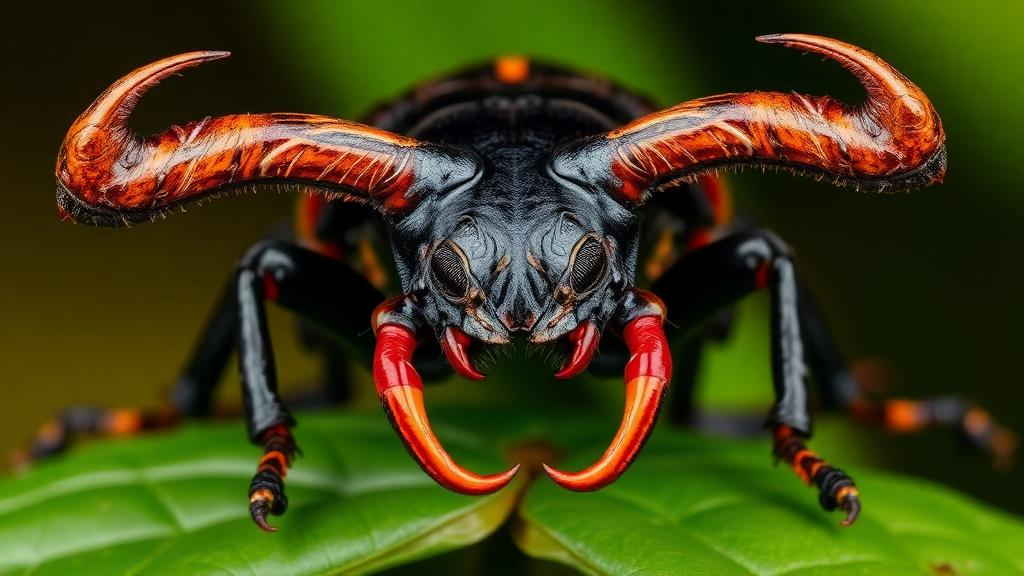
Morphologically, male Ceruchus ahualuo measure 13.5 to 17.0 millimeters in body length, with a black body and slightly paler labial palps, maxillary palps, and legs. The pronotum is wider than long and strongly convex, and the elytra bear seven distinct longitudinal striae. The head carries a distinct subconical depression anteromedially on the vertex, and the mandibles are slender, longer than the head, with acute apices. The most striking feature is a large finger-like tooth on the dorsal margin near the base of each mandible, curved upward and directed obliquely forward, with a subquadrate obtuse denticle immediately posterior to it. Females measure 10.5 to 13.5 millimeters, are dark brown, and have small mandibles shorter than the head, with a shallowly trifurcate arched plate on the dorsal mandibular margin.
This discrete mandibular character separates the new species from its closest relatives. Ceruchus ahualuo is similar to C. niger, C. sinensis, and C. yangi in body size and the density of setae on the mesofemora, but the large finger-like tooth on the dorsal mandibular surface was not observed in any other examined species of the genus. In the male genitalia, the new species differs from C. yangi and C. niger by the caudal margin of the basal piece of the aedeagus bearing a shallow median emargination in ventral view, rather than an M-shaped margin. It also differs from C. sinensis by the median lobe being swollen medially in lateral view. An updated diagnostic key to all known Chinese species of Ceruchus accompanies the description, prepared from specimen examination with reference to earlier work by Huang and Chen (2017).
Because the new species occurs sympatrically with its close relative Ceruchus niger in Yunnan, the researchers turned to mitochondrial DNA to confirm the separation. Two specimens were newly sequenced, representing the new species and C. niger. Total genomic DNA was extracted from fresh tissue, and whole-genome paired-end short-read sequencing was performed on an Illumina platform, generating 150 bp paired-end reads and approximately 10 Gb of data per sample. Mitochondrial candidate scaffolds were recovered from the whole-genome reads using GetOrganelle v. 1.7.7.1 under the animal mitochondrial mode, and the standard DNA barcode fragment of mitochondrial cytochrome c oxidase subunit I (COI) was identified from these scaffolds by BLAST searches against reference sequences.
The molecular results were decisive. In the maximum-likelihood tree based on mitochondrial COI sequences, reconstructed in IQ-TREE v. 3.1.3 with the best-fit substitution model selected by ModelFinder and branch support assessed with 1000 ultrafast bootstrap replicates, the new species was recovered as a distinct lineage clearly separated from C. niger, with Sinodendron yunnanense used as the outgroup. The pairwise Kimura 2-parameter distance between the two species was 0.1359, falling within the range of interspecific distances observed among the sampled Ceruchus species and much higher than the distance between the two C. minor sequences, which was only 0.0077. These molecular results are consistent with the morphological differences and provide additional support for separating the new species from its sympatric relative.
To place the discovery in geographic context, the researchers compiled a distribution map of the genus in China using ArcGIS Pro v. 3.7, drawing on published records and specimen data from laboratory collections and field surveys. Occurrence records were spatially thinned to retain only one record per species within a 5 km radius, and digital elevation model data at 30 arc-seconds resolution from the WorldClim 2.1 database served as the topographic base map. The underlying occurrence data were deposited in the Global Biodiversity Information Facility. The map shows that the core distribution of Ceruchus in China is concentrated along the eastern margin of the Qinghai-Tibet Plateau and in the Hengduan Mountains, where species are densely distributed along complex north–south-oriented mountain systems.
This pattern suggests that the Hengduan Mountains may represent a major centre of diversification or refugium for the genus in East Asia. Certain species, such as C. minor and C. yangi, extend eastward beyond the Hengduan region, dispersing along mountain systems such as the Qinling and Daba Mountains into mid- to high-elevation habitats in central and southern China. The broad distribution pattern of Ceruchus closely follows the major topographic transition zones of China, implying that geographic isolation imposed by deep gorges and high mountains, together with associated microhabitat variation, likely played a crucial role in the radiation and present-day distribution of the genus. Male Ceruchus primarily use their broad, thick mandibles for excavating decaying wood rather than for frequent combat, and the beetles are adapted to cold and temperate climates, typically inhabiting high-altitude areas at low latitudes and low-altitude areas at high latitudes across the Palaearctic and Nearctic regions.
Interspecific differences within Ceruchus are generally slight, and male polymorphism is not strongly developed, which makes the genus a distinct taxonomic challenge compared with lucanid groups in which male allometry produces extreme intraspecific variation. Traditionally, mandibular morphology and the density of setae on the mesofemora have been regarded as characters of high diagnostic value, but the researchers found that male genitalia may exhibit some degree of variation among different geographic populations, whereas female genitalia appear to show only limited interspecific differentiation. Specific aspects of aedeagus morphology, such as the parameres, median lobe, and the caudal margin of the basal piece in ventral view, when combined with selected external morphological characters, may still provide useful taxonomic evidence.
Specimens of this genus are scarce in available collections, with some species such as C. ganyanae and C. luojishanensis known from only a few records and very limited material available for examination. The prevalence of singletons and rare species poses a fundamental challenge to species delimitation because it restricts the assessment of true intra- and interspecific variation. Consequently, many diagnostic characters still require further evaluation based on additional specimens and, where possible, support from molecular data. Future taxonomic revisions will require broader field surveys to obtain additional specimens, together with rigorous population-level morphometric analyses and molecular phylogenetic evidence, in order to establish a stable taxonomic framework for the genus. For now, the finger-like mandibular tooth of Ceruchus ahualuo stands as a vivid reminder that even the most unassuming beetles can harbor surprises waiting in the rotting logs of Asia’s highest mountains.
Subject of Research: Description of a new species of Ceruchus MacLeay (Coleoptera, Lucanidae), with taxonomic notes on the Chinese species of the genus
Article Title: Description of a new species of Ceruchus MacLeay ( Coleoptera , Lucanidae ), with taxonomic notes on the Chinese species of the genus
Article References: Huang, Y., Liu, Y., Shen, Y., Feng, X., & Wan, X. (2026). Description of a new species of Ceruchus MacLeay (Coleoptera, Lucanidae), with taxonomic notes on the Chinese species of the genus. ZooKeys, 1289, 353-365. https://doi.org/10.3897/zookeys.1289.190703
Image Credits: AI Generated
DOI: 10.3897/zookeys.1289.190703
Keywords: Description, species, Ceruchus, MacLeay, Coleoptera, Lucanidae, taxonomic, notes, Chinese, genus, scientific research
News Source: Gavin Prescott. (October 19, 2026). New stag beetle species with striking finger-like mandible teeth found in Yunnan, China. Scienmag.