One of the most stubborn problems in cancer care is not the tumor itself but the vomiting and nausea that follow treatment. Chemotherapy-induced nausea and vomiting, or CINV, has been tamed dramatically since the 1990s, yet a growing body of real-world evidence shows that symptoms can persist for eight to fourteen days after chemotherapy, well beyond the standard five-day window that antiemetic guidelines were designed to cover. A new pharmacokinetic and pharmacodynamic modeling analysis, published in Supportive Care in Cancer, now provides a quantitative explanation for why one antiemetic drug may outlast another in that vulnerable late period, and the results carry particular weight for patients receiving the newest class of targeted cancer drugs, antibody–drug conjugates.
The study, led by Hirotoshi Iihara of Gifu University Hospital in Japan together with an international team of oncologists and clinical pharmacologists including Giampaolo Bianchini, Matti Aapro, and Hope Rugo, set out to answer a deceptively simple question: how long does each of two commonly used antiemetics actually keep blocking the brain receptor that drives delayed vomiting? The two drugs in question, netupitant and aprepitant, belong to the same pharmacological family, the neurokinin-1 receptor antagonists. These agents work by occupying NK1 receptors in the brainstem emetic centers, blocking substance P, the neuropeptide that triggers vomiting signals. Because receptor occupancy can be measured directly in humans with positron emission tomography, and because PET studies have shown that occupancy tracks with clinical antiemetic effect, the researchers used modeled receptor occupancy as a surrogate for efficacy.
The timing matters because of a shift in the oncology treatment landscape. Antibody–drug conjugates such as trastuzumab deruxtecan, datopotamab deruxtecan, and sacituzumab govitecan combine a monoclonal antibody with a potent cytotoxic payload, and they are increasingly used across breast, lung, and other solid tumors. Clinical experience shows that nausea and vomiting with these agents can begin late and persist for ten days or longer, often until the very end of a treatment cycle. Persistent symptoms can force dose reductions, undermining the efficacy of these expensive and powerful therapies. Experiencing nausea on days four and five after chemotherapy is also a known risk factor for subsequent long-delayed symptoms, which means that antiemetic coverage extending beyond the first five days may be critical for breaking that cascade.
To compare the drugs, the team reconstructed plasma concentration–time profiles from previously published healthy-volunteer studies using compartmental pharmacokinetic modeling. For netupitant, a two-compartment model with first-order absorption and a lag time best described the data after a single 300-milligram oral dose, the dose bioequivalent to intravenous fosnetupitant 235 milligrams. For aprepitant, a one-compartment model was fitted to data following a 125-milligram dose, and linear pharmacokinetics were assumed when simulating the standard three-day oral regimen of 125 milligrams on day one followed by 80 milligrams on days two and three, as well as a single 165-milligram dose bioequivalent to intravenous fosaprepitant 150 milligrams. The fits were excellent, with a weighted determination coefficient of 0.9999 for netupitant and 0.9851 for aprepitant.
The pharmacokinetic contrast that emerged is striking. Netupitant reached a peak concentration of 462.4 nanograms per milliliter about six hours after dosing and displayed a huge volume of distribution of nearly 1,500 liters, reflecting its high lipophilicity, with an estimated partition coefficient of 5.48 compared with 2.44 for aprepitant. Most importantly, the terminal half-life of netupitant was 101.6 hours, roughly 6.1 times longer than aprepitant’s 16.6 hours. Aprepitant, despite a lower clearance of 5.52 liters per hour, distributes into a much smaller volume, about 132 liters, so it is eliminated from plasma far faster. Preclinical data add another dimension: netupitant’s brain-to-plasma ratio in rats ranged from 2.4 to 4.9 after intravenous dosing, whereas aprepitant’s brain-to-plasma ratio in ferrets at steady state was only 0.4 to 0.6, suggesting netupitant penetrates the central nervous system considerably more effectively.
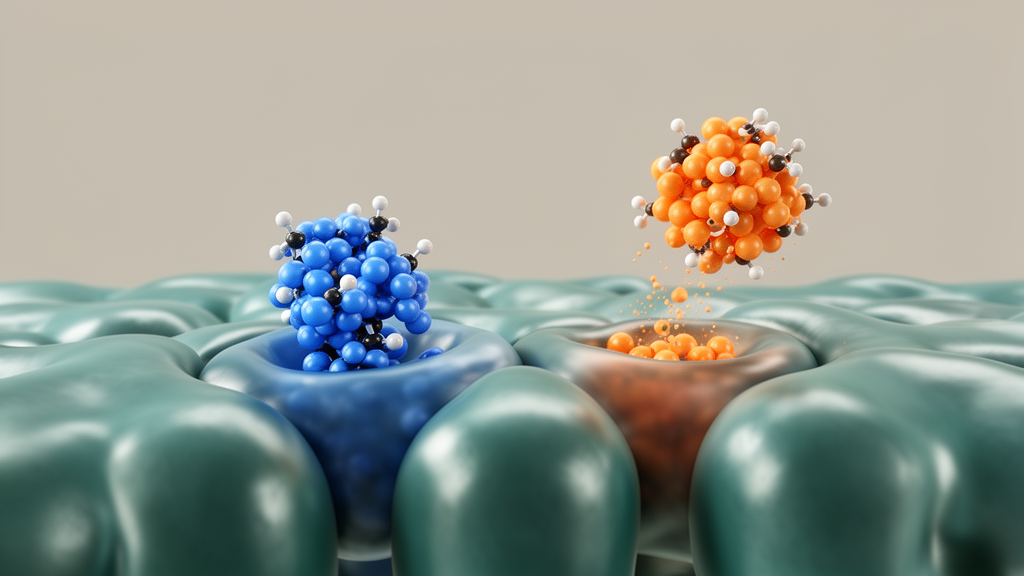
On the pharmacodynamic side, the team linked plasma concentrations to striatal NK1 receptor occupancy measured by PET, using the striatum because it carries the highest density of NK1 receptors in the human brain and yields the strongest specific PET signal. For netupitant, a sigmoid maximum-effect model fitted to PET data gave a maximal occupancy of 93.0 percent and a concentration producing half-maximal occupancy, the EC50, of 10.2 nanograms per milliliter. For aprepitant, a simple maximum-effect model yielded an E-max of 98.1 percent and a nearly identical EC50 of 10.4 nanograms per milliliter. The critical difference was therefore not potency but persistence: netupitant concentrations stayed above the EC50 through day ten, while aprepitant concentrations fell below it by around day seven after the three-day regimen and by roughly day five after a single dose, dropping an order of magnitude below threshold by day ten.
The simulated receptor occupancy curves translate these numbers into a clinically intuitive picture. All three regimens achieved robust initial target engagement, exceeding 90 percent occupancy within three hours of the first dose. Through day five, the picture remained similar, with 76 percent occupancy for single-dose netupitant and 81 percent for the three-day aprepitant course, while single-dose aprepitant had already fallen to 45 percent. After day five, the curves diverged dramatically. At day seven, predicted occupancy was 70 percent for netupitant versus 39 percent for three-day aprepitant and just 10 percent for single-dose aprepitant. By day ten, netupitant still held 60 percent occupancy while aprepitant had collapsed to 3 percent or less, and by day twenty netupitant retained 21 percent occupancy compared with essentially none for aprepitant.
Whether these late occupancy levels matter clinically depends on the threshold for efficacy, and here the evidence suggests the two drugs differ. Historical PET studies of aprepitant indicate that maximal antiemetic effect requires more than 90 percent receptor occupancy. Netupitant, by contrast, appears to work at substantially lower occupancy: clinical studies found that even the 100-milligram dose of netupitant controlled nausea and vomiting effectively over five days after cisplatin chemotherapy, corresponding to only about 50 percent striatal occupancy on day four. If roughly half occupancy suffices for netupitant, then the modeled 70 percent at day seven and 60 percent at day ten remain comfortably above a conservative activity threshold, whereas aprepitant’s occupancy falls to negligible levels within the same period regardless of regimen. Consistent with this modeling, pooled analyses and an individual-patient-data meta-analysis have shown better nausea and vomiting control with the netupitant-palonosetron combination than with aprepitant-based regimens beyond 120 hours, and an exploratory analysis of a phase 3 study demonstrated superior protection through day seven with intravenous fosnetupitant compared with fosaprepitant.
The authors are careful to frame these predictions as hypothesis-generating rather than proof of clinical superiority. The analysis was retrospective, built on mean pharmacokinetic data and PET occupancy measurements from independent studies in small numbers of healthy volunteers, using different PET tracers that may limit direct comparability. It also assumes that relationships observed in healthy subjects apply to patients with cancer, and it does not model interactions with concomitant anticancer therapy, although no clinically meaningful pharmacokinetic differences between healthy volunteers and patients have been reported for either drug. Individual risk factors for nausea and vomiting, which vary widely among patients, are not captured by the model.
Nevertheless, the work illustrates how pharmacometric modeling can address clinically urgent questions that prospective trials have not yet reached, particularly for the expanding population of patients on antibody–drug conjugates whose emetic risk extends deep into each treatment cycle. A single dose of netupitant, delivered either orally as the fixed netupitant-palonosetron combination or intravenously as fosnetupitant, may provide pharmacological coverage for a week or more after administration, aligning antiemetic protection with the actual duration of risk. The authors call for prospective clinical validation, especially in ADC-treated patients, but the message of the curves is clear: when it comes to keeping the brain’s vomiting switch turned off, how long a drug lingers may matter as much as how strongly it binds.
Subject of Research: Pharmacokinetic and pharmacodynamic modeling of neurokinin-1 receptor occupancy by netupitant and aprepitant for prevention of long-delayed chemotherapy-induced nausea and vomiting
Article Title: Netupitant versus aprepitant: model-predicted neurokinin-1 receptor occupancy and implications for long-delayed nausea and vomiting prevention
Article References: Iihara, H., Bianchini, G., Aapro, M., Licata, L., Bernareggi, A., Navari, R. M., Park, Y. H., Jordan, K., Vidal, M., Scotté, F., Roeland, E. J., Schwartzberg, L., & Rugo, H. S. (2026). Netupitant versus aprepitant: model-predicted neurokinin-1 receptor occupancy and implications for long-delayed nausea and vomiting prevention. Supportive Care in Cancer, 34(10), Article 933. https://doi.org/10.1007/s00520-026-11175-y
Image Credits: AI Generated
DOI: 10.1007/s00520-026-11175-y
Keywords: netupitant, aprepitant, NK1 receptor antagonist, chemotherapy-induced nausea and vomiting, antibody-drug conjugates, pharmacokinetic modeling, receptor occupancy, PET imaging, antiemetics, supportive care in cancer, half-life, trastuzumab deruxtecan
News Source: Nathaniel Bowman. (October 19, 2026). Modeling Study Shows Single-Dose Netupitant Blocks Nausea Receptors Far Longer Than Aprepitant. Scienmag.