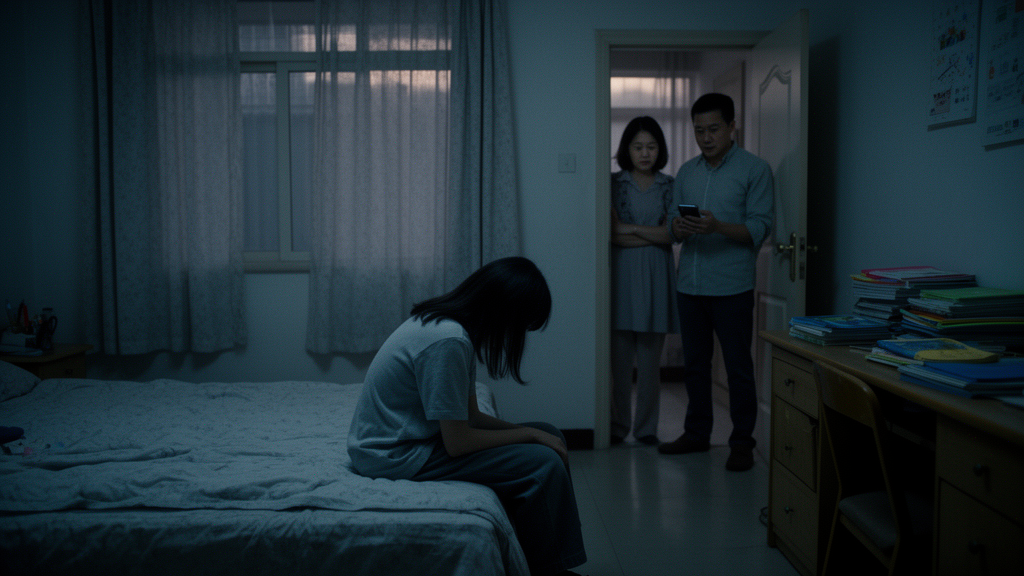
In the intensive care corridors of a tertiary psychiatric hospital in eastern China, a research team sat down with twelve families torn apart by adolescent suicide attempts — and what they heard was not a story about sick children and healthy parents, but about a single illness flowing in both directions through the family bloodstream. A new qualitative study published in BMC Pediatrics by Yan Han, Rongying Sun, Yan Tang, and Chunhong Wei of Huai’an No. 3 People’s Hospital documents, in unsettling detail, how depression and suicidality in Chinese adolescents do not merely wound the child: they ricochet between generations, transforming parents into patients and homes into pressure vessels. The findings arrive against a grim epidemiological backdrop. Depression is implicated in more than 70 percent of adolescent suicide cases in China, and the disorder recurs in over 80 percent of young patients within a single year. Over the past two decades, while overall suicide rates in China have declined, young people have paradoxically shown the fastest rise in suicide risk, with suicidal ideation reported by 10.7 to 32 percent of youth, suicide planning by 9 to 11 percent, and attempts by 2.7 to 5 percent.
The study’s design is deceptively simple but methodologically rigorous. Between August and October 2024, the researchers used purposive sampling to recruit twelve adolescent-parent dyads — twenty-four people in total — from a tertiary hospital specializing in mental health services. Every adolescent met the diagnostic criteria of the International Classification of Diseases, 10th Revision for a depressive episode, had a documented suicide attempt within the month before hospitalization, and ranged in age from 12 to 17 years, with a mean of 14.9 years. Seven of the twelve were girls. Nine of the twelve — 75 percent — had made multiple previous attempts. The mean duration of depressive symptoms before hospitalization was 8.7 months, a delay that would prove to be one of the study’s most damning statistics. Each adolescent was paired with the primary caregiver: seven mothers and five fathers, averaging 39.2 years of age, five of whom had experienced work disruption because of caregiving.
The researchers framed their inquiry with two theoretical engines: family systems theory, which treats individual pathology as embedded within relational networks rather than confined to a single skull, and stress contagion models, which describe how psychological distress transmits between family members through reciprocal influence. Data collection took the form of separate semi-structured interviews — adolescents and parents were interviewed apart, in a private psychotherapy room, to prevent mutual influence and encourage candor. Sessions lasted roughly thirty to forty minutes, recorded verbatim, with the interviewer documenting nonverbal cues such as gestures, eye contact, facial expression, and vocal tone. Analysis followed Colaizzi’s seven-step phenomenological method, with dyads analyzed as integrated units. Two independent coders reached substantial agreement (Cohen’s kappa of 0.87), and the team used member checking, triangulation across four researchers, and negative case analysis to guard against interpretive drift. Contradictions between parent and adolescent accounts were not discarded as noise; they were treated as data, revealing the misalignment at the heart of these families.
The first thematic domain to emerge was bidirectional stress transmission, and its physical signature was strikingly symmetrical. On the adolescent side, 91.7 percent reported chronic fatigue, 83.3 percent experienced sleep disturbances, and 75 percent described somatic pain with no identifiable medical cause. One adolescent described the sensation with brutal economy: exhaustion so profound that lying in bed felt like being run over by a car, accompanied by severe insomnia and palpitations. On the parental side, two-thirds of caregivers — 66.7 percent — developed new-onset physical symptoms since their child’s diagnosis, including headaches in 58.3 percent, gastrointestinal disturbances in half, and cardiovascular symptoms in a third. One mother, whose daughter had attempted suicide three times in a single year, reported that the obligation to care for her had made her physically ill herself. The caregiving burden, in other words, was not merely emotional; it was somatic, measurable, and reciprocal.
The psychological feedback loop was even more destructive. Every single adolescent in the study — 100 percent — identified parental emotional states as significant triggers for suicidal ideation, and 83.3 percent described specific incidents in which parental distress directly precipitated self-harm behaviors. One participant said that his parents’ constant nagging pushed him toward breakdown, and that his death seemed the only solution to end everyone’s suffering. The transmission ran the other way, too: 91.7 percent of parents described their emotional state as entirely contingent on their child’s daily functioning, with three-quarters unable to maintain emotional stability independent of the patient’s status. One father called his son his mood barometer — the boy’s basic functioning temporarily relieving the father’s anxiety, while depressive episodes triggered uncontrollable weeping that the son then criticized. This is stress contagion made visible: two nervous systems locked in a loop, each amplifying the other’s worst moments.
The second domain concerned communication, and here the numbers describe a family system going dark. 83.3 percent of adolescents reported complete cessation of emotional disclosure to their parents, and 91.7 percent described their home environment as emotionally unsafe. Adolescents withdrew strategically, as a shield against invalidation — one participant described sharing pain only to be scolded for overreacting, after which all meaningful communication ceased, an isolation that she said directly drove her suicidality. Parents, meanwhile, had their own avoidance strategy: 75 percent had actively reduced communication frequency, and two-thirds avoided all mental health discussions, motivated by fear of triggering a relapse. One parent only realized, through reading his son’s suicide note, that the family’s silence had compounded the boy’s isolation. The researchers identified two pathological parental extremes after a suicide attempt: unconditional compromise, in which constant attention is perceived by the adolescent as surveillance and oppression, and frightened withdrawal, which avoids conflict on the surface but starves the relationship of emotional interaction. Both deepen the adolescent’s loneliness — and loneliness, in this population, is a accelerant for suicidal thinking.
Beneath the communication breakdown lay a cognitive chasm. Only 25 percent of parents demonstrated an accurate understanding of depression as a medical condition; 75 percent attributed their child’s symptoms to personal weakness or behavioral choices. One parent suspected his son was feigning illness, frustrated by unexplained bedridden states. For the adolescents, being fundamentally misunderstood by their primary support system was itself a catalyst: every adolescent identified parental misunderstanding as a primary factor in suicidal ideation, and 91.7 percent expressed the belief that suicide was the only means of communicating the severity of their suffering. One participant said that perhaps only death would make his parents understand depression’s reality. The clinical implication is stark — when a family interprets a treatable illness as a character defect, the adolescent’s suffering becomes invisible, and the desperate act of self-destruction becomes, tragically, a form of testimony.
The third domain mapped the destabilization of the family system itself. 83.3 percent of families reported complete disruption of established routines, and 75 percent described role confusion among family members. Adolescents resisted what they perceived as transactional care — 66.7 percent interpreted parental caregiving efforts as attempts at control, and 58.3 percent reported increased suicidal ideation in response to perceived parental sacrifices. One adolescent said her parents’ sacrifices felt like control, and that she would rather die than continue that dynamic. Meanwhile, the parents’ own relationships frayed: 58.3 percent of families experienced marital strain or separation, and 91.7 percent reported substantial deterioration in parent-child relationship quality. One mother recounted that her husband had withdrawn while she persevered alone, that her daughter had not called her mother in eighteen months, and that the family was disintegrating. Layered over all of this was a crushing economic burden: families spent an average of 42,500 yuan annually on treatment-related costs — 34.2 percent of the median household income in the study region — with a third of families exceeding 50,000 yuan per year. The financial strain fed directly back into the illness: 75 percent of adolescents expressed guilt about treatment costs, and 58.3 percent identified financial burden as a contributing factor to suicidal ideation. One participant said he was unworthy of his parents’ hard-earned money, and that his death would ease their lives.
The fourth domain extended beyond the household to systemic failures. 91.7 percent of families reported experiencing discrimination or social rejection related to the child’s mental health condition — stigma so pervasive that one educated parent avoided all social contacts to conceal her son’s condition, while another adolescent described being characterized by his parents as their shame, which extinguished his will to live. Healthcare infrastructure compounded the damage: the average delay between symptom onset and appropriate psychiatric care was 5.3 months, and two-thirds of families initially sought help from non-specialist providers. One rural family thought their daughter’s crying was bad luck until a near-fatal suicide attempt revealed severe depression. Even after hospitalization, institutional barriers persisted: 83.3 percent of adolescents encountered significant barriers to school re-entry, and 58.3 percent were required to provide extensive medical documentation and liability waivers to return to class — bureaucratic rituals that reinforced stigma precisely when adolescents were trying to resume normal development.
The study’s authors argue that these findings demolish the traditional, individual-focused intervention paradigm. Adolescent depression, they contend, should be understood as a systemic phenomenon embedded in relational networks that can maintain and amplify distress through reciprocal feedback. Their prescription is a comprehensive family-centered model: bidirectional health support built on the family unit, including emotional regulation programs, empathy training, and role-playing to help family members identify and balance negative emotions; parental psychoeducation to replace attributions of weakness with an understanding of depression as a treatable medical illness; boundary-setting guidance to reconcile adolescent autonomy with parental protectiveness; and structural reforms — special funds for adolescent mental health, optimized insurance reimbursement, school-based mental health officers, and public campaigns to reduce stigma. The authors are candid about limitations: the sample was drawn from a single tertiary hospital, the design is cross-sectional, the cultural context is specifically Chinese, and twelve dyads support thematic depth rather than statistical generalization. But the core message travels across borders. Suicide risk in adolescents is not manufactured by a single mind in isolation; it is co-produced, cycle by cycle, in the space between a child in pain and the parents who love, fear, misunderstand, and are themselves sickened by that pain. Breaking the cycle, the evidence suggests, requires treating the family — and the society around it — as the patient.
Subject of Research: Bidirectional parent-child stress transmission in adolescent depression and suicidality in China
Article Title: Bidirectional pathways to suicide: how parent-child interactions shape adolescent depression and suicidality in China
Article References: Han, Y., Sun, R., Tang, Y., & Wei, C. (2026). Bidirectional pathways to suicide: how parent-child interactions shape adolescent depression and suicidality in China. BMC Pediatrics, 26(1), Article 869. https://doi.org/10.1186/s12887-026-07402-4
Image Credits: AI Generated
DOI: 10.1186/s12887-026-07402-4
Keywords: adolescent depression, suicide attempts, parent-child interaction, family systems theory, stress contagion, qualitative research, China, mental health stigma, family-centered intervention, healthcare access, economic burden, BMC Pediatrics
News Source: Glenn Wilkins. (October 19, 2026). When a Child’s Depression Sickens the Whole Family: Inside China’s Bidirectional Suicide Crisis. Scienmag.