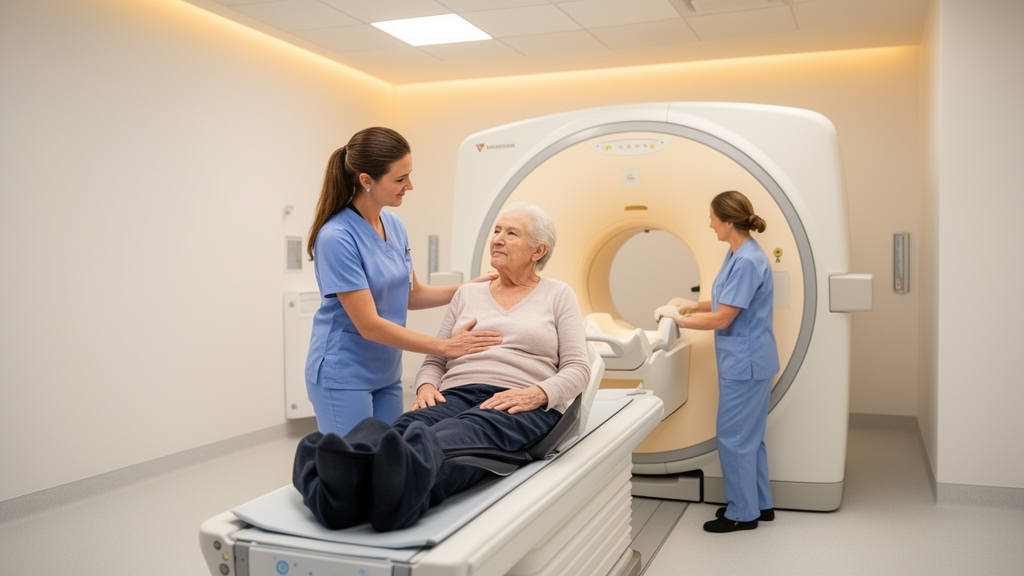
Radiation therapists sit at a peculiar crossroads of modern cancer care. They operate some of the most technically sophisticated equipment in medicine, delivering precisely sculpted beams of radiation to tumors measured in millimeters, yet they are also the clinicians a patient sees every single day of a treatment course that can stretch across weeks. That daily proximity makes them uniquely positioned to notice when a patient is unraveling emotionally, but a new qualitative study suggests that whether they can actually act on what they notice depends far less on their compassion than on the healthcare system around them.
The study, published in the journal Supportive Care in Cancer, compared how radiation therapy technologists in Norway and Canada understand and deliver psychosocial and supportive care, a domain researchers abbreviate as PSSC. Led by Espen Aas of Sykehuset Innlandet in Norway and Safora Johansen of Oslo Metropolitan University, with collaborators from St. Francis Xavier University, Dalhousie University, and other Canadian institutions, the research team conducted semi-structured interviews with 26 practicing therapists, 13 in each country, between March and July 2025. The interviews explored how these professionals perceive their psychosocial role, what they actually do in clinical practice, what barriers stand in their way, and what changes they believe would improve care.
The methodological approach was deliberately interpretive. Using a constructivist framework, the researchers treated each interview as a window into how social and cultural context shapes clinical behavior, rather than assuming that therapists in different countries experience the same job. Transcripts were analyzed with inductive thematic analysis, coded independently by two researchers using NVivo software, with discrepancies resolved through team discussion. Norwegian interviews were conducted over Zoom and professionally translated into English, while Canadian sessions ran on Microsoft Teams. The design built directly on an earlier cross-national survey by Bezanson and colleagues, which had already revealed a striking pattern: therapists in both countries valued psychosocial care, but Norwegians reported spending more time on it and feeling more satisfied with their capacity, while Canadians expressed stronger appetite for training and institutional backing.
The interviews put flesh on those statistical bones. Therapists in both countries described psychosocial care as fundamental rather than optional. One Canadian participant called it the bread and butter of the job, while a Norwegian therapist explained the clinical logic in strikingly practical terms: patients who are tense and stressed struggle to lie completely still on the treatment table, and that movement directly affects the accuracy of radiation delivery. Emotional state, in other words, is not a soft concern appended to the hard physics of treatment. It is woven into whether the treatment works as planned.
Yet the two national groups described reaching for this shared goal through visibly different mechanisms. Norwegian therapists emphasized a relational, patient-centered model protected by scheduling flexibility and collegial teamwork. When a patient needed extra time, coworkers could step in to keep the treatment list moving, allowing the therapist to stay with the person in distress. Canadian therapists, by contrast, described working within rigidly time- and staffing-constrained environments, where psychosocial care is delivered through structured assessments, standardized checklists, and formalized weekly check-ins documented in electronic clinical systems. One Canadian therapist described recording each patient’s psychosocial response on a checklist during the first encounter, turning emotional assessment into a trackable, repeatable procedure. Neither approach is inherently superior, the authors suggest, but each reflects what its respective system makes possible.
Both groups traced the limits of their psychosocial practice back to their education. Participants reported that training programs covered symptom and side-effect management thoroughly, but left emotional, spiritual, and psychological support largely underdeveloped. One Norwegian therapist noted that the subject was never really emphasized in school, and that personal interest in psychology filled the gap. A Canadian participant said they felt well prepared to manage side effects but uncertain about spiritual or emotional care. Confidence, the interviews revealed, is not primarily a product of the classroom. It grows through accumulated workplace experience, repeated exposure to distressed patients, and institutional environments that either permit or prevent therapists from practicing those conversations.
The barriers therapists described were strikingly consistent across borders, even as their intensity differed. Time pressure dominated. Norwegian therapists described efficiency demands eroding the space available for good care, with one lamenting that the time to support patients feels like it is disappearing. Canadian therapists faced a starker arithmetic: demand for radiation therapy is outstripping the supply of qualified therapists so severely that some centers have considered shortening appointment slots, leaving no room to assess patients properly. Understaffing, limited interdisciplinary collaboration, and inconsistent awareness of available support services compounded the problem in both countries. One Canadian therapist captured a tension many clinicians will recognize, observing that the field has become extraordinarily technical and precise, but that the profession needs to shift focus back to asking how the person in front of us is actually doing.
The prior survey data help explain why similar pressures land differently in the two systems. Forty-eight percent of Canadian therapists had reported limited organizational support, compared with only six percent of their Norwegian counterparts. In Canada, resource constraints are persistent and structural; in Norway, therapists navigate cultural expectations for efficiency within comparatively well-resourced departments. The new interviews add a psychological dimension to this disparity. Previous research by Elsner and colleagues and by Gunn and colleagues suggests that when referral pathways are unclear, therapists hesitate to probe psychosocial needs at all, fearing they will uncover problems they cannot manage. This creates a self-reinforcing cycle: systemic constraints limit care, which limits therapists’ opportunities to build psychosocial skills, which further limits care.
When asked what would improve the situation, therapists in both countries converged on a remarkably similar wishlist. More time was the most cited need, followed closely by better education and training, with participants asking for skill refreshers and stronger grounding in psychology. They also wanted clear, responsive referral pathways and routine collaboration with nurses, psychologists, and social workers. Some noted practical obstacles that receive little attention, including language barriers that complicate needs assessment even when digital translation tools are available. Canadian participants additionally called for institutional supports such as staff in-services and attention to therapist self-care to prevent burnout, with one noting that with a national shortage of radiation therapists, dedicating time to psychosocial work can feel like a luxury. Notably, Canada has clinical guidelines for psychosocial health services in cancer care, but participants appeared unaware of them, while Norway has no such guidelines at all, a knowledge-translation gap the authors flag as significant.
The study’s conclusion is quietly radical in its implication: the quality of emotional support a cancer patient receives during radiation therapy may depend less on the individual therapist’s empathy than on organizational design. Both national groups showed deep commitment to psychosocial care, but commitment alone could not overcome the shape of the systems they worked in. The authors argue that effective delivery requires alignment between therapists’ roles, targeted education, and institutional structures that protect time and clarify referral routes. They also acknowledge the study’s limitations, including convenience and snowball sampling that may have overrepresented therapists already dedicated to psychosocial work, and they call for future research that interviews patients directly to determine whether therapists’ worries about providing insufficient care reflect reality. For now, the message to cancer centers is clear: if you want therapists to care for the whole person, you have to build a system that lets them.
Subject of Research: Psychosocial and supportive care delivered by radiation therapy technologists in Norway and Canada
Article Title: Psychosocial and supportive care in radiation therapy: a qualitative comparison of Norway and Canada
Article References: Aas, E., Bezanson, S., Tørris, C., Penney, J., Ruco, A., & Johansen, S. (2026). Psychosocial and supportive care in radiation therapy: a qualitative comparison of Norway and Canada. Supportive Care in Cancer, 34(10), Article 938. https://doi.org/10.1007/s00520-026-11181-0
Image Credits: AI Generated
DOI: 10.1007/s00520-026-11181-0
Keywords: radiation therapy, psychosocial care, supportive care, radiation therapists, cancer care, qualitative research, cross-national comparison, Norway, Canada, patient-centered care, oncology nursing, healthcare systems
News Source: Nathaniel Bowman. (October 19, 2026). How Radiation Therapists in Norway and Canada Deliver Psychosocial Care Differently. Scienmag.