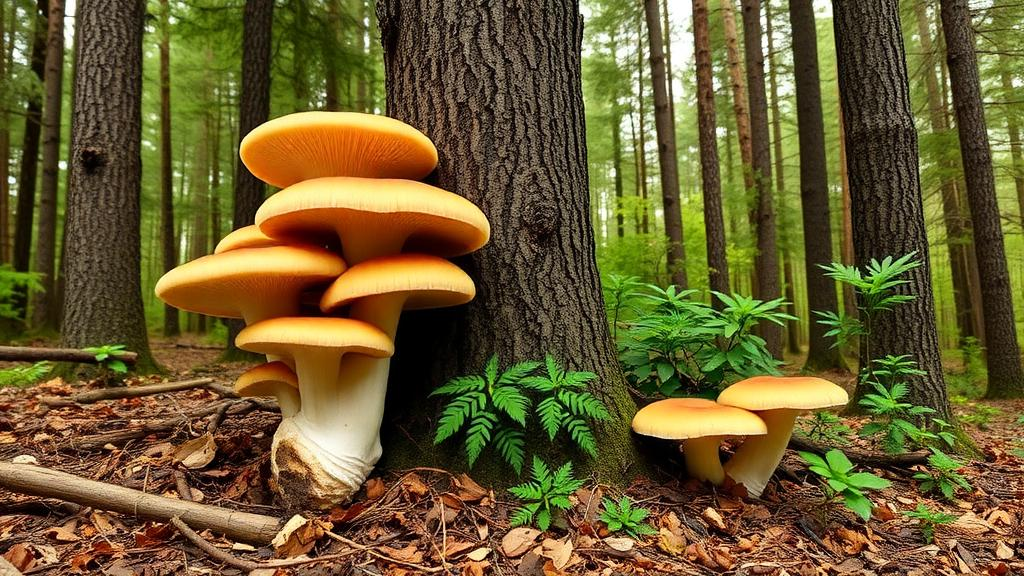
Beneath the soil of nearly every forest on Earth lies a hidden marketplace. Trees trade sugars with fungi that wrap around, or thread into, their finest roots, and in exchange the fungi deliver water and mineral nutrients that the trees cannot efficiently gather on their own. For decades, ecologists have known that these partnerships, called mycorrhizas, come in two broad types: ectomycorrhizal associations, in which fungal sheaths coat the roots of pines, oaks, and beeches, and arbuscular mycorrhizal associations, in which fungi penetrate the root cells of maples, ashes, and many tropical hardwoods. A new study from the temperate–subtropical transition zone of China now shows that the balance between these two fungal strategies is not a trivial detail of root biology. It is a powerful predictor of how much carbon a forest stores, how many species it supports, and how evenly its trees grow.
The research, published in BMC Plant Biology, was conducted by Guanjie Wang of Henan Agricultural University and colleagues, working in permanent forest monitoring plots established in the Baotianman National Nature Reserve. The team analyzed a total of six hectares of forest, a substantial area for this kind of work, in a region where the cold-loving coniferous and broadleaved forests of the temperate zone give way to the species-rich evergreen and deciduous forests of the subtropics. This transition zone is a natural laboratory for studying how ecological rules change with climate, because both ectomycorrhizal and arbuscular mycorrhizal trees coexist there in varying proportions, allowing researchers to ask what happens to a forest as one fungal guild replaces the other.
The central question was deceptively simple: as the relative abundance of ectomycorrhizal trees rises, what happens to the forest’s aboveground biomass, the total mass of living wood, bark, and branches above the soil? Aboveground biomass matters enormously because it is the most direct measure of the carbon a forest pulls from the atmosphere and locks away in its trunks. It also reflects the forest’s productivity, its successional maturity, and its vulnerability to disturbances such as storms and droughts. But biomass does not exist in isolation. It is shaped by how many species share the canopy, by the range of tree sizes present, and by the competitive and facilitative interactions among neighbors. Disentangling these threads requires both careful measurement and sophisticated statistics.
To do so, the researchers deployed a three-tiered analytical strategy. First, they used bivariate regressions to examine simple pairwise relationships between variables. Second, they built Gaussian linear mixed-effects models, which allow scientists to estimate the influence of fixed predictors, such as mycorrhizal abundance, while accounting for random variation among plots. Third, and most revealing, they constructed a mixed-effects piecewise structural equation model, a framework that maps networks of hypothesized cause-and-effect pathways simultaneously rather than testing each link in isolation. This approach matters because ecological variables are deeply intertwined: a fungus-driven shift in species composition could influence biomass directly, or indirectly by changing how many species coexist or how variable tree sizes are, and only a path analysis can separate these routes.
The headline finding is striking. In the mixed-effects model, the relative abundance of large ectomycorrhizal trees accounted for 42.66 percent of the explained fixed-effect variation in aboveground biomass, while species richness accounted for 31.46 percent. In other words, the identity of the fungal partnership a tree forms predicted more of the variation in forest carbon storage than the sheer number of species did. The piecewise structural equation model sharpened the picture further: large ectomycorrhizal tree relative abundance showed the strongest direct positive association with biomass of any variable tested, with a standardized path coefficient of 0.570 and a p-value below 0.001, indicating an extremely unlikely chance occurrence.
Yet the story is not one of fungal dominance producing unambiguously richer forests. Species richness, although its direct link to biomass was weaker, accumulated influence through indirect routes, and its total effect on biomass, 0.466, slightly exceeded the total effect of large ectomycorrhizal tree abundance, which was 0.425. This means that while ectomycorrhizal trees are the heavyweight champions of direct carbon accumulation, diversity contributes to biomass through a web of secondary pathways, perhaps by improving resource partitioning, filling canopy gaps, or buffering the stand against environmental fluctuations. Both dimensions of forest structure matter, but they matter in different ways and through different mechanisms.
The negative side of the ledger is equally important. As large ectomycorrhizal tree abundance rose, the relative abundance of arbuscular mycorrhizal trees fell, with a path coefficient of −0.509, and tree-diameter variation collapsed even more dramatically, with a coefficient of −0.803. Diameter variation is a measure of how unevenly sized the trees in a stand are; high variation signals a forest with towering old giants alongside young saplings, a hallmark of complex, multi-aged structure. Its sharp decline under ectomycorrhizal dominance suggests that these forests become more uniformly sized, perhaps because ectomycorrhizal trees, with their ability to tap nitrogen directly through fungal networks, outcompete neighbors and drive the stand toward a narrower range of growth trajectories.
Crucially, when the researchers summed up all the indirect effects of ectomycorrhizal abundance on biomass, the total was negative, at −0.145. The suppression of species richness and the flattening of tree-size variation together worked against carbon storage, even as the direct pathway pushed it upward. The net result is that the positive relationship between ectomycorrhizal dominance and biomass is driven almost entirely by the direct route, the sheer capacity of these trees and their fungi to build wood, rather than by any indirect benefit flowing through structural complexity. This is a subtle but important correction to simpler narratives that equate fungal type with forest quality.
Why would ectomycorrhizal trees be such efficient carbon accumulators? The answer likely lies in fungal physiology. Ectomycorrhizal fungi can access organic forms of nitrogen, breaking down complex soil compounds that arbuscular mycorrhizal fungi largely cannot exploit. In nitrogen-limited temperate forests, this capability gives ectomycorrhizal trees a decisive edge, allowing them to sustain high growth rates on nutrient-poor soils. Many ectomycorrhizal species, such as pines and oaks, also tend toward denser, longer-lived wood, which stores more carbon per unit volume. The trade-off is that the same traits that make these trees competitive, including dense canopies and litter that alters soil chemistry, can exclude arbuscular mycorrhizal species and reduce the recruitment opportunities that maintain a diverse, uneven-aged forest.
The implications reach well beyond the mountains of central China. As climate change shifts the ranges of tree species, and as nitrogen deposition alters soil nutrient availability, the global balance between ectomycorrhizal and arbuscular mycorrhizal forests is expected to move. Models that forecast future carbon storage often treat forests as interchangeable pools of biomass, but this study suggests that the fungal identity of the dominant trees is a first-order control on both carbon and biodiversity outcomes. A future forest dominated by ectomycorrhizal species may store more carbon per hectare while supporting fewer species and a simpler size structure, a trade-off that conservation planners and climate policymakers will need to weigh together. The hidden marketplace beneath our feet, it turns out, helps set the terms for everything above it.
Subject of Research: Associations between ectomycorrhizal tree abundance, species diversity, tree-size variation, and aboveground biomass in temperate–subtropical transition forests
Article Title: Ectomycorrhizal tree relative abundance is associated with higher aboveground biomass but reduced species richness and tree-size variation in temperate–subtropical transition forests
Article References: Wang, G., Shi, K., Zhang, T., Huang, Q., Zhao, B., Chen, Z., Qian, J., Kong, D., Yang, L., Yu, C., Jin, X., & Wang, T. (2026). Ectomycorrhizal tree relative abundance is associated with higher aboveground biomass but reduced species richness and tree-size variation in temperate–subtropical transition forests. BMC Plant Biology. https://doi.org/10.1186/s12870-026-09910-y
Image Credits: AI Generated
DOI: 10.1186/s12870-026-09910-y
Keywords: ectomycorrhiza, arbuscular mycorrhiza, aboveground biomass, species richness, tree-size variation, forest ecology, mycorrhizal fungi, temperate–subtropical transition, carbon storage, structural equation modeling, Baotianman, plant ecology
News Source: Alan Morgan. (October 18, 2026). Fungal Partners Shape Forest Carbon: Ectomycorrhizal Trees Boost Biomass but Trim Diversity. Scienmag.