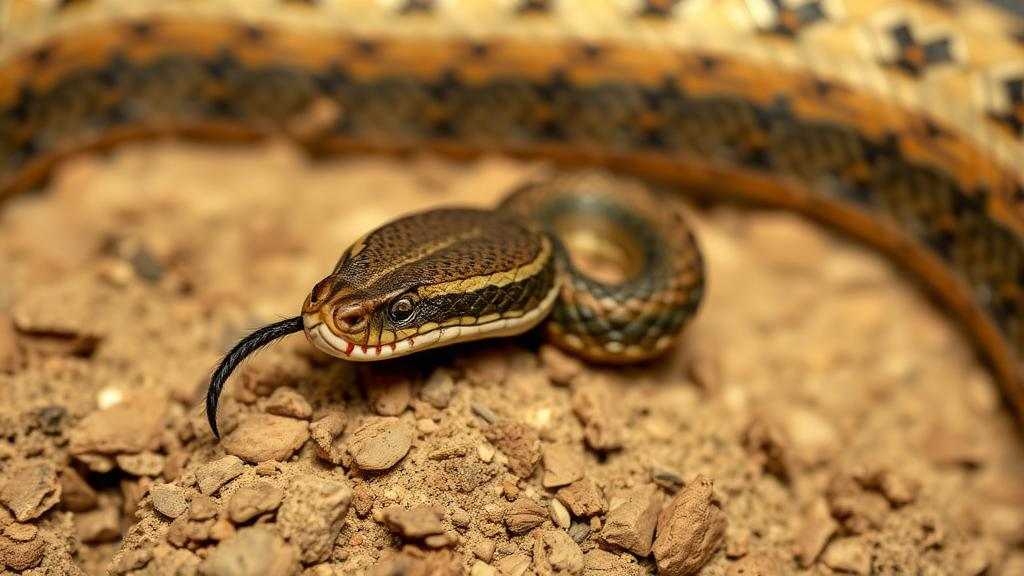
In January 2003, a herpetologist browsing the shelves of a small Budapest butterfly museum stumbled upon something that should not have been there: a mummified juvenile viper, collected in 1962 and mislabeled for decades as a common European adder. According to a study published in the journal Herpetozoa, the specimen represents a previously unknown historical occurrence of the Hungarian meadow viper (Vipera ursinii rakosiensis), one of Europe’s rarest and most endangered snakes. The discovery, made between the towns of Mogyoród and Gödöllő north-east of Budapest, quietly rewrites the historical map of a species that has spent the past century teetering on the edge of extinction in the Carpathian Basin.
The Hungarian meadow viper is a small, venomous, steppe-dwelling subspecies endemic to the region, meaning it lives nowhere else in the world. By the time the scientific community recognized how scarce it had become, the viper had already vanished from most of its former haunts. Today, only two isolated populations survive in Hungary: one in the grasslands of the Kiskunság in the central part of the country, and another near the Austrian border in the northwest. The new study, led by Gábor Szelényi, documents a third historical locality north of Budapest, east of the only previously known site in that region, near Fót, which was reported back in 1943 based on a specimen housed at the Hungarian Natural History Museum.
The story of the specimen itself reads like a detective novel. On July 6, 1962, a 16-year-old nature enthusiast found a dead juvenile viper crushed on a dirt road in the Mogyoród area, northwest of the Szentjakab stop on the Gödöllő HÉV suburban railway line. The teenager assumed the snake was a common European adder (Vipera berus) and took it home. The specimen eventually entered the collection of the Újpest Butterfly Museum, a private institution founded and directed by the amateur entomologist György Juhász, who labeled the viper and preserved it, naturally mummified, among the butterflies. There it sat, forgotten, for more than forty years.
When Szelényi photographed the specimen in 2003, its true identity was still waiting to be recognized. Only two viper species occur in Hungary, the common European adder and the meadow viper, and the two are never sympatric, meaning their ranges do not overlap, because of their fundamentally different habitat requirements. The adder does not occur anywhere near Budapest, while the meadow viper was historically documented on the outskirts of the capital as far back as 1894, when the Hungarian zoologist Lajos Méhely first recorded it. That biogeographical argument alone pointed to the mummified snake being a meadow viper, but the researchers went further, turning to the fine details of head scale anatomy to settle the question.
The examination revealed a suite of diagnostic characters that clearly separate the specimen from Vipera berus. Most tellingly, the animal has a single apical scale on the top of its head, a feature characteristic of Vipera ursinii, whereas the common European adder typically has two apical scales. The other head shields matched the meadow viper’s pattern precisely: two canthal scales on each side (2/2), five intercanthalia, one frontal scale, two parietalia, one supraocular on each side (1/1), and three intersupraocular scales (3/3). The well-preserved coloration and pattern of the mummified remains, visible in the photographs, further confirmed the identification. Taken together, the evidence showed the specimen was indeed a Hungarian meadow viper, a juvenile measuring 18 centimeters in total length.
The photographs even allowed the researchers to determine the sex of the animal. By measuring the tail length from the images, they recorded a tail of 22 millimeters, which, compared against data on newborn Hungarian meadow vipers published by Halpern and colleagues in 2007, indicates the individual was male. Timing adds another layer to the story. The specimen was found in early July, but young meadow vipers are usually born at the end of July or in early August. Considering that the average birth length of juveniles at the Hungarian Meadow Viper Conservation Centre, based on several years of measurements, varied between 135.4 (±9.2) and 146.9 (±5.1) millimeters, the 18-centimeter juvenile was almost certainly born the previous year, in 1961.
The location of the find is as significant as the identification. The specimen was discovered in an area that, at the turn of the twentieth century, was a grassy meadow suitable for this habitat specialist. Aerial photographs from 1966, just four years after the snake was found, show the landscape already heavily fragmented by weekend houses, small plots, and large-scale agricultural fields. Over the following decades, the meadows were gradually developed, rendering the area uninhabitable for the viper. The site lies between the former Fót locality and the eastern outskirts of Budapest, and the closest aerial distances to known meadow viper sites are 7 kilometers to Fót, 12 kilometers to Budapest-Káposztásmegyer, 13 kilometers to Budapest-Felsőrákosi rétet, and 48 kilometers to Dabas-Gyónti rét, the nearest recent occurrence. Notably, an almost continuous green corridor still connects the former Fót and Mogyoród sites, hinting at what habitat once linked these populations.
The researchers are careful to acknowledge the limits of their evidence. Finding the mummified remains near Mogyoród does not prove the individual lived there; it could have been transported from another location, for example, during hay transportation, a plausible scenario in an agricultural landscape. Still, the find supplements the historical record of the species in Hungary with a previously unknown locality, joining a documented list of occurrences that stretches from Bugac and Izsák in Bács-Kiskun County in the south, through Budapest itself, to more than a dozen sites in Győr-Moson-Sopron County near the Austrian border, reported by generations of Hungarian herpetologists from Méhely in 1911 and 1912 through Korsós and colleagues in 2001.
There is also a melancholy coda to the story. After György Juhász’s death in 2015, the subsequent fate of the mummified specimen became unknown. The Újpest Butterfly Museum still operates as of 2024, now run by the son of the previous owner, but the researchers report there is no information about the current whereabouts of the remains. All that survives of this six-decade-old discovery are the photographs taken in 2003, which now serve as the only documentation of a lost population’s last trace. For a species whose global range is confined to the Carpathian Basin, every historical record matters for understanding how much habitat has been lost and where conservation efforts might still succeed.
The Hungarian meadow viper has become a flagship for conservation in the region, with a dedicated conservation centre in Hungary breeding juveniles for reintroduction and habitat restoration projects working to reconnect fragmented grasslands. The new record shows that the species once occupied meadows north-east of Budapest that have long since been converted to weekend houses and farmland, a sobering reminder of how thoroughly a habitat specialist can be squeezed out within a single human lifetime. It also demonstrates the unexpected scientific value hiding in private collections: a mislabeled mummified snake, preserved among butterflies for forty years, turned out to carry a piece of evolutionary and biogeographical history that no living population could provide. As researchers continue to piece together the historical range of Vipera ursinii rakosiensis, discoveries like this one show that the past still holds surprises, sometimes in the most forgotten corners of a museum shelf.
Subject of Research: A new historical occurrence of the Hungarian meadow viper (Vipera ursinii rakosiensis) in Hungary
Article Title: A new historical occurrence of the Hungarian meadow viper ( Vipera ursinii rakosiensis ) in Hungary
Article References: Szelényi, G., Varga, N., Gál, J., & Tóth, T. (2025). A new historical occurrence of the Hungarian meadow viper (Vipera ursinii rakosiensis) in Hungary. Herpetozoa, 38, 7-11. https://doi.org/10.3897/herpetozoa.38.e136221
Image Credits: AI Generated
DOI: 10.3897/herpetozoa.38.e136221
Keywords: conservation, herpetology, Hungary, endangered species, museum collections, historical, occurrence, Hungarian, meadow, viper, Vipera, ursinii
News Source: Margaret Porter. (October 18, 2026). Mummified viper reveals lost Hungarian population after six decades. Scienmag.