A landmark study from Montreal has pulled back the curtain on what it actually takes to make a hospital feel safe for Indigenous people experiencing homelessness, and the answers are reshaping how one of Canada’s largest medical centres thinks about healing. Researchers at the Centre hospitalier de l’Université de Montréal, working hand in hand with the Indigenous organization Projets Autochtones du Québec, surveyed and interviewed the doctors, nurses, and managers who stand on the front lines of care. Their findings, published in BMC Health Services Research, reveal a healthcare workforce that is willing but often unequipped, operating within a system that was never designed with Indigenous worldviews in mind.
The numbers behind the study are stark. Indigenous peoples remain dramatically overrepresented among Montreal’s homeless population, a disparity rooted in generations of colonization, displacement, and systemic discrimination. When someone who has experienced that cumulative weight walks through the doors of an emergency department, they often carry more than a medical complaint. They carry a history of institutions that have failed them, and the study set out to understand whether the hospital itself could become part of the repair rather than the repetition.
To do that, the research team adopted a methodology known as Two-Eyed Seeing, or Etuaptmumk in the Mi’kmaq language, which asks researchers to look at a problem through both Indigenous knowledge systems and Western scientific frameworks simultaneously. Rather than treating these as competing lenses, Two-Eyed Seeing holds that each reveals something the other cannot. In practice, this meant pairing conventional survey instruments and statistical analysis with community-grounded interpretation, ensuring that the questions being asked and the conclusions being drawn respected Indigenous ways of knowing from the very beginning of the research process rather than being retrofitted afterward.
The study unfolded in two complementary phases. First, the researchers distributed questionnaires to frontline hospital staff, gathering quantitative data on their familiarity with Indigenous cultures, their confidence in providing culturally safe care, and their awareness of the social determinants that shape Indigenous health. Then they sat down with the people who manage the system itself, including service managers, heads of medical units, and clinical coordinators, for in-depth interviews that probed the structural barriers and institutional culture that no survey could fully capture. This mixed-methods design allowed the team to measure the breadth of the challenge while also understanding its depth.
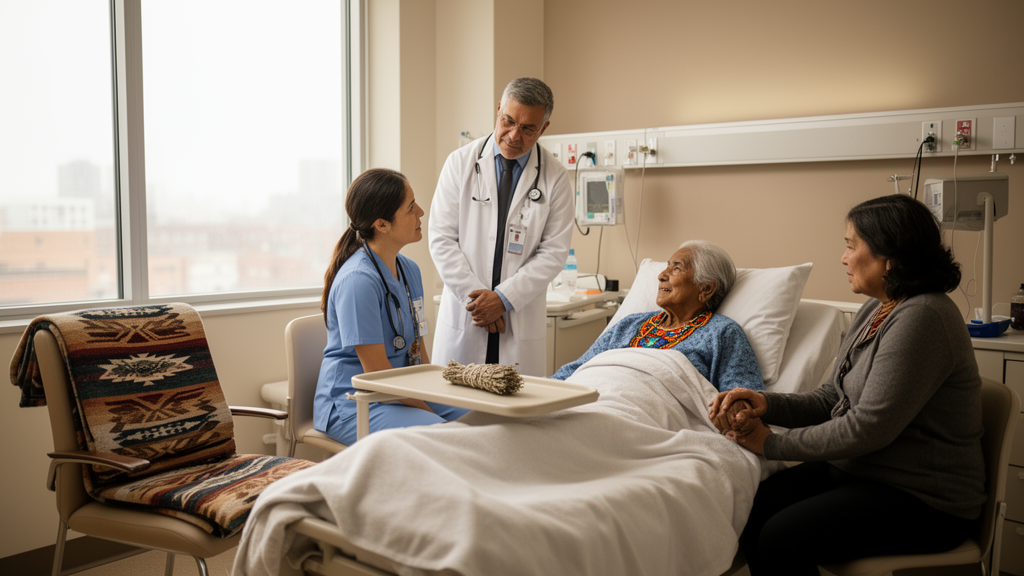
What emerged from the data was a portrait of a workforce caught between good intentions and limited preparation. Many healthcare professionals expressed genuine commitment to serving Indigenous patients well, but the study found significant gaps in their knowledge of Indigenous histories, cultures, and the ongoing effects of colonization on health outcomes. Cultural safety, a concept developed by Indigenous nurses in New Zealand that reframes care around the patient’s experience rather than the provider’s self-assessment, requires more than a training module. It demands an ongoing examination of the power dynamics embedded in every clinical encounter, and the interviews revealed that many staff had never been given the tools or the institutional space to do that work.
The concept of cultural safety is deceptively simple but operationally demanding. Unlike cultural competence, which can imply that a provider has achieved a fixed level of knowledge about another culture, cultural safety is determined by the patient, not the practitioner. It asks whether the person receiving care felt respected, heard, and free from discrimination throughout their interaction with the system. This patient-defined standard means that no amount of provider self-assessment can substitute for the lived experience of the person in the hospital bed, and it fundamentally shifts accountability from the institution’s perspective to the individual’s.
The study also examined how healthcare professionals understood the relationship between trauma and health. The researchers drew on frameworks including the Inuit concepts of Ilusirsusiarniq, Qanuqatsiarniq, and Inuuqatigiitsiarniq, which together encompass wellbeing through knowledge, community, and relationships. These frameworks, alongside the Public Health Agency of Canada’s recognition of trauma-informed care, provided a lens for understanding that the health of Indigenous peoples experiencing homelessness cannot be separated from the historical and ongoing violence of colonization. Healthcare professionals who grasped this connection were better positioned to provide care that addressed root causes rather than just symptoms.
Perhaps the most actionable finding from the research centred on collaboration. The study identified partnerships between the hospital and Indigenous-led organizations as the most promising pathway toward meaningful change. When healthcare professionals worked alongside Indigenous knowledge keepers, community navigators, and specialized services, they reported greater confidence in their ability to serve Indigenous patients and a deeper understanding of the barriers those patients face. These collaborations also created feedback loops that allowed the hospital to adjust its practices based on direct input from the communities it serves, rather than relying on assumptions or one-size-fits-all protocols.
The implications of this research extend well beyond Montreal. Hospitals across Canada and around the world serve Indigenous populations that have been systematically marginalized by colonial institutions, and the Montreal study offers a template for how healthcare systems can begin to address that legacy. The findings suggest that institutional change requires more than policy statements or annual cultural awareness days. It demands sustained investment in relationship-building, structural flexibility that allows for Indigenous-led approaches to care, and a willingness on the part of healthcare leadership to examine the power dynamics that shape every clinical interaction.
As the research team looks toward the future, their work points to a healthcare system that could look fundamentally different. A hospital where Indigenous patients are met with understanding rather than judgment, where clinical protocols make room for traditional healing alongside Western medicine, and where the workforce reflects the diversity of the communities it serves. The Montreal study does not claim to have achieved that vision, but it has mapped the terrain, identified the obstacles, and demonstrated that with genuine partnership and sustained commitment, the journey toward culturally safe care is not only possible but already underway.
Subject of Research: Towards culturally safe holistic healthcare for Indigenous peoples experiencing homelessness in Montréal: a mixed-methods study among healthcare professionals
Article Title: Towards culturally safe holistic healthcare for Indigenous peoples experiencing homelessness in Montréal: a mixed-methods study among healthcare professionals
Article References: Neicun, J., Marsan, S., Ouimet, L.-C., & Bruneau, J. (2026). Towards culturally safe holistic healthcare for Indigenous peoples experiencing homelessness in Montréal: a mixed-methods study among healthcare professionals. BMC Health Services Research. https://doi.org/10.1186/s12913-026-15574-z
Image Credits: AI Generated
DOI: 10.1186/s12913-026-15574-z
Keywords: Indigenous health, cultural safety, healthcare equity, trauma-informed care, Montreal hospital study, Two-Eyed Seeing, Indigenous homelessness, health services research, Towards, culturally, safe, holistic
News Source: Ophelia Keating. (October 18, 2026). Inside Montreal’s Hospital Wards, Clinicians Confront the Cultural Divide in Indigenous Care. Scienmag.