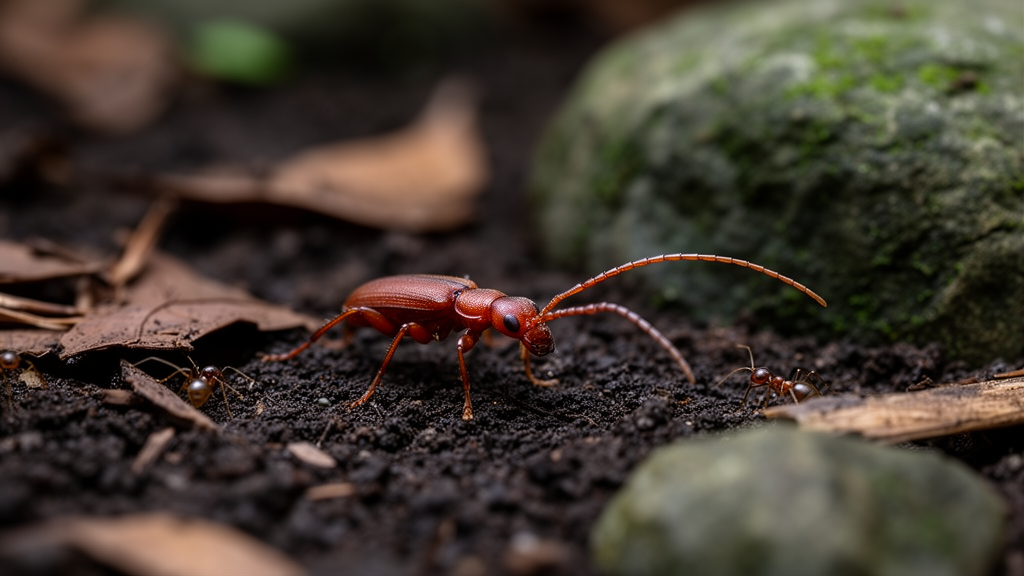
Deep in the forests of East China’s Tianmushan National Nature Reserve, a collector lifting a stone in May 2024 uncovered something remarkable: a tiny, reddish-brown beetle nestled inside a colony of Pseudolasius ants. The insect, measuring just 2.33 millimeters long, turned out to be a species entirely new to science, and one of the strangest members of an already peculiar group of insects. Named Triartiger caiyujiei in honor of its discoverer Yu-Jie Cai, the beetle belongs to the Clavigeritae, a supertribe of rove beetles that have abandoned life on their own and become obligate guests inside ant nests.
The discovery, published in the Deutsche Entomologische Zeitschrift by entomologists Wen-Yin Yin and Niu, brings the number of known Triartiger species to seven and provides only the third confirmed record of a host ant for the entire genus. That may sound like modest progress, but for a group as secretive as this one, it represents a significant leap. Before 2013, not a single host association had been documented for any Triartiger species, leaving scientists almost entirely in the dark about how these beetles live, what they eat, and how they persuade ants to tolerate their presence.
Clavigerite beetles are among the most extreme examples of myrmecophily, or ant-loving, in the insect world. Over evolutionary time they have lost their ability to fend for themselves: their bodies have become compact and rounded, their mouthparts reduced, and their wings vestigial. In exchange, they have developed trichomes, specialized glandular structures that produce secretions ants find irresistible. Ants lick these secretions and, in return, carry the beetles into their nests, feed them, and care for them as if they were members of the colony. It is a biological con of extraordinary sophistication, played out in the darkness beneath stones and inside soil galleries.
What makes the new species immediately striking is its antennae. All Clavigeritae are characterized by three-segmented antennae, a trait that gives the genus Triartiger its name, but T. caiyujiei takes this to an extreme. Its third antennomere is approximately 13 times as long as the second, an exceptionally elongated structure that immediately separates it from its closest relatives. In the identification key updated by the authors, this single feature, combined with patches of long setae on the rear portions of the elytra and rows of long setae along the posterior margin of the abdomen, cleanly distinguishes the new species from T. klapperichorum of Taiwan, whose antennomere 3 is only about 8.5 times as long as the second segment.
The beetle’s trichome architecture is equally noteworthy. According to the description, T. caiyujiei possesses the most intricate elytral and abdominal trichome structures observed within the genus. Large triangular trichomes sit at the posterolateral margins of the elytra, while the abdomen bears a pair of broad basolateral trichomes and paratergites equipped with greatly curved longitudinal trichomes at their bases. These structures are not decorative; they are the interface between beetle and ant, the organs through which the symbiosis is mediated. Their elaboration in this species suggests a correspondingly sophisticated relationship with its Pseudolasius host, though the precise chemistry and behavioral dynamics remain to be studied.
The holotype specimen, a single male, was collected by hand from a small Pseudolasius colony nesting beneath a stone in a mixed coniferous-deciduous forest at 1,245 meters elevation on the pass to the summit of West Tianmu Mountain. The site coordinates place the discovery in Zhejiang Province, east China, extending the known mainland range of the genus. The specimen is deposited in the Insect Collection of Shanghai Normal University, where it was examined using high-resolution imaging equipment including a Canon EOS R5 camera fitted with a 10-times Mitutoyo lens, with image stacking performed in Helicon Focus to produce sharp composite photographs of the tiny anatomy.
Detailed morphological analysis revealed a suite of diagnostic features beyond the antennae. The head is subcylindrical and longer than wide, with a narrow rostrum formed by the frons and distinct microsculpture on the vertex. The compound eyes are weakly prominent, each composed of roughly ten ommatidia, a further sign of the reduced visual capacity typical of life underground. The mesofemur carries a large blade-like ventral spine and the mesotibia bears a large triangular spine at the middle of its mesal margin, while the hind femur is simple and unadorned. The aedeagus, the male copulatory organ used to distinguish closely related species, is dorsoventrally symmetrical with a basal capsule bearing a large ventral projection and an apical lobe that narrows abruptly before its tip.
The taxonomic history of Triartiger reads like a slow-motion detective story. Four species were described between 1944 and 2008 from the islands of Tsushima and Taiwan, none with any host information. It was not until Maruyama and colleagues documented more than a dozen adults of T. reductus assembled in a nest of the ant Crematogaster osakensis that the first host record for the genus existed. Then, within a single fiscal year from December 2023 to December 2024, three species surfaced in eastern China: T. spatulatus found in Fujian’s mountains with the ant Tetramorium nipponense, T. jiangxinongda collected in a flight intercept trap at Mount Meiling in Jiangxi, and now T. caiyujiei from Zhejiang. The mainland, long considered virtually unexplored for this genus, is suddenly yielding discoveries at an unprecedented pace.
That burst of discovery says as much about sampling methods as it does about the beetles themselves. Myrmecophilous insects are notoriously difficult to collect because they live hidden within ant colonies, and standard techniques such as pitfall traps or canopy fogging rarely intercept them. Two of the three recent Chinese species were found by hand-searching ant nests, a labor-intensive approach that requires knowing where to look. The third, T. jiangxinongda, came from a flight intercept trap, suggesting that at least some Triartiger disperse by flight despite their vestigial wings, and that passive trapping methods may have untapped potential for finding more species. The authors compiled a comprehensive table summarizing distribution, collecting methods, host associations, and available material for all seven known species, providing a roadmap for future fieldwork.
The rarity of these beetles in both the field and museum collections underscores how much remains unknown. Most species are known from only one or a handful of specimens, and the biology and natural history of the majority remain poorly understood. The female of T. caiyujiei, for instance, has never been observed. Yet the fact that a new species was found at an easily accessible site on West Tianmu Mountain, a well-visited reserve, hints that clavigerite diversity in China may be far richer than current records suggest. As researchers intensify their searches of ant colonies across the country’s forests, the box of chocolates, as the authors wryly note in invoking a famous movie line, may contain many more surprises yet.
Subject of Research: Taxonomic description of a new myrmecophilous rove beetle species associated with Pseudolasius ants in East China
Article Title: Triartiger caiyujiei sp. nov., a remarkable clavigerite beetle ( Coleoptera , Staphylinidae , Pselaphinae ) associated with Pseudolasius ants ( Hymenoptera , Formicidae ) from East China
Article References: Yin, Z.-W., & Niu, X.-L. (2025). Triartiger caiyujiei sp. nov., a remarkable clavigerite beetle (Coleoptera, Staphylinidae, Pselaphinae) associated with Pseudolasius ants (Hymenoptera, Formicidae) from East China. Deutsche Entomologische Zeitschrift, 72(1), 9-14. https://doi.org/10.3897/dez.72.144365
Image Credits: AI Generated
Keywords: Triartiger caiyujiei, Pselaphinae, Clavigeritae, myrmecophily, Pseudolasius, Staphylinidae, new species, Zhejiang, Tianmushan, ant symbiosis, taxonomy, East China
News Source: Drew Townsend. (October 18, 2026). New ant-loving beetle with extraordinary antennae discovered in East China. Scienmag.