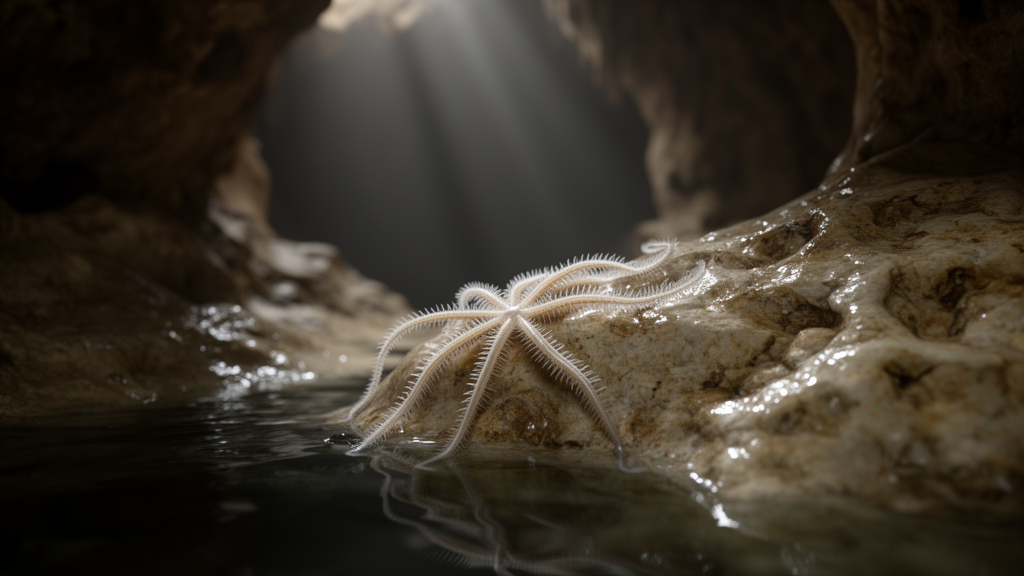
A newly detailed study of Amphicutis stygobita, the world’s first known cave-dwelling brittle star, offers a fascinating glimpse into how life adapts to extreme subterranean environments. Found only in two anchialine caves on San Salvador Island in The Bahamas, this tiny echinoderm has evolved a suite of unusual traits that allow it to thrive in the dark, brackish waters of Bernier Cave and Lighthouse Cave. Published in the journal Subterranean Biology, the research provides the first comprehensive look at the species’ feeding habits, reproductive strategies, and skeletal morphology, revealing a creature that defies many expectations of its deep-sea and surface-dwelling relatives.
Amphicutis stygobita is remarkably small, with adults possessing a central disk diameter of only 3 to 4 millimeters and arms extending to just 10 millimeters. Its lack of body pigment helps it blend seamlessly into the detritus-rich substrate of its cave home, making it difficult to spot even with underwater flashlights. The study highlights that this species is a microphagous deposit feeder, surviving exclusively on energy-rich detritus that falls into the cave from the surface. This detritus contains algae, bacteria, invertebrates, and a sticky biofilm rich in extracellular polymeric substances, which provides a crucial energy source in an environment devoid of photosynthesis.
One of the most striking findings from the research involves the brittle star’s skeletal structure, which has been significantly modified to conserve energy. Scanning electron microscopy revealed that the internal skeletal elements, or ossicles, are highly fenestrated, featuring a net-like lattice of bone with large open spaces. This reduction in skeletal density is likely a response to the cave’s low salinity, which ranges from 14 to 28 parts per thousand, reducing ionic precipitation and resulting in lighter, less calcified bones. This paedomorphic trait, where adult animals retain juvenile characteristics, allows the brittle star to avoid the energetic costs of producing and maintaining a heavy, fully developed skeleton.
The reproductive biology of Amphicutis stygobita is equally unusual, as the species is a hermaphroditic brooder. While most brittle stars release larvae into the water column, this cave species retains its offspring within the ovaries until they are ready to emerge. In captivity, researchers observed three babies born over a period of several weeks in 2018. These newborns were tiny, with disk diameters of approximately 0.8 millimeters, and possessed only two arm segments per arm. Their development was slow, with the longest-lived baby growing only slightly over a period of 14.5 months, adding just one additional arm segment. This slow growth rate mirrors the extremely slow regeneration rate observed in adults, which is about one percent of the average rate for other brittle star species.
The feeding behavior of the cave brittle star is adapted to its specific dietary needs. Unlike many of its relatives that use complex mouthparts to filter or grasp food, A. stygobita has reduced and highly variable oral structures. It feeds by pulling soft detritus directly into its mouth using tube feet, without chewing or filtering. The sticky nature of the detritus, held together by extracellular polymeric substances produced by diatoms and bacteria, makes it easier to consume with these simplified mouthparts. This adaptation further supports the hypothesis that paedomorphy is an energy-saving strategy, as the animal does not need to invest resources in developing complex feeding apparatuses for soft, energy-rich food.
Comparisons with other cave-dwelling brittle stars reveal that A. stygobita exhibits a more extensive set of troglomorphisms, or cave adaptations, than recently described species from Japan, Mexico, and Christmas Island. While other cave species may have elongated arms or reduced pigmentation, they often retain normal skeletal density and mouth structures. The unique combination of low salinity, abundant detritus, and reduced predation pressure in Bernier Cave appears to have driven the evolution of these extreme adaptations in A. stygobita. The cave’s large ceiling entrance allows sunlight to reach the water, promoting the growth of algae and the accumulation of organic matter, which sustains the brittle star population.
The study also challenges previous taxonomic classifications by providing evidence that two deep-sea species, Amphilepis patens and Amphilepis platytata, should be recognized as distinct rather than synonyms. Scanning electron microscopy images showed clear differences in their oral frames, tentacle scales, and vertebral structures, contradicting earlier assumptions that their variations were due to growth stages. This taxonomic clarification is important for understanding the evolutionary relationships within the family Amphilepididae, which includes A. stygobita and several deep-sea relatives.
Despite its specialized adaptations, Amphicutis stygobita does not appear to be endangered. Access to Bernier Cave is limited, and conservation efforts by the Gerace Research Centre help protect the habitat from disturbance. The species’ ability to survive in captivity using only cave detritus offers hope for future research into its biology and ecology. As scientists continue to explore subterranean habitats, the discovery of A. stygobita highlights the incredible diversity of life in the deep places of the Earth, where evolution takes unexpected turns to meet the challenges of survival.
This research underscores the importance of studying cave ecosystems, which are often overlooked in broader ecological surveys. The paedomorphic traits of A. stygobita provide a model for understanding how energy conservation drives morphological evolution in low-nutrient environments. By retaining juvenile features, the brittle star optimizes its resource allocation, ensuring its survival in a niche where food is scarce but sufficient. As climate change and human activity continue to impact marine environments, understanding the resilience of such specialized species may offer insights into the broader dynamics of ecological adaptation and conservation.
Subject of Research: Morphology and ecology of the cave-dwelling brittle star Amphicutis stygobita
Article Title: Amphicutis stygobita ( Echinodermata , Ophiuroidea , Amphilepidida , Amphilepididae ), a brooding brittle star from anchialine caves in The Bahamas: feeding, reproduction, morphology, paedomorphisms and troglomorphisms
Article References: Carpenter, J. H. (2025). Amphicutis stygobita (Echinodermata, Ophiuroidea, Echinodermata, Amphilepididae), a brooding brittle star from anchialine caves in The Bahamas: feeding, reproduction, morphology, paedomorphisms and troglomorphisms. Subterranean Biology, 51, 147-196. https://doi.org/10.3897/subtbiol.51.152663
Image Credits: AI Generated
DOI: 10.3897/subtbiol.51.152663
Keywords: Amphicutis stygobita, brittle stars, cave ecology, paedomorphy, anchialine caves, The Bahamas, Subterranean Biology, echinoderms, troglomorphisms, marine biology, Amphicutis, stygobita
News Source: Gavin Prescott. (October 18, 2026). Cave Brittle Star Reveals Energy-Saving Evolution. Scienmag.