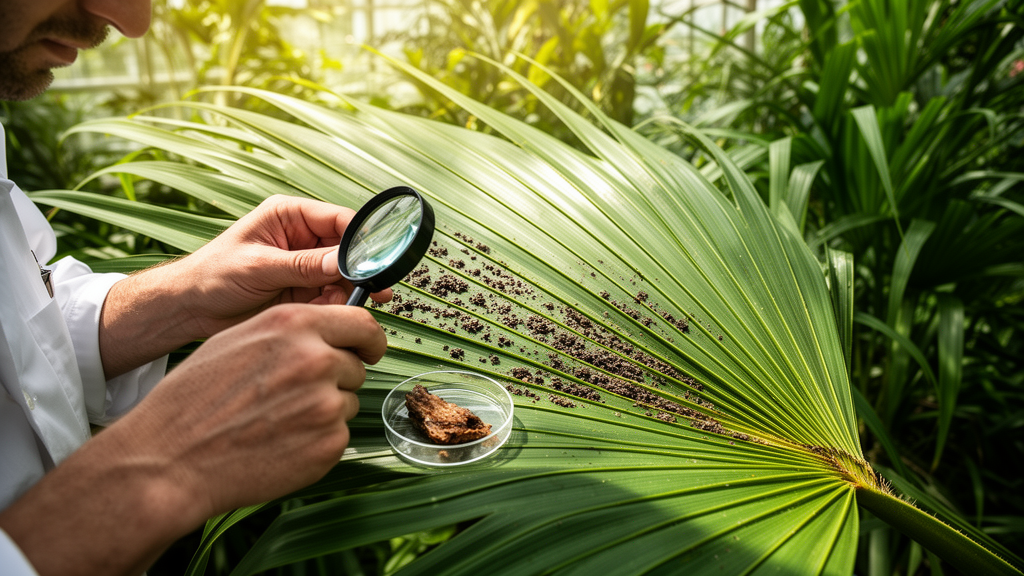
Researchers have identified two previously unknown species of fungi associated with palm plants in southwestern China, adding to the growing catalog of microbial life linked to these ornamental hosts. The discovery, published in the journal MycoKeys, highlights the persistent biodiversity hidden within the tissues of plants that are widely cultivated for their aesthetic value. The two new species, designated as Scolecobasidium yunnanense and Yunnanomyces didymosporus, belong to the family Sympoventuriaceae and were isolated from senescent fronds collected at the Xishuangbanna Tropical Botanical Garden in Yunnan Province. This finding underscores the importance of tropical regions in harboring cryptic fungal diversity that remains largely uncharacterized despite the global prominence of palm cultivation.
Palm plants, classified under the family Arecaceae, are globally distributed ornamental hosts with approximately 2,600 recognized species. While these plants are economically significant and widely planted in southern China, the majority of cultivated taxa are exotic introductions. Estimates suggest that around 76,000 fungal species are associated with palm hosts worldwide, yet fewer than 2,500 have been formally described. This vast gap between estimated and documented diversity indicates that many fungal lineages remain undiscovered, particularly in regions where palms are heavily cultivated but microbial surveys have been limited. The current study addresses this knowledge gap by examining the microfungal communities present on dead leaves of specific palm species in Yunnan.
The genus Scolecobasidium, established in 1927, is the largest genus within the family Sympoventuriaceae, with over 100 records listed in Index Fungorum. Members of this genus are characterized by reduced, unbranched or rarely branched conidiophores and dark conidia. The taxonomic history of the genus has been complex, with the synonym Ochroconis previously used to accommodate species with unbranched conidia. Recent molecular phylogenetic analyses have consolidated these taxa, confirming that Ochroconis is a synonym of Scolecobasidium. The new species, Scolecobasidium yunnanense, is distinguished by its branched, septate, thick-walled hyphae and smooth, mostly two-septate conidia measuring 8.3 to 12.6 by 2.0 to 3.5 micrometers. Its conidiophores are often reduced to denticulate conidiogenous cells, a feature that helps differentiate it from other members of the genus.
The second new species, Yunnanomyces didymosporus, belongs to the genus Yunnanomyces, which was established in 2018. This genus is typically associated with monocotyledonous plants, including palms, and is characterized by mononematous conidiophores and conidia that are often muriform or arranged in chains. Yunnanomyces didymosporus is notable for its monilioid mature hyphae and intercalary conidiogenous cells. Its conidia are mostly one-septate, forming chains of up to eight spores, and feature a dark hilum on one or both ends. The conidia measure 6.1 to 11.9 by 2.0 to 4.2 micrometers. The etymology of the name refers to the predominantly two-celled nature of its conidia, distinguishing it from other species in the genus that typically produce muriform or subglobose spores.
The isolation of these fungi involved rigorous field surveys and laboratory protocols. Samples were collected from senescent fronds, including leaves and petioles, in November 2024. After rinsing and air-drying, the leaves were placed in Petri dishes with moistened filter paper and incubated at 25 degrees Celsius with 75 percent relative humidity. Mycelia and fruiting bodies that emerged were isolated onto potato dextrose agar plates using the three-zone streaking method to obtain pure cultures. This method ensures that the resulting isolates are free from contaminating organisms, allowing for accurate morphological and genetic characterization. The pure cultures were then grown under controlled conditions to facilitate detailed microscopic observation.
Morphological characterization was conducted using slide culture methods to ensure clear visibility of fungal structures. Observations were performed using Zeiss stereo and fluorescence microscopes, with structures mounted in distilled water. Reproductive structures were examined using a compound microscope with differential interference contrast (DIC) optics. Sixty measurements were obtained for each morphological structure to provide robust statistical data. The color of the colonies and structures was determined using standard mycological color charts. For Scolecobasidium yunnanense, colonies on potato dextrose agar reached 2.48 to 2.6 centimeters in diameter after 15 days, appearing smooth to felty with a grayish-brown to dark-brown surface. Conidia were visible on the culture surface as early as the fifth day post-inoculation.
Phylogenetic analyses were performed using multi-locus DNA datasets to confirm the distinctiveness of the new species. For Scolecobasidium, a concatenated dataset comprising the internal transcribed spacer (ITS), nuclear large subunit (nLSU), beta-tubulin (tub2), and translation elongation factor 1-alpha (tef1-alpha) genes was used. The analysis included 78 strains representing 57 species. Maximum Likelihood and Bayesian Inference methods were employed, with the new species forming a robust, well-supported monophyletic lineage with 100 percent bootstrap support and 1.00 Bayesian posterior probability. It was found to be closely related to Scolecobasidium leishanicola, together forming a strongly supported clade. This phylogenetic placement confirms that the new species is distinct from all previously known members of the genus.
For Yunnanomyces, a combined dataset of ITS, nLSU, nuclear small subunit (nrSSU), and RNA polymerase II second largest subunit (RPB2) genes was analyzed. The dataset comprised 65 strains representing 51 species. The new species, Yunnanomyces didymosporus, formed a fully supported unique lineage sister to Yunnanomyces hagahagaensis. Sequence divergence analysis revealed a difference of 17 base pairs in the ITS region between the new species and its closest relative, with a divergence rate exceeding 2 percent. This level of genetic differentiation, combined with morphological differences such as conidia size and septation, supports the recognition of Yunnanomyces didymosporus as a distinct species. The phylogenetic results align with previous studies that have supported the monophyly of Yunnanomyces within the family Sympoventuriaceae.
The discovery of these two new species contributes to the understanding of microfungal diversity associated with palms in tropical regions. Yunnan Province is a recognized hotspot for fungal diversity due to its unique topography, climate gradients, and preserved vegetation. The presence of these fungi on dead leaves suggests that they may play roles as saprobes or potential pathogens, although their ecological impact requires further investigation. Palm-associated fungi fulfill various ecological functions, including decomposing dead litter, acting as beneficial endophytes, or causing diseases. The identification of new species from ornamental hosts highlights the need for continued surveillance of plant health in cultivated environments. As global trade and cultivation of exotic plants increase, the potential for introducing and establishing new fungal lineages also rises, making comprehensive biodiversity assessments essential for managing plant health and ecosystem stability.
Subject of Research: Discovery of two novel Sympoventuriaceae fungal species from palms in China
Article Title: Two novel species of Sympoventuriaceae from palms in China
Article References: Zhang, Q.-Y., Cao, Y.-H., Sun, H., Zhou, L., Huang, L., Tan, Y.-H., Li, D.-W., & Zhu, L.-H. (2026). Two novel species of Sympoventuriaceae from palms in China. MycoKeys, 138, 35-56. https://doi.org/10.3897/mycokeys.138.200127
Image Credits: AI Generated
DOI: 10.3897/mycokeys.138.200127
Keywords: mycology, fungal taxonomy, Sympoventuriaceae, palm plants, biodiversity, phylogenetics, Yunnan Province, microfungi, novel, species, palms, China
News Source: Roger Howard. (October 18, 2026). Two New Fungal Species Discovered on Palms in China. Scienmag.