Every day, India’s cities generate roughly 170,000 tonnes of municipal solid waste, yet barely half of it is processed before the rest piles up in landfills or open dumps. A new open-access study from Banaras Hindu University suggests that a large share of that urban refuse could be transformed into a genuine agricultural resource. Researchers report that composted municipal solid waste, applied together with modest amounts of poultry manure, lifted spinach yields by as much as 62.5 percent in a controlled pot experiment, while simultaneously enriching the soil with organic carbon, macronutrients, and micronutrients. The findings, published in Discover Soil, position integrated organic amendments as a technically credible alternative to chemical fertilizers in leafy vegetable production, provided heavy metal loading is carefully managed.
The experiment, conducted at the university’s Institute of Agricultural Sciences in Varanasi, focused on an Inceptisol, one of the soil orders that dominates the Indo-Gangetic alluvial plains. Surface soil from the top 15 centimeters was collected, air-dried, ground, and sieved to two millimeters before being homogenized and distributed into 21 polythene-lined earthen pots, each holding 10 kilograms. The researchers then tested seven treatments in a completely randomized design with three replications: a control with no amendments, municipal solid waste compost at 20, 30, and 40 tonnes per hectare applied alone, and the same three compost rates each supplemented with poultry manure at 5 tonnes per hectare. Spinach, variety Kashi Baramasi, was sown in November 2024 and harvested roughly 50 days later, a short growth cycle that makes the crop an ideal biological probe for nutrient availability and amendment efficiency.
The chemical logic behind the combination is complementary rather than redundant. Analysis of the two amendments revealed that composted municipal solid waste contained 1.00 percent nitrogen, roughly double the 0.50 percent found in poultry manure, but poultry manure was markedly richer in phosphorus at 2.26 percent versus 0.71 percent, and in sulphur at 1.13 percent versus 0.27 percent. Poultry manure also carried higher concentrations of zinc, iron, and manganese. In practice, this means the compost supplies a slow-release nitrogen reserve while the manure delivers immediately available phosphorus and trace elements, creating what the authors describe as a dual mechanism of short-term and long-term fertility benefits.
The morphological and physiological responses of the spinach were striking. Plants receiving the highest combined treatment, 40 tonnes per hectare of compost plus 5 tonnes per hectare of poultry manure, reached an average height of 29.48 centimeters at 50 days after sowing, compared with 22.55 centimeters in the control, a 30.8 percent increase. Leaf number rose by 35.6 percent, the leaf area index climbed by 51.2 percent to 2.30, and chlorophyll content measured with a SPAD meter increased by 10.9 percent. Because nitrogen is a structural component of the chlorophyll molecule, the elevated SPAD readings point directly to improved nitrogen uptake and photosynthetic efficiency under the integrated regime.
Yield and biomass data confirmed the visual gains. Fresh shoot weight per pot increased from 48.03 grams in the control to 78.10 grams under the best treatment, while dry weight rose from 3.52 to 5.96 grams, a 69.3 percent enhancement. Expressed on a field basis, the top treatment produced 17.49 tonnes of spinach per hectare against 10.76 tonnes in the control. Notably, all three combination treatments were statistically on par, meaning the 30-tonne compost rate supplemented with poultry manure achieved nearly identical productivity with a lower compost dose, a detail with practical relevance for farmers weighing cost against heavy metal risk.
Nutrient uptake told an even more dramatic story. Leaf nitrogen concentration increased from 0.47 percent in the control to 1.45 percent under the best treatment, and total nitrogen uptake per pot rose more than fivefold, a 426 percent increase. Phosphorus content peaked at 0.45 percent with uptake of 2.82 grams per pot, while potassium showed the largest relative gain of all, with leaf content reaching 4.23 percent and uptake climbing 190 percent to 25.20 grams per pot. The authors attribute the potassium surge to improved root development, enhanced cation exchange capacity, and better nutrient solubilization in the amended soils.
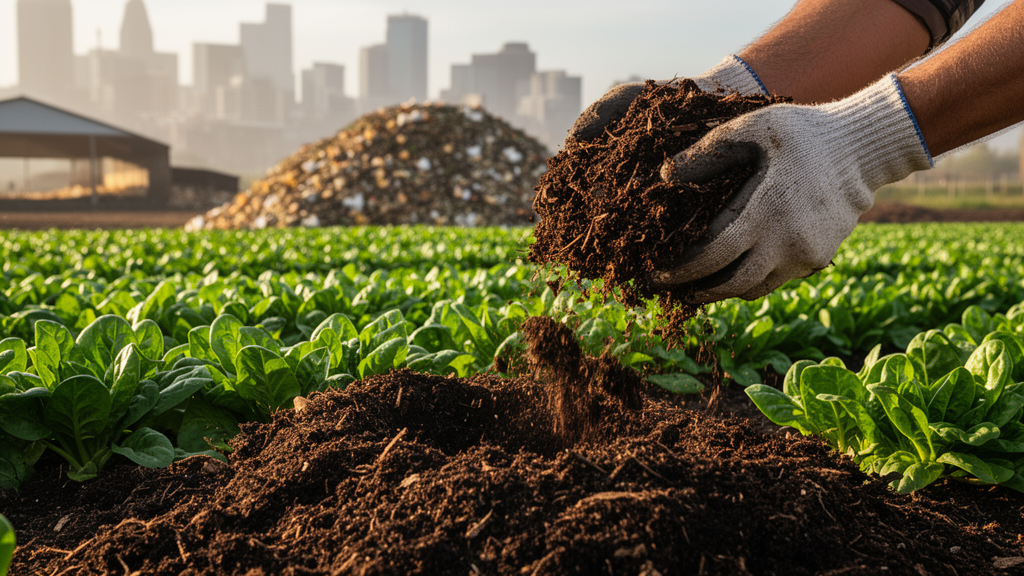
The soil itself was transformed. Organic carbon, initially a meager 0.76 percent, reached 2.79 percent under the highest combined treatment, while available nitrogen rose from 48.53 to 70.43 milligrams per kilogram, available phosphorus from 25.59 to 43.99 milligrams per kilogram, and available potassium nearly doubled to 195.88 milligrams per kilogram under the 30-tonne compost treatment. Micronutrient availability improved in parallel, with DTPA-extractable zinc rising from 1.09 to 3.57 milligrams per kilogram and iron from 11.52 to 15.90 milligrams per kilogram. Dehydrogenase activity, a widely used proxy for total microbial respiration and soil biological vitality, increased with every increment of compost and manure, reaching its maximum under the highest combined dose.
Heavy metals are the study’s central caveat. DTPA-extractable chromium, nickel, cadmium, and lead remained low under the control and moderate treatments, but significant increases appeared under the 40-tonne-per-hectare compost treatments, whether applied alone or with poultry manure. Lead concentrations, for example, reached 3.80 milligrams per kilogram under the top treatment compared with 1.26 milligrams per kilogram in the control, and cadmium and nickel rose nearly threefold at the highest compost rate. All measured values stayed within the permissible limits set by FAO and WHO standards and European Commission guidelines for agricultural soils, and post-harvest analysis confirmed that metal accumulation in the crop itself remained well below phytotoxic thresholds. Still, the authors warn that continuous application at rates of 40 tonnes per hectare or higher could drive gradual metal buildup that threatens long-term soil health and food chain safety.
The broader implications reach well beyond a single pot experiment. India’s Central Pollution Control Board reports that about 51.3 percent of the country’s municipal solid waste is biodegradable and compostable, meaning that diverting this stream into agriculture addresses two problems at once: landfill pressure and greenhouse gas emissions from decomposing organic waste, and the steady depletion of soil organic matter that undermines fertility across tropical farming systems. Composting also transforms labile organic nitrogen into more stable, gradually mineralized forms, and the resulting near-neutral pH and acceptable electrical conductivity make the finished product suitable for most crops. Previous long-term studies cited by the team have documented yield improvements of up to 250 percent under continuous organic amendment, along with enhanced water retention, aggregate stability, and carbon sequestration.
The researchers are careful to frame their conclusions within the limits of the design. The experiment ran for one season in a controlled net-house environment, so repeated applications across multiple cropping cycles, field-scale validation across diverse agro-climatic zones, and comprehensive monitoring of trace metal bioavailability remain necessary before the approach can be recommended as standard practice. They also call for cost-benefit analyses to assess farmer adoption potential and for standardized composting techniques that minimize heavy metal content given the regional heterogeneity of municipal waste. Within those boundaries, the study offers a technically coherent pathway: moderate compost doses supplemented with poultry manure can sustain high spinach productivity, rebuild soil fertility, and recycle urban waste, all while regular soil monitoring keeps the heavy metal question firmly under control.
Subject of Research: Integrated use of municipal solid waste amendment with poultry manure for enhancement of soil nutrient status and productivity of spinach (Spinacea oleracea L.) in Inceptisol
Article Title: Integrated use of municipal solid waste amendment with poultry manure for enhancement of soil nutrient status and productivity of spinach (Spinacea oleracea L.) in Inceptisol
Article References: Banerjee, S., Singh, Y. V., Bharteey, P. K., Singh, R., Kumar, S. B., & Singh, K. (2026). Integrated use of municipal solid waste amendment with poultry manure for enhancement of soil nutrient status and productivity of spinach (Spinacea oleracea L.) in Inceptisol. Discover Soil, 3(1), 190. https://doi.org/10.1007/s44378-026-00350-6
Image Credits: AI Generated
DOI: 10.1007/s44378-026-00350-6
Keywords: municipal solid waste compost, poultry manure, spinach, soil fertility, organic amendments, Inceptisol, nutrient uptake, heavy metals, sustainable agriculture, circular economy, soil organic carbon, waste recycling
News Source: Alan Morgan. (October 18, 2026). City Waste Compost and Poultry Manure Boost Spinach Yields by 62 Percent. Scienmag.