Deep in the semi-evergreen forests of Tamhini Ghat in Maharashtra’s Western Ghats, a decaying twig collected on 5 August 2023 has yielded a fungus that rewrites a tangled chapter of fungal classification. In a study published in MycoKeys, researchers at the Agharkar Research Institute in Pune, working with international collaborators, describe Rostriconidium synnematicum sp. nov., formally reinstate the genus Rostriconidium within the family Torulaceae, and establish an entirely new family, Sporidesmioidesaceae fam. nov., to accommodate the enigmatic monotypic genus Sporidesmioides. The work, grounded in a five-locus phylogenetic framework, exposes how superficially identical asexual morphs can conceal lineages separated by hundreds of millions of years of evolution, and it delivers a pointed warning about synonymies proposed without molecular evidence from type specimens.
Pleosporales is the largest order within the class Dothideomycetes, accounting for roughly 34 percent of dothideomycetous fungi. According to recent estimates cited in the study, the order encompasses 92 families and about 591 genera, a number that has since risen with the introduction of Megacapitulaceae and Mangifericomitaceae. Its members are cosmopolitan, occurring as epiphytes, saprobes, endophytes, parasites, pathogens, hyperparasites of fungi and insects, and even lichenised forms. Within this sprawling order sits Torulaceae, described by Corda in 1829 with Torula as its type genus, currently comprising seven genera including the dark-spored, rostrate-conidial genus Rostriconidium established by Su and colleagues in 2018 with R. aquaticum as the type species. The genus Sporidesmioides, introduced by Li and colleagues in 2016 with S. thailandica as its type, was initially placed within Torulaceae on the basis of combined LSU, SSU, tef1-α and rpb2 sequence data, but subsequent analyses with broader taxon sampling revealed it forming a distinct clade basal to Roussoellaceae and Thyridariaceae, separate from Torulaceae proper.
The taxonomic chaos in this group traces largely to a 2022 preprint by Qiu and colleagues, which was never validly published under the International Code of Nomenclature for algae, fungi, and plants. That work synonymised both Rostriconidium and Sporidesmioides under the older genus Neopodoconis based purely on morphological resemblance, relying on phylogenetic inferences drawn solely from combined LSU and SSU loci. Wang and colleagues accepted those proposals in 2023 despite the preprint’s invalid status and introduced Neopodoconis yunnanensis, revealing two phylogenetically unrelated clades masquerading under one generic name: one grouping within Torulaceae with Rostriconidium, the other placed outside the family alongside Sporidesmioides. Li and colleagues in 2024 confirmed this separation and tentatively resurrected both Rostriconidium and Sporidesmioides pending type-based resolution of Neopodoconis. Compounding the confusion, Koukol and Delgado in 2021 synonymised Pseudohelminthosporium clematidis with Neopodoconis ampullacea and placed Neopodoconis within Neomassarinaceae, a treatment based entirely on morphological comparison of type material without any phylogenetic support.
The new Indian collection was isolated from decaying litter during post-monsoon surveys of lignicolous microfungal diversity. Conidia were picked directly from an unidentified decaying twig and single-conidial cultures established on 2 percent malt extract agar. Morphological observations combined light microscopy with scanning electron microscopy, with synnemata and conidia gold-palladium sputter-coated for SEM imaging on a Carl Zeiss EVO 50. Thirty measurements were taken per structure, mounted in lactic acid and cotton blue. Genomic DNA was extracted from two-week-old colonies, and four loci were amplified and sequenced bidirectionally: the 5′ ends of the 28S large subunit and 18S small subunit nuclear ribosomal RNA genes, plus the protein-coding partial rpb2 (RNA polymerase II second largest subunit) and tef1-α (translation elongation factor 1-alpha) regions. Notably, repeated attempts to amplify the internal transcribed spacer region failed for the new species, a technical limitation the authors candidly acknowledge.
Two concatenated datasets were assembled and aligned with MAFFT v. 7.453 using the G-INS-i option, then manually curated in BioEdit to remove ambiguously aligned regions. Dataset 1, addressing familial relationships across Pleosporales, comprised 4,382 characters for 300 strains plus outgroups from Tubeufiales, yielding a maximum likelihood tree with a log-likelihood of -154487.525 under the GTR+F+R8 model selected by ModelFinder on the Bayesian Information Criterion. Dataset 2, resolving relationships within Torulaceae, comprised 5,148 characters for 63 strains, analysed under the TIM2+F+I+G4 model with a log-likelihood of -27071.853. Maximum likelihood analyses ran in IQ-TREE v. 3.0.1 with 1,000 non-parametric bootstrap replicates, while Bayesian posterior probabilities were estimated in MrBayes v. 3.2.7a across two parallel runs of four chains each for up to 100 million generations, discarding the first 25 percent of sampled trees as burn-in. Gene and site concordance factor analyses were additionally conducted to evaluate phylogenetic congruence among loci.
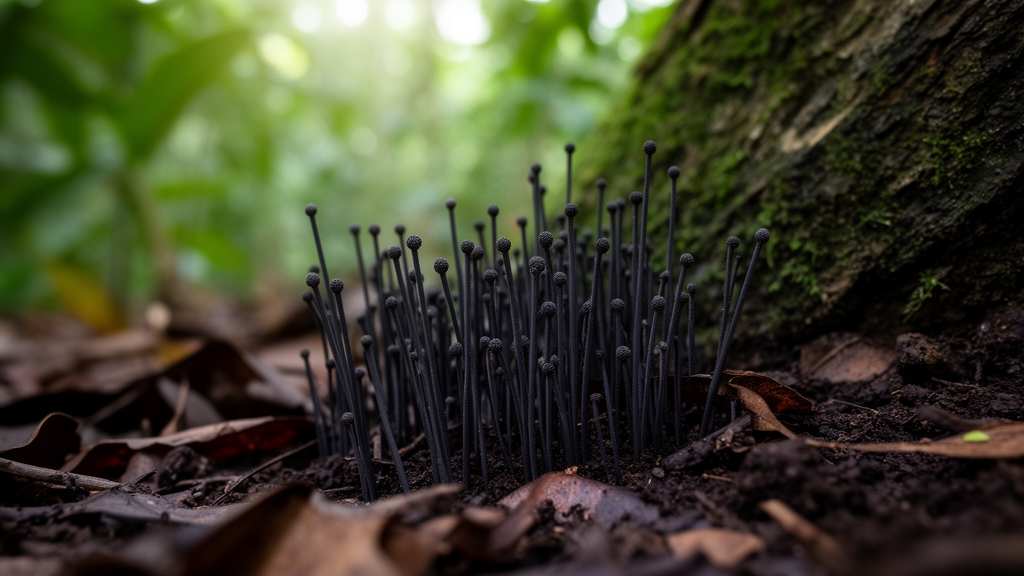
The phylogenetic verdict was unambiguous. Rostriconidium synnematicum, strain AMH 10845, formed a sister lineage to all other accepted Rostriconidium species within Torulaceae with maximal statistical support (ML-BS = 100 percent, BY-PP = 1.00), clustering with R. aquaticum, R. cangshanense, R. pandanicola and R. yunnanensis in a strongly supported clade. The new species is the only synnematous member of the genus, producing dark brown to black unbranched synnemata measuring 720–1450 × 8.2–17.5 μm, with enteroblastic, monotretic or polytretic conidiogenous cells and solitary conidia of 44–70 × 13–22 μm bearing 4–6 septa, dark bands at the septa and a black truncate basal scar. Its conidia are the smallest reported in the genus, and MegaBLAST searches placed its SSU sequences closest to R. aquaticum at 99 percent identity. The species name refers directly to its synnematous habit, and the holotype AMH 10845 is deposited in the Ajrekar Mycological Herbarium with the ex-type living culture NFCCI 6243 preserved at the National Fungal Culture Collection of India.
Equally consequential is the establishment of Sporidesmioidesaceae, a monotypic new family registered as IF904794, to accommodate Sporidesmioides thailandica, known only from its asexual morph on the stem of a dead herb in Chiang Rai Province, Thailand. In the order-level analyses spanning 93 families, S. thailandica formed a distinct lineage basal to Roussoellaceae, Thyridariaceae and Torulaceae with 99 percent bootstrap support, substantiating earlier placements by Wang and colleagues and Li and colleagues. Morphologically, the family differs fundamentally from Torulaceae in its mode of conidiogenesis, which is strictly polyblastic, whereas Rostriconidium and Neopodoconis exhibit mono- or polytretic conidiogenesis. Sporidesmioidesaceae produces erect, cylindrical, unbranched conidiophores arising from a stromatic base, with solitary ampulliform to obclavate conidia, contrasting with the branched chains of subcylindrical conidia typical of Torulaceae, and it lacks the well-developed sexual morphs and coelomycetous asexual morphs characteristic of Roussoellaceae and Thyridariaceae.
The study also reinstates the genus Pseudohelminthosporium, originally introduced by Phukhamsakda and colleagues in 2020 within Neomassarinaceae, and rejects the synonymisation of P. clematidis under Neopodoconis ampullacea proposed by Koukol and Delgado in 2021. Their conclusion rested on morphological resemblance alone, without molecular data from the type materials of either taxon, and the type strain of N. ampullacea remains unavailable, rendering the congeneric status speculative. In the order-level phylogeny, P. clematidis strain MFLUCC 17-2086 formed a separate lineage basal to Neomassarinaceae with 99 percent bootstrap support and full Bayesian posterior probability. Re-examination of the type specimen MFLU 17-1494 also revealed a discrepancy in the original description: conidial septation is amended to 3–12-euseptate rather than the originally reported 3–5-euseptate. The authors additionally propose the new combination Rostriconidium yunnanensis, transferring Neopodoconis yunnanensis of Wang and colleagues into Rostriconidium based on multigene phylogeny, and they correct an anomaly in the published descriptions of R. cangshanense, R. pandanicola and R. yunnanensis, whose photoplates clearly show enteroblastic, monotretic or polytretic conidiogenesis despite original descriptions incorrectly citing monoblastic or polyblastic modes.
Ecologically, the new species marks the first report of Rostriconidium from terrestrial habitat in the Western Ghats; all previously known species were described from Yunnan Province, China, isolated from decaying plant litter in freshwater and terrestrial environments. Phylogenetically, Sporidesmioidesaceae joins a cluster of related Pleosporales families with contrasting ecologies: Torulaceae species function as saprobes on submerged wood, dead branches and herbaceous litter worldwide, with some reported as opportunistic pathogens of plants and humans; Roussoellaceae, with 12 genera, predominantly inhabits woody substrates including bamboo and palms, rarely reported as a human pathogen; and Thyridariaceae, with nine genera, extends into marine and semi-marine environments exemplified by the genus Thyridariella. The authors do not recognise the five species introduced in the invalid Qiu preprint, noting that Articles 29.1 and 32.1(c) of the ICNafp mandate effective publication in a journal with an ISSN and registration of fungal names in recognised repositories such as Index Fungorum or MycoBank, requirements the preprint failed to meet.
The findings underscore a critical principle in modern mycology: morphological characters alone are insufficient for reliable delimitation at generic or species level when character overlap is significant, and synonymy among cryptic genera must be validated through multi-locus sequence analysis of type specimens before being proposed. The authors acknowledge limitations, including unamplified ITS regions, unavailable sexual morphs for most taxa, geographically restricted sampling, and historically complex species complexes whose type material was inaccessible or not re-sequenced. Future work should prioritise expanded biogeographic sampling, sequencing of type and epitype material, incorporation of sexual morph data, and genome-scale phylogenomic approaches to clarify deeper evolutionary relationships within Pleosporales, especially among morphologically convergent and polyphyletic genera. The study also revalidated the placement of the recently proposed family Megacapitulaceae within Pleosporales, providing multigene sequence information whose GenBank accession numbers were inadvertently omitted from the original publication in Kavaka.
Subject of Research: Mycology
Article Title: Phenotypic plasticity and cryptic generic enigma in Pleosporales : Establishing Sporidesmioidesaceae fam. nov. and Rostriconidium synnematicum sp. nov. from India
Article References: Paraparath, S. O., Rajeshkumar, K. C., Siddiqui, S., Chandran, D., Phookamasak, R., Li, J., Wijayawardene, N. N., Verma, R. K., Karunarathna, S. C., Tibpromma, S., Gautam, A. K., Kapoor, R., Suwannarach, N., & Jeewon, R. (2026). Phenotypic plasticity and cryptic generic enigma in Pleosporales: Establishing Sporidesmioidesaceae fam. nov. and Rostriconidium synnematicum sp. nov. from India. MycoKeys, 138, 1-33. https://doi.org/10.3897/mycokeys.138.184414
Image Credits: AI Generated
DOI: 10.3897/mycokeys.138.184414
Keywords: Mycology, Taxonomy, Phylogenetics, Pleosporales, Fungi, Biodiversity, Phenotypic, plasticity, cryptic, generic, enigma, Establishing
News Source: Roger Howard. (October 18, 2026). New fungal family and synnematous species from India untangle a cryptic Pleosporales enigma. Scienmag.