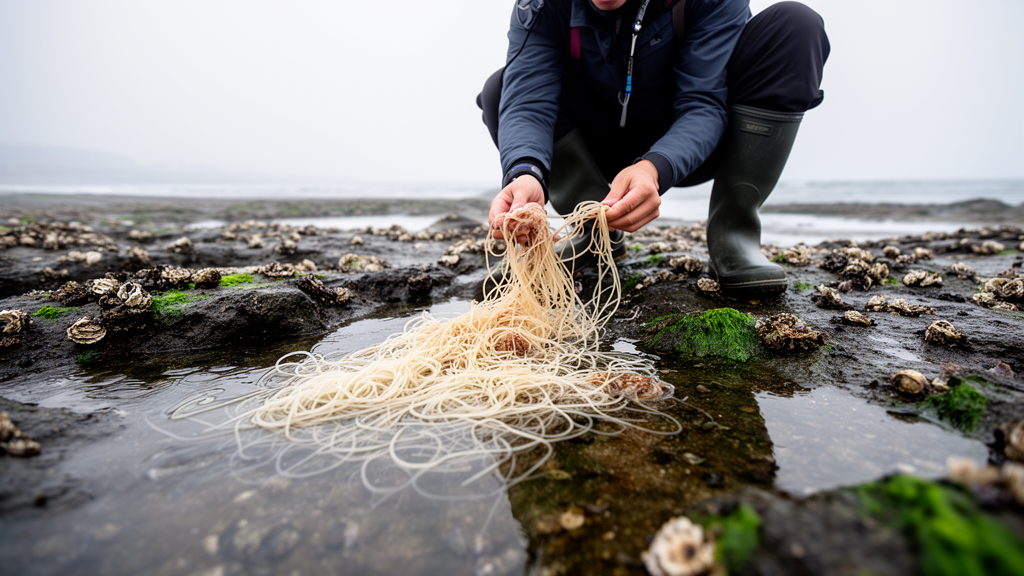
On the intertidal rocks of Qingdao, a city on China’s northeastern coast best known for its beaches and beer, scientists have pulled a new species of marine worm out of the tide pools. The animal belongs to the family Terebellidae, a group of tubicolous annelids often called spaghetti worms for the tangle of grooved feeding tentacles they spread across the sediment. Described in the journal Zoosystematics and Evolution as Nicolea qingdaoensis sp. nov., the species is only the second member of its genus ever recorded in Chinese waters, and it arrives with an unusually complete scientific dossier: detailed morphology, DNA sequences from five genes, and the entire mitochondrial genome.
Terebellids are sedentary polychaetes that build protective tubes from sand, gravel and shell fragments and feed by extending a crown of long, ciliated tentacles over the surrounding substrate. The genus Nicolea, erected by Malmgren in 1866, currently contains 30 accepted species distributed from Sweden and the Mediterranean to Australia, New Zealand and the Malay Archipelago. Twelve of those species have type localities in the Western Pacific, yet until now only one, Nicolea sinensis, described by Fauvel in 1932 from Yantai, had been documented along the Chinese coast. That scarcity says less about the worms than about how little the region’s terebellid fauna has been studied; the authors of the new paper describe their find as the tip of an iceberg.
Between 2024 and 2025, the research team collected 19 specimens from three intertidal sites around Qingdao: the rocky shore near the new Zhanqiao Pier, known locally as the Deep Blue Light, plus Hongshiya and Haizhifeng. The worms live in sturdy tubes built of sand grains and shell debris, and in life they are salmon, yellow or reddish with white pigment, fading to yellowish-white or pale green in ethanol. The holotype, a complete female, measures 22 millimeters long and 1.5 millimeters wide across 61 body segments; paratypes range from 9 to 24 millimeters. Specimens were photographed alive, stained with methyl green, examined under stereomicroscope and scanning electron microscope, and deposited at the Marine Biological Museum of the Chinese Academy of Sciences.
What marks the animal as a Nicolea is a suite of shared traits: two pairs of arborescent, tree-like branchiae on segments 2 and 3, no lateral lobes, notopodia beginning on segment 4, neuropodia from segment 5, short-handled uncini, and both nephridial and genital papillae in the expected positions. What marks it as new is a combination of characters that no congener shares. It carries rows of eyespots on the prostomium. It has exactly 17 pairs of thoracic notopodia. Ventral shields run from segment 2 to segment 17 before giving way to a mid-ventral groove. Its uncini, the tiny hooked chaetiae that grip the tube, are arranged in completely intercalated double rows starting at segment 11, with a dental formula of 3 to 4 teeth above 2 to 3. And it bears two pairs of genital papillae on segments 6 and 7 that are strikingly sexually dimorphic: small spheres in females, finger-like projections in males.
That last character does much of the diagnostic work. Nicolea sinensis, the only previous Chinese record, has four pairs of genital papillae spanning segments 6 to 9, glandular in females and elongated in males, and a different uncinial formula. Because the type specimen of N. sinensis, held in Paris, was unavailable, the team re-examined museum specimens collected at Daheilan, Qingdao in 1964 and confirmed their identification against Fauvel’s original description. The comparison also revealed an ecological split: N. sinensis appears to be a subtidal species dredged from mud, while the new species lives on intertidal rocky shores. The authors caution that a definitive molecular comparison with fresh material from N. sinensis’s type locality remains a task for future work.
Distinguishing a species from its 29 relatives is one thing; placing it on the tree of life is another, and here the study makes its largest contribution. The genus Nicolea has long been a phylogenetic headache. Morphological analyses have variously recovered it as sister to the single-branched genus Ramex, grouped with Hadrachaeta and Laphania, or placed it as the earliest branching lineage of the subfamily Terebellinae. Molecular data were nearly nonexistent: only four cox1 sequences from identified Nicolea species had ever been deposited in GenBank, far too few for reliable species delimitation.
The team sequenced four specimens on a next-generation platform and assembled markers from five genes: cox1, 16S, 18S, 28S and histone H3, a concatenated dataset of 6,363 base pairs spanning 109 species in 31 genera, with three pectinariid worms as outgroups. Maximum likelihood and Bayesian analyses agreed. Nicolea emerged as a well-supported monophyletic clade within the tribe Lanicini, alongside genera such as Pista, Lanice and Lanicola. Within the genus, the new species sits as sister to a clade containing N. venustula from the Mediterranean, N. gracilibranchis from the Philippines and Hawaii, and an unidentified Nicolea from Redondo Beach, California, with strong statistical support.
The genetic distances back the morphology. Interspecific cox1 divergence across the genus ranges from 4.4 to 30.3 percent, while the four sequenced specimens of the new species differ from each other by only 0.9 to 1.8 percent. Against its closest sequenced relative, an unnamed Californian worm, the new species diverges by 11.4 percent. Nuclear 18S tells the same story, with divergences near 18 percent against N. zostericola and nearly 23 percent against a specimen labeled N. uspiana. That last result carries a warning the authors emphasize: the so-called N. uspiana sequence came from the Eastern Arabian Sea, thousands of kilometers from the species’ type locality in Brazil, and the phylogeny places it far from other Nicolea, close to Lanice instead. It is almost certainly misidentified.
This is the study’s quieter but arguably most consequential message. Sequences in public databases derived from specimens collected far from their type localities may not correspond to the species they claim to represent, and may even be undescribed species in disguise. The same doubt shadows records of N. zostericola from the United States, Canada and Germany, all geographically disjunct from the Swedish type locality and all landing in separate phylogenetic clades. The authors argue that future phylogenies should be built on voucher specimens verified against type material, with problematic sequences discarded and priority given to samples from or near type localities. In a genus where a single diagnostic character, the double rows of uncini, can start at segment 10 or 11 depending on the species, and where some assigned species, such as those with three pairs of branchiae, do not even fit the generic diagnosis, that kind of rigor is not pedantry. It is the difference between a tree and a tangle.
The new species also arrives with its complete mitochondrial genome, roughly 15,700 to 15,800 base pairs carrying 13 protein-coding genes and 23 transfer RNAs, including two trnM copies, with a gene order consistent with other terebellids apart from a transposition of two tRNAs. For a genus that had almost no molecular data a year ago, the package is remarkable: a new species, a mitochondrial genome, nuclear markers, and a phylogeny that finally anchors Nicolea within Lanicini. Given how little of China’s terebellid fauna has been formally catalogued, the rocky pools of Qingdao may hold considerably more surprises, and the authors plan to keep looking.
Subject of Research: Description of a new terebellid annelid species, Nicolea qingdaoensis, from Qingdao, China, with morphological diagnosis and multi-gene phylogenetic analysis
Article Title: A new species of Nicolea ( Annelida , Terebellidae ) from Qingdao, China
Article References: He, C., Hutchings, P., Sun, Y., & Zhang, Y. (2026). A new species of Nicolea (Annelida, Terebellidae) from Qingdao, China. Zoosystematics and Evolution, 102(2), 421-441. https://doi.org/10.3897/zse.102.182152
Image Credits: AI Generated
Keywords: Nicolea qingdaoensis, Terebellidae, polychaete, annelid, new species, Qingdao, taxonomy, mitochondrial genome, phylogenetics, cox1, marine biodiversity, China
News Source: Juliet Wilcox. (October 18, 2026). New Spaghetti Worm Species Unearthed on Qingdao’s Rocky Shores. Scienmag.