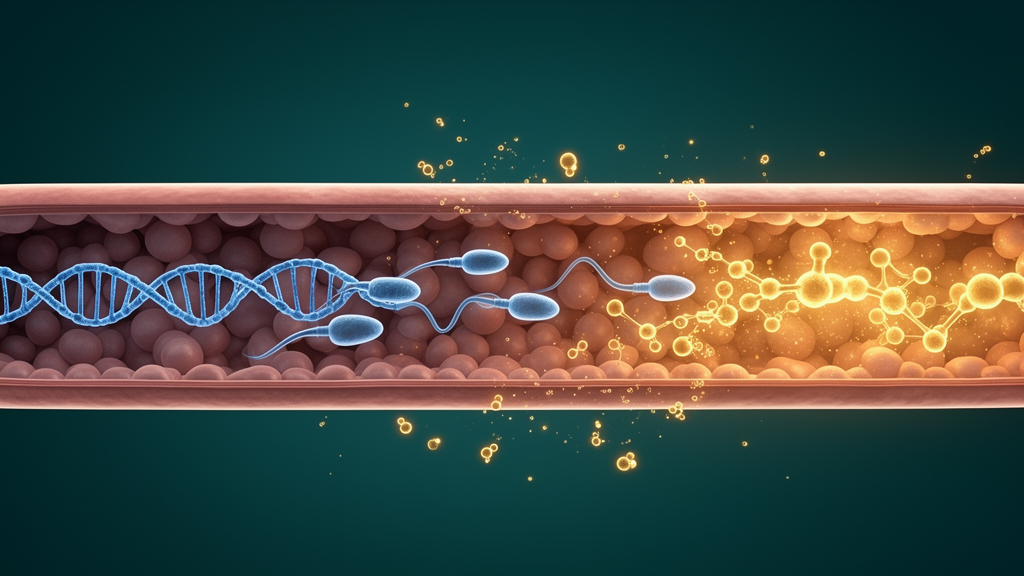
Male infertility has quietly become one of the defining reproductive health challenges of our time, affecting roughly 17.5 percent of couples of reproductive age worldwide, with male factors accounting for nearly half of all cases. Now, a team of researchers in China has uncovered a metabolic clue that may point toward a new therapeutic strategy. In a study published in iScience, investigators identified S-adenosylmethionine, or SAM, as a key molecule depleted in infertile men whose sperm carry high levels of DNA damage, and demonstrated in laboratory and animal models that supplementing this metabolite can restore sperm quality by reprogramming a fundamental antioxidant pathway inside the testes.
The research began with a deceptively simple question: what is biochemically different about the seminal plasma of men whose sperm show extensive DNA fragmentation? Sperm DNA damage, measured clinically as the DNA fragmentation index or DFI, is far more than a laboratory curiosity. Men with elevated DFI typically produce sperm with reduced motility and diminished capacity to penetrate the oocyte, leading to decreased chances of successful conception. Worse still, compromised paternal DNA integrity has been linked to adverse pregnancy outcomes, including chromosomal abnormalities and arrested embryonic development. Conventional antioxidant supplementation with vitamin C, vitamin E, and coenzyme Q10 has become a common clinical strategy, but its efficacy remains inconsistent, prompting scientists to search for metabolites that can precisely regulate the endogenous antioxidant defense system within the testis and sperm.
To answer that question, the researchers enrolled 111 male patients with a mean age of 34.75 years. Eighty fertile men with normal or mild sperm DNA fragmentation, defined as a DFI below 30 percent, formed the normal group, while 31 infertile individuals with high sperm DNA fragmentation, defined as a DFI at or above 30 percent, formed the high group. There was no difference in age between the two groups, although progressive motility and sperm concentration were higher in the normal group. Using untargeted metabolomics on isolated seminal plasma, the team found that lipids accounted for 35 percent of total metabolite content, followed by organoheterocyclic compounds at 18 percent and organic acids at 17 percent. The metabolite compositions of the two groups showed significant separation, with 263 upregulated and 218 downregulated differentially expressed metabolites between them.
Among the differential metabolites, SAM and ceramide were significantly downregulated in the high DFI group, while 7α-OH-DHEA and sphingomyelin were significantly upregulated. Kyoto Encyclopedia of Genes and Genomes pathway analysis emphasized cysteine and methionine metabolism, glutathione metabolism, and steroid hormone biosynthesis as the pathways most disrupted in the infertile men. SAM, which is generated from the essential amino acid methionine through the one-carbon metabolism cycle, serves as the primary methyl donor for the methylation of DNA, RNA, and proteins, thereby influencing gene expression and cellular function. This process is crucial for the epigenetic regulation of sperm, and dysregulation of methionine metabolism can lead to hyperhomocysteinemia, a condition associated with diminished ovarian reserve, impaired endometrial receptivity, recurrent pregnancy loss, and male infertility.
With SAM identified as a candidate molecule, the researchers moved to the laboratory bench to test whether it could protect human sperm from oxidative damage directly. They treated sperm samples with hydrogen peroxide at final concentrations of 0, 50, 100, or 200 micromoles per liter, incubating the suspensions for 30, 60, or 90 minutes. The condition of 200 micromoles per liter hydrogen peroxide with a 30-minute incubation effectively induced a consistent injury model, resulting in an approximate 50 percent reduction in both progressive and total sperm motility while concurrently about doubling the DFI compared to the control group. When sperm suspensions were co-incubated with SAM at concentrations of 50, 100, or 200 micromoles per liter in the presence of the oxidative insult, treatment with 100 micromoles per liter SAM produced the most pronounced decrease in sperm DFI.
In the definitive in vitro experiment using sperm from 16 healthy men, co-treatment with 100 micromoles per liter SAM significantly reduced hydrogen peroxide-induced sperm DNA oxidative damage. The DFI in the control group measured 15.76 percent, rising to 30.01 percent under oxidative stress, but falling to 19.20 percent when SAM was present. Western blot analysis confirmed that SAM treatment reduced the content of γ-H2AX, a well-established biomarker of DNA double-strand breaks, while comet and TUNEL assays independently verified the protective effect. Examination of redox homeostasis indicators, including reduced glutathione, oxidized glutathione, superoxide dismutase, malondialdehyde, and reactive oxygen species, revealed that SAM exerted a regulatory effect on the changes induced by hydrogen peroxide, suggesting the molecule works through the cell’s own antioxidant machinery rather than by simple chemical scavenging.
To explore the mechanism in a living organism, the team established a mouse model of oligoasthenozoospermia using cyclophosphamide, or CTX, a chemotherapeutic agent widely used to induce spermatogenic disorders in laboratory animals. Eight-week-old male BALB/c mice were randomly assigned to three groups receiving either vehicle, CTX at 200 milligrams per kilogram once weekly for five weeks, or CTX plus SAM at 100 milligrams per kilogram three times weekly for four weeks. The CTX group showed a significant decrease in testicular index, and H&E staining revealed that the number of spermatogenic cells in the seminiferous tubules decreased along with tubule thickness. Immunofluorescence staining showed that the number of DAZL-positive spermatogonia and SYCP3-positive spermatocytes significantly decreased in the CTX group, with significant improvement in the SAM-treated group, although PGK2-positive spermatozoa, TNP1-positive spermatids, and WT1-positive Sertoli cells did not show changes among the three groups.
Computer-assisted semen analysis demonstrated that CTX reduced sperm concentration, progressive motility, and total motility, all of which were significantly restored by SAM treatment. Fertility experiments confirmed that CTX treatment reduced the fertility rate, while SAM treatment exhibited an ameliorating effect on the fertility decline. Flow cytometry using the sperm chromatin structure assay revealed that the DFI of the CTX group increased significantly, and the SAM group decreased significantly compared with the CTX group. Targeted metabolomics of testicular tissues then revealed the mechanistic underpinning: CTX exposure significantly reduced testicular levels of SAM, glutathione, and oxidized glutathione, whereas exogenous SAM supplementation effectively reversed these depletions and restored testicular glutathione. Western blot analysis showed that the expression of cystathionine β-synthase, or CBS, and the cystine/glutamate transporter xCT was reduced in the testes of CTX-treated mice, and SAM treatment restored the protein levels of CBS, xCT, and SOD2.
These findings converge on the transsulfuration pathway, a biochemical route through which SAM ultimately contributes to the generation of glutathione, the end-product of the pathway and one of the body’s most important antioxidant molecules. CBS is a key enzyme in this pathway, playing an important role in the generation of hydrogen sulfide and the homeostasis of homocysteine, and the binding of SAM to CBS stimulates its activity. In testicular tissue, sufficient glutathione eliminates free radicals, maintains intracellular redox balance, and creates a favorable environment for spermatogenesis. The researchers also assessed oxidative stress indicators, finding that CTX exposure significantly elevated testicular malondialdehyde and hydrogen peroxide levels while reducing total antioxidant capacity, superoxide dismutase activity, and glutathione peroxidase activity. SAM administration significantly alleviated the CTX-induced elevations in malondialdehyde and hydrogen peroxide and the reduction in total antioxidant capacity, while showing a tendency to restore superoxide dismutase and glutathione peroxidase activities.
RNA sequencing of testicular samples added a further dimension to the story. Comparing the control and CTX groups, the researchers identified 5,893 upregulated and 4,696 downregulated differentially expressed genes, while the SAM and CTX comparison revealed 4,222 upregulated and 4,426 downregulated genes, with 7,826 common differentially expressed genes between the two analyses. Heatmaps showed that proapoptotic related genes such as Casp3, Casp6, Casp9, and Bax were downregulated in both comparisons, and WikiPathways enrichment analysis indicated that downregulated genes were enriched in the apoptotic pathway and oxidation damage response. TUNEL assays confirmed that the number of TUNEL-positive seminiferous tubules and cells significantly increased in CTX mice but significantly decreased in SAM-treated mice. Western blotting showed that CTX significantly upregulated the protein expression of BAX, caspase-3, and caspase-8, whereas SAM treatment partly reversed this expression. Taken together, these results suggest that SAM may not act solely as an antioxidant, but rather as a metabolic modulator that facilitates redox balance through potentially complementary mechanisms, reinforcing the intrinsic antioxidant capacity of testicular tissue via modulation of key transsulfuration pathway components while simultaneously suppressing excessive germ cell apoptosis.
Subject of Research: S-adenosylmethionine ameliorates spermatogenic dysfunction and sperm DNA damage via transsulfuration pathway
Article Title: S-adenosylmethionine ameliorates spermatogenic dysfunction and sperm DNA damage via transsulfuration pathway
Article References: Deng, C., Jin, Z., Wu, H., Fang, Z., Yang, Y., Zhao, Q., Hang, J., Zhang, Z., & Jiang, H. (2026). S-adenosylmethionine ameliorates spermatogenic dysfunction and sperm DNA damage via transsulfuration pathway. iScience, 29(11), Article 117931. https://doi.org/10.1016/j.isci.2026.117931
Image Credits: AI Generated
DOI: 10.1016/j.isci.2026.117931
Keywords: S-adenosylmethionine, ameliorates, spermatogenic, dysfunction, sperm, damage, transsulfuration, pathway, scientific research
News Source: Denise Maddox. (October 18, 2026). S-adenosylmethionine ameliorates spermatogenic dysfunction and sperm DNA damage via transsulfuration pathway. Scienmag.