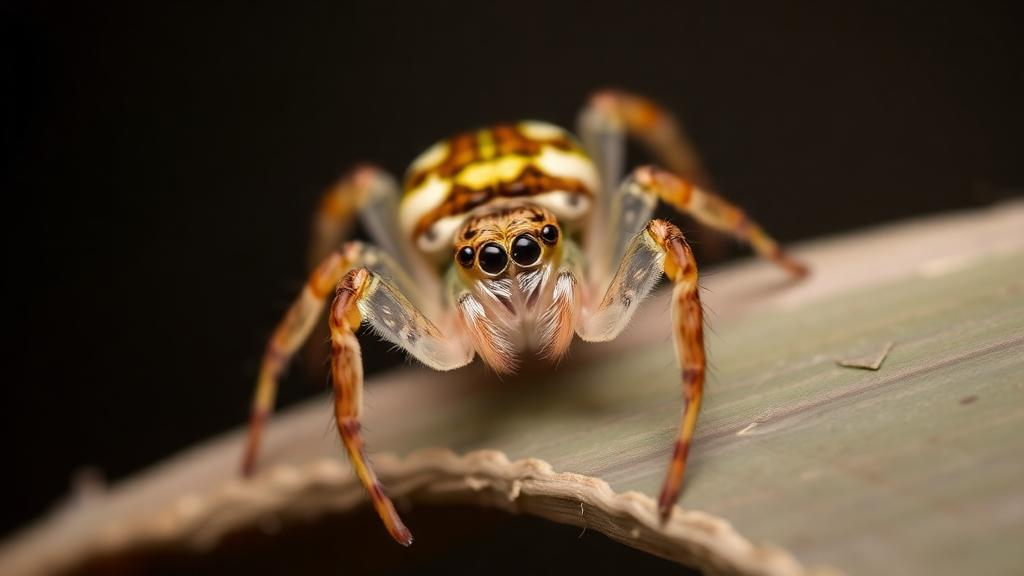
Deep in the humid riparian forests of Condeúba, in the Brazilian state of Bahia, researchers beating the branches of trees around a small mountain stream collected something unexpected: a small, flattened spider covered in dense dark grey spots and stripes. Now formally described as Gephyrellula condeuba, this new species is doing more than adding a name to the catalog of life. Together with fresh DNA sequences and newly mapped records of its relatives, it is helping to untangle one of the more stubborn puzzles in spider systematics — where, exactly, a peculiar Neotropical genus belongs on the evolutionary tree of the running crab spiders.
The running crab spider family Philodromidae includes 529 known species in 30 genera, active predators that hunt on branches, leaves, grass, bark, rocks and leaf litter rather than waiting in ambush like their crab spider cousins in Thomisidae. They are small spiders with conspicuously flattened bodies, a dense covering of soft, recumbent setae, eight eyes arranged in two recurved rows without a tapetum, and legs usually tipped with scopulae, with the second leg often the longest. Originally described as a subfamily of Thomisidae, the group was elevated to full family rank by Homann in 1975 on the basis of morphological and developmental characters, and recent molecular and morphological phylogenies have consistently supported its monophyly. The key shared derived feature is the presence of tenent hairs in the palps of both males and females.
Within the family, the genus Gephyrellula has long been a taxonomic oddity. Described by Mello-Leitão in 1918 as Gephyrella, based on a single pale species from Rio de Janeiro state, the name had to be replaced in 1932 by Strand because it was already occupied by a moth genus, becoming Gephyrellula. For more than a century the genus hovered between one species and two: a second species described from São Paulo in 1943 was later sunk as a junior synonym of the type species Gephyrellula violacea, restoring the genus to monotypy, until the description of Gephyrellula lavidabonita from Colombia in 2024. These are small, flat, pale spiders, and their systematics within the Neotropics — where only five of the 14 cited genera have ever been taxonomically revised — remains poorly studied.
The real problem was phylogenetic. The only analysis ever to include Gephyrellula, a molecular study by Prado and colleagues in 2022 during a revision of the genus Cleocnemis, placed the genus in the subfamily Philodrominae but gave contradictory answers about its closest relatives depending on the method used. The maximum likelihood tree nestled Gephyrellula among the Hawaiian genera Pedinopistha and Pagiopalus, while the Bayesian inference tree associated it instead with species of the widespread genus Philodromus. A likely culprit was missing data: of the four molecular markers used in that study, only one, the histone gene H3, had actually been sequenced for Gephyrellula violacea. With so little genetic evidence, the genus’s position wavered with every analytical approach.
To settle the question, a research team led by Brazilian arachnologists conducted new phylogenetic analyses built on the earlier dataset, this time including two terminals of Gephyrellula — the type species G. violacea and the newly discovered Bahian spider — each sequenced for all four molecular markers: partial sequences of the mitochondrial cytochrome oxidase subunit I gene (COI), the ribosomal genes 16S and 28S, and the nuclear histone gene H3. Genomic DNA was extracted with a commercial blood and tissue kit, markers were amplified by polymerase chain reaction with carefully controlled annealing temperatures, and successful amplicons were purified and sent for Sanger sequencing. The newly generated sequences, along with those for outgroup terminals of Apollophanes gaucho and Fageia amabilis, were deposited in GenBank, adding a substantial block of new data to a matrix that ultimately spanned 2,400 base pairs.
The analytical pipeline was rigorous. Multiple alignments were conducted in MAFFT, with the E-INS algorithm for ribosomal markers and the Auto setting for the others. Maximum likelihood analyses were run in IQ-TREE 2.3.5 on the concatenated matrix, with partitions for each marker and each codon position of the coding genes, and the best evolutionary model and partition scheme selected by the Bayesian information criterion in ModelFinder. Clade support was inferred through 1,000 replicates of the approximate likelihood ratio test with Shimodaira-Hasegawa correction, together with ultrafast bootstrap. Bayesian inference was performed in MRBAYES 3.2.7 through two independent searches of 50 million generations each, with convergence diagnostics — average standard deviation of split frequencies below 0.005, potential scale reduction factor of 1.00, and effective sample sizes exceeding 10,000 — confirming that the analyses had fully mixed.
The resulting trees, from both maximum likelihood and Bayesian inference, agreed on the big picture. Philodromidae divides into two subfamilies, Thanatinae and Philodrominae, and Gephyrellula sits firmly within the latter, in a clade alongside Petrichus, Philodromus, Pedinopistha and Pagiopalus, recovered with moderate to high support. But the finer placement was a surprise. Gephyrellula was recovered neither inside the Hawaiian clade containing Pagiopalus and Pedinopistha, as the earlier maximum likelihood analysis had suggested, nor among the three Philodromus species, which grouped together with high support in both analyses, as the earlier Bayesian tree had implied. Instead, the two Gephyrellula terminals clustered together with maximum or near-maximum support, forming a lineage of their own within Philodrominae — a distinct branch whose closest relative remains unresolved.
The new species itself is a striking animal. The male holotype, collected at around 950 meters altitude on Morro da Feirinha in Condeúba, measures just over three millimeters in total length and is unusually dark, its body covered in abundant black to dark grey spots and stripes, with the carapace bearing black dots and radial bands throughout and lacking the white triangular mark characteristic of G. violacea. The male palp carries a wider, bifid retrolateral tibial apophysis with sclerotized acute tips, a ventral tibial apophysis with a clearly convex margin and basal flap, and a larger, distinctly hook-shaped paraconductor apophysis — all features that separate it cleanly from its congeners. The female paratype, by contrast, is much lighter, pale orange-yellow with white guanine spots on the abdomen, and its epigyne shows a thin, acutely pointed, elevated median lobe of the lateral plates and longer, deeper guide pockets than in G. violacea.
One intriguing caveat shadows the description. Although males of Gephyrellula generally carry more black pigment than females, the degree of dark coloration on the male holotype of G. condeuba is unusually high even for the genus, and the authors note that it remains unclear whether this pattern is the normal condition of the species or whether the holotype is simply a melanic individual. Only additional specimens, they caution, can answer that question. The species is known so far only from its type locality, where all specimens were collected by beating tree branches in the small humid forest patches that punctuate the surrounding dry Cerrado landscape — habitat that makes the discovery all the more notable.
The study also expands the known range of the type species. Newly examined voucher specimens place Gephyrellula violacea in Corrientes and Jujuy provinces in Argentina, in the Paraguayan departments of Central, Paraguarí and Itapúa, and across all regions of Brazil, while the genus as a whole is now recorded from Colombia’s Magdalena region through the Neotropics to southern South America. The comparative diagnosis accompanying the revision rules out several putative relatives on morphological grounds: Gephyrellula lacks the leg scopula and differs in clypeus proportions from Halodromus and Rhysodromus, bears lateral spines on the first and second tibiae and metatarsi and well-developed tibial apophyses unlike Ebo, and carries a small hook-shaped paraconductor apophysis absent in Titanebo. The Hawaiian genus Pedinopistha shares a small paraconductor apophysis and, in the new species, a bidentate retrolateral tibial apophysis, but its median ocular quadrangle is much wider than long and its clypeus spans over half the carapace width, far more than in Gephyrellula.
What emerges is a genus that has finally shed its phylogenetic limbo, even if its exact sister group remains open. The authors emphasize that further studies with additional molecular data from terminals of Ebo, Titanebo and other poorly known Neotropical philodromids are still needed to define which lineage is Gephyrellula’s closest relative and to decipher the relationships among the genera of Philodrominae. For now, the message is clear: a tiny, flattened spider from a mountain forest fragment in Bahia, sequenced across four genes and analyzed alongside a century of taxonomic history, has established that one of the Neotropics’ least understood spider genera is a lineage all its own — and that the running crab spiders of South America still hold far more evolutionary surprises than their size suggests.
Subject of Research: Evolutionary Systematics
Article Title: A new species and the phylogenetic placement of the Neotropical genus Gephyrellula Strand, 1932 ( Araneae , Philodromidae )
Article References: Schinelli, H. B. P., Wanderley do Prado, A., Cerqueira Baptista, R. L., & Takiya, D. M. (2025). A new species and the phylogenetic placement of the Neotropical genus Gephyrellula Strand, 1932 (Araneae, Philodromidae). Evolutionary Systematics, 9(1), 87-98. https://doi.org/10.3897/evolsyst.9.143758
Image Credits: AI Generated
DOI: 10.3897/evolsyst.9.143758
Keywords: spiders, arachnology, phylogenetics, taxonomy, new species, Brazil, Philodromidae, biodiversity, species, phylogenetic, placement, Neotropical
News Source: Gavin Prescott. (October 18, 2026). New Spider Species From Brazil Rewrites the Family Tree of Running Crab Spiders. Scienmag.