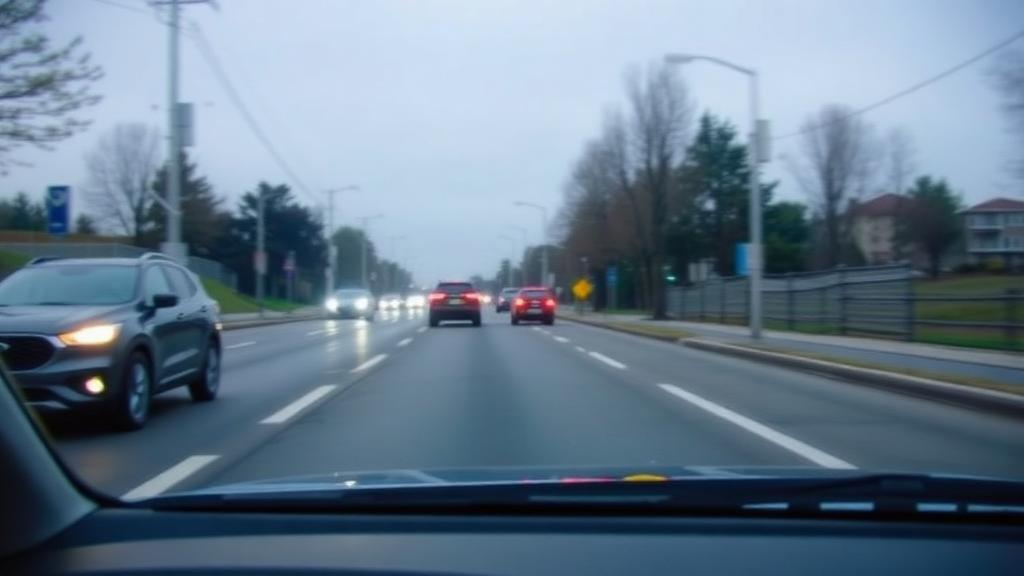
Roughly 1.35 million people die on the world’s roads every year, and most of those collisions are not blamed on brake failure or burst tires. The dominant factor is delayed hazard perception: a driver, or the automated system meant to assist them, simply notices the unfolding danger too late. A new study published in Scientific Reports argues that the humble dashcam, already mounted on millions of windshields, could become the eyes of an early-warning system that anticipates accidents seconds before they happen.
The research, led by Lohith Kumar Pullur Somasekar and colleagues at Vellore Institute of Technology in Tamil Nadu, India, introduces DashGuard, a framework that trains and rigorously compares six spatio-temporal deep learning models on dashcam footage. Rather than championing a single architecture, the team ran a controlled head-to-head contest: a 3D convolutional neural network, a CNN paired with an LSTM, a CNN paired with a Transformer, and three two-stream variants built around a lightweight CNN, ResNet-18, and a Transformer. All six faced the same data, the same training protocol, and the same leak-free evaluation, a consistency that accident-anticipation studies have rarely offered.
The evidence base is the Car Crash Dataset, a public collection of dashcam videos containing 1500 crash clips and 2000 normal driving clips, much of it drawn from footage shared by the dashcam company Nexar. The team’s first technical decision was to prevent contamination between training and test material. Instead of randomly dividing individual frames or short segments, they split the data at the video level, assigning 70 percent of videos to training, 15 percent to validation, and 15 percent to testing. Because clips from the same crash cannot appear on both sides of that divide, the reported scores reflect genuine generalization to unseen accidents rather than memorized scenes.
Timing is the essence of accident anticipation, and DashGuard encodes it with unusual care. Each video receives four-level soft labels that describe how far the current moment sits from the accident frame, so a model is not merely asked whether a crash will occur but how imminent it is. This graded supervision pushes networks to read the subtle precursors of danger: a vehicle drifting across a lane, a pedestrian edging into the roadway, the sudden compression of traffic ahead. Hard yes-or-no labels would flatten that structure; soft labels preserve it and let the models learn the temporal anatomy of a crash.
The most distinctive component is a two-clip temporal consistency gate designed to suppress false alarms. Dashcams see a torrent of ambiguous motion: swerving that ends safely, hard braking that stops in time, shadows and glare that mimic sudden obstacles. A single suspicious clip can trigger an alert that turns out to be nothing. DashGuard instead requires agreement across two consecutive clips before an alert is confirmed, gating the decision on temporal consistency. According to the study, this gate substantially cuts false-positive alerts, the failure mode that would make any real-world deployment unbearable to drivers.
On the held-out test set, the Two-Stream Transformer emerged as the clear winner, achieving an area under the ROC curve of 0.981 and an F1 score of 0.870, with a recall of 0.991. That recall figure deserves emphasis: of the accidents the system should flag, it missed roughly one in a hundred. In a safety application, missing a crash is the costliest error, and a recall approaching unity while keeping precision high is exactly the operating point engineers seek. The authors attribute the advantage to explicitly separating motion and appearance: one stream processes optical flow, the raw geometry of movement, while the other processes static visual appearance, and attention mechanisms fuse the two. Single-stream designs must entangle these cues; two-stream attention keeps them apart and gives the clearest gains over single-stream architectures on this task.
The study also offers a pragmatic option for hardware-constrained deployments. The lightweight 3D CNN reached an AUC of 0.949 with roughly 180,000 parameters, a model small enough to run on edge devices such as the processors inside dashcams themselves. A ResNet-18-based two-stream variant and a CNN-LSTM filled out the middle of the pack, but the headline result is the contrast between the heavyweight Transformer, which maximizes accuracy, and the featherweight 3D CNN, which maximizes deployability. A model with 180,000 parameters can plausibly execute in real time on low-power silicon, turning anticipation from a cloud service into a windshield-level reflex.
The comparison matters because accident anticipation research has often suffered from incomparable results. Studies train different models on different splits with different labels, making it impossible to know whether a reported improvement reflects better architecture or a friendlier evaluation. By holding the dataset, the video-level split, the soft-label scheme, and the consistency gate fixed across all six models, DashGuard provides something the field has lacked: a controlled experiment in which architectural choices are the only variable. The finding that two-stream attention outperforms single-stream designs is therefore evidence rather than anecdote.
DashGuard is positioned as a low-cost complement to sensor-heavy advanced driver assistance systems rather than a replacement. ADAS platforms rely on radar, lidar, and ultrasonic arrays that add thousands of dollars to a vehicle’s price; a dashcam-based anticipator needs only a camera and software, and it can retrofit the existing fleet. The authors also built a React and FastAPI web interface that supports interactive evaluation, letting users upload footage and inspect model behavior, and the entire stack rests on open-source tools including PyTorch, OpenCV, FastAPI, and React. The work received no external funding, and the authors declare no competing interests.
The implications stretch beyond the laboratory. A dashcam that watches the road with a recall of 0.991 and warns of danger seconds early could buy drivers the reaction time that delayed hazard perception steals, and the same logic extends to fleet telematics, insurance risk scoring, and infrastructure planning, where aggregated anticipation data could map the precursors of danger across a road network. The study is published as open access under a Creative Commons license, with the Car Crash Dataset and Nexar footage publicly available, so other teams can replicate the protocol, stress-test the consistency gate on new geographies and lighting conditions, and push the lightweight 3D CNN toward production silicon. Road safety has long waited for technology that sees trouble coming; the evidence from this study suggests the wait may be measured in software updates rather than vehicle generations.
Subject of Research: DashGuard: spatio-temporal deep learning for dashcam-based road accident anticipation
Article Title: DashGuard: spatio-temporal deep learning for dashcam-based road accident anticipation
Article References: Pullur Somasekar, L. K., Sinha, A., Chintaluri, N., & Madasamy, B. (2026). DashGuard: spatio-temporal deep learning for dashcam-based road accident anticipation. Scientific Reports. https://doi.org/10.1038/s41598-026-74110-5
Image Credits: AI Generated
DOI: 10.1038/s41598-026-74110-5
Keywords: DashGuard, spatio-temporal, deep, learning, dashcam-based, road, accident, anticipation, scientific research
News Source: Blake Davidson. (October 18, 2026). Two-stream AI spots dashcam crashes seconds before impact. Scienmag.