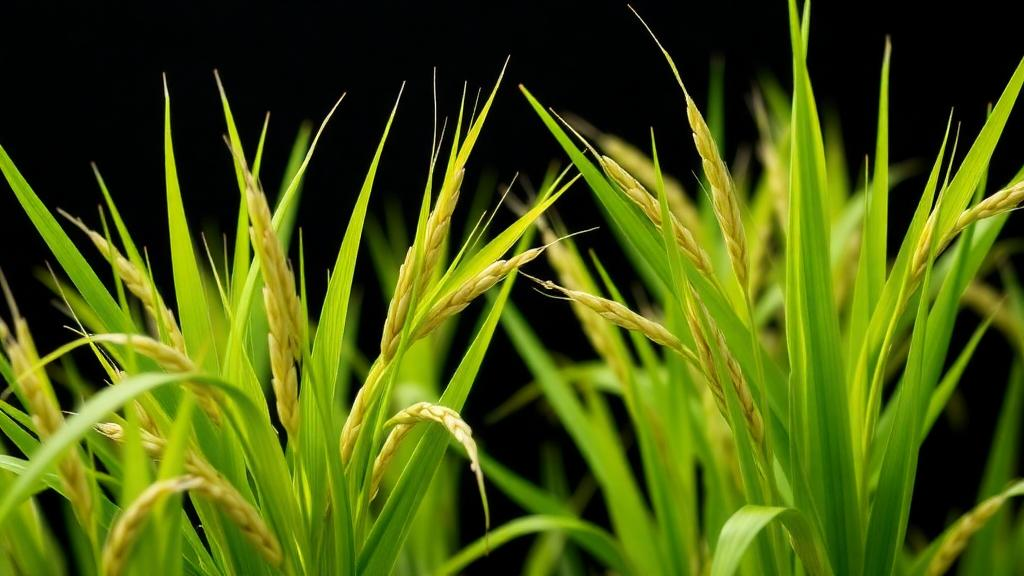
Photorespiration is one of the great hidden taxes on plant life. In rice and other C3 crops, the enzyme Rubisco keeps grabbing oxygen as well as carbon dioxide, and every oxygenation event sets off a wasteful metabolic loop that releases previously fixed carbon back into the air. For decades, plant engineers have tried to reroute this loop inside the chloroplast, converting the toxic intermediates directly into carbon dioxide so that Rubisco sees a richer CO2 atmosphere and photosynthesis runs more efficiently. A new study in BMC Plant Biology reports a sobering twist in that effort: a stress-inducible version of a synthetic photorespiratory bypass in rice switched on its genes exactly as designed, yet the enzymes it encoded never arrived in functional form, and the plants gained no stress tolerance at all.
The bypass in question is known as GOC, an acronym drawn from its three components: glycolate oxidase, oxalate oxidase, and catalase. In earlier work by collaborators, constitutive expression of these three enzymes in chloroplasts enhanced biomass in rice and potato, apparently by short-circuiting photorespiration and raising the CO2 concentration around Rubisco. The logic behind the new experiment was elegant. Rather than running the bypass all the time, which carries metabolic costs when water is plentiful, the researchers placed the three transgenes under the control of drought-inducible promoters, so the pathway would spin up only when water scarcity made photorespiration most punishing. The goal was to increase CO2 around Rubisco precisely under stress and thereby improve the drought tolerance of rice.
At the transcript level, the design worked spectacularly. Under drought stress, messenger RNA from all three transgenes was strongly induced, reaching levels tens of times higher than the endogenous control gene used for comparison. By every conventional molecular metric, the synthetic pathway had been activated. The promoters fired, the chloroplast transit peptides were in place, and the cell was flooded with instructions for building the three enzymes. If gene expression stopped at transcription, this would have been a textbook success story for inducible metabolic engineering.
But the story collapsed at the next level of the central dogma. When the team measured the corresponding proteins, neither glycolate oxidase, oxalate oxidase, nor catalase accumulated in proportion to their transcripts. The enzymatic activities told the same tale: under drought, and even more strikingly under abscisic acid or osmotic treatment, the activities remained at wild type levels or actually decreased. Abscisic acid is the hormone that orchestrates drought responses in plants, and osmotic treatment mimics the cellular dehydration that drought causes, so these assays probed the same stress program from different angles. In every case, the massive transcript induction decoupled from any functional protein accumulation.
The phenotypic consequences followed directly. Transgenic lines showed no improved tolerance to drought or osmotic stress compared with wild type plants. Under osmotic stress, the engineered lines actually exhibited greater membrane damage than their unmodified counterparts, an unexpected and unwelcome result. Membrane damage is a standard readout of cellular injury under water stress, so the bypass not only failed to protect the plants but appeared to leave them more vulnerable. Without functional enzymes in the chloroplast, the synthetic pathway existed only as a blueprint, and the plants paid the price of carrying the transgenes without receiving any benefit.
Why would a cell transcribe genes at extraordinary rates yet fail to produce the proteins? The authors propose two converging bottlenecks. The first is a stress-activated blockade of chloroplast protein import. Chloroplast-targeted enzymes are synthesized in the cytosol as precursor proteins bearing N-terminal transit peptides, and they must be threaded through the TOC-TIC translocon complexes in the chloroplast envelopes. Recent work has identified a chloroplast ubiquitin ligase system, sometimes called CHLORAD, that tags envelope and imported proteins for ubiquitin-mediated degradation, allowing the cell to regulate chloroplast proteome composition from outside. The researchers suggest that drought and its hormonal signals may activate a CHLORAD-like mechanism that degrades or blocks incoming precursor proteins, so the enzymes are made and then destroyed, or never admitted at all.
The second bottleneck is translational capacity. The GOC bypass requires the coordinated production of three separate chloroplast-targeted enzymes, each competing for ribosomes, chaperones, and import machinery. Under stress, the cell globally represses protein synthesis to conserve resources, prioritizing survival proteins over growth. Multiple transgenes induced simultaneously under such conditions may simply overwhelm the diminished translational and import capacity, so none of them reaches functional accumulation. The combination of an import blockade and insufficient translation would explain why transcripts soared while proteins and activities flatlined.
The implications reach far beyond this single experiment. Stress-inducible expression is an increasingly popular strategy in synthetic biology for crops, because constitutive expression of engineered pathways can carry fitness costs when the pathway is not needed. Inducible promoters promise to spend the metabolic budget only when it matters. Yet this study delivers a cautionary empirical note: transcript induction alone does not guarantee protein synthesis or delivery to the chloroplast. A pathway that looks switched on at the RNA level may be entirely dark at the protein level, and the disconnect is invisible unless researchers verify protein accumulation and enzymatic activity under the exact stress conditions the pathway is meant to serve.
For the broader community engineering photorespiratory bypasses and other chloroplast metabolic modules, the message is that the chloroplast envelope is not a passive doorway. It is an actively regulated gate that stress can slam shut, and the cytosolic translation apparatus is a shared, rationed resource that drought repossesses. Future designs may need to consider bypassing the cytosolic import route altogether, for example by expressing bypass enzymes directly inside chloroplasts through chloroplast transformation, or by engineering resistance to stress-activated degradation systems. Protein-level verification under target stress conditions, the authors argue, is not an optional confirmation but an indispensable step for anyone building inducible metabolic pathways in chloroplasts.
The study, led by Haiyan Teng and colleagues at Yichun University in China and supported by the Jiangxi Provincial Natural Science Foundation, was published as an open access research article in BMC Plant Biology. Its value lies less in a successful crop improvement than in a precise mapping of where an engineering strategy failed, and why. In the race to make photosynthesis more efficient under a drying climate, knowing that the last mile of gene expression, the journey from transcript to functional chloroplast enzyme, can be severed by the very stress the pathway is meant to conquer, may redirect the entire field toward designs that survive that journey.
Subject of Research: Plant Biotechnology
Article Title: Transcript-protein decoupling of chloroplast targeted enzymes in a stress inducible GOC photorespiratory bypass in rice
Article References: Teng, H., Liu, Z., Wang, R., Shen, X., & Li, J. (2026). Transcript-protein decoupling of chloroplast targeted enzymes in a stress inducible GOC photorespiratory bypass in rice. BMC Plant Biology. https://doi.org/10.1186/s12870-026-09975-9
Image Credits: AI Generated
DOI: 10.1186/s12870-026-09975-9
Keywords: rice, chloroplast, photorespiration, GOC bypass, drought stress, transcript-protein decoupling, protein import, synthetic biology, Transcript-protein, decoupling, targeted, enzymes
News Source: Juliet Wilcox. (October 17, 2026). Rice stress gene switch fails at the protein level, revealing a chloroplast engineering bottleneck. Scienmag.