

• HOME
  • NEWS
  • EXPLORE
    • CAREER
      • Companies
      • Jobs
    • EVENTS
    • iGEM
      • News
      • Team
    • PHOTOS
    • VIDEO
    • WIKI
  • BLOG
  • COMMUNITY
    • FACEBOOK
    • INSTAGRAM
    • TWITTER
Saturday, February 7, 2026
BIOENGINEER.ORG
No Result
View All Result
  • Login
  • HOME
  • NEWS
  • EXPLORE
    • CAREER
      • Companies
      • Jobs
        • Lecturer
        • PhD Studentship
        • Postdoc
        • Research Assistant
    • EVENTS
    • iGEM
      • News
      • Team
    • PHOTOS
    • VIDEO
    • WIKI
  • BLOG
  • COMMUNITY
    • FACEBOOK
    • INSTAGRAM
    • TWITTER
  • HOME
  • NEWS
  • EXPLORE
    • CAREER
      • Companies
      • Jobs
        • Lecturer
        • PhD Studentship
        • Postdoc
        • Research Assistant
    • EVENTS
    • iGEM
      • News
      • Team
    • PHOTOS
    • VIDEO
    • WIKI
  • BLOG
  • COMMUNITY
    • FACEBOOK
    • INSTAGRAM
    • TWITTER
No Result
View All Result
Bioengineer.org
No Result
View All Result
Home NEWS Science News Biology

Warmer waters from climate change will leave fish shrinking, gasping for air

Bioengineer by Bioengineer
August 21, 2017
in Biology
Reading Time: 2 mins read
0
Share on FacebookShare on TwitterShare on LinkedinShare on RedditShare on Telegram
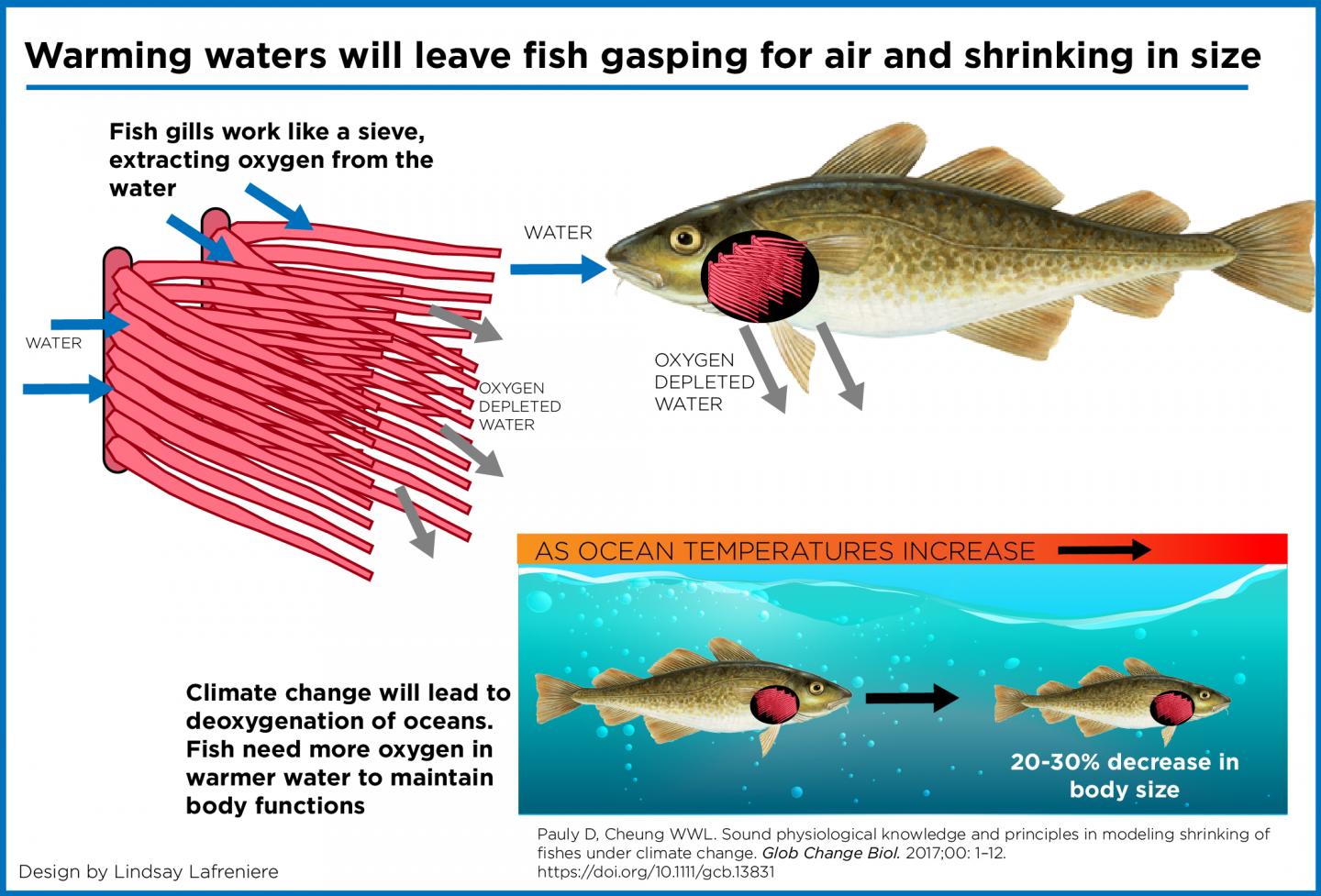
IMAGE

Credit: Lindsay Lafreniere

Fish are expected to shrink in size by 20 to 30 per cent if ocean temperatures continue to climb due to climate change.

A new study by researchers at the University of British Columbia provides a deeper explanation of why fish are expected to decline in size.

"Fish, as cold-blooded animals, cannot regulate their own body temperatures. When their waters get warmer, their metabolism accelerates and they need more oxygen to sustain their body functions," said William Cheung, co-author of the study, associate professor at the Institute for the Ocean and Fisheries and director of science for the Nippon Foundation-UBC Nereus Program. "There is a point where the gills cannot supply enough oxygen for a larger body, so the fish just stops growing larger."

Daniel Pauly, the study's lead author and principal investigator of the Sea Around Us at the Institute for the Ocean and Fisheries, explains that as fish grow into adulthood their demand for oxygen increases because their body mass becomes larger. However, the surface area of the gills — where oxygen is obtained — does not grow at the same pace as the rest of the body. He calls this set of principles that explains why fish are expected to shrink "gill-oxygen limitation theory."

For example, as a fish like cod increases its weight by 100 per cent, its gills only grow by 80 per cent or less. When understood in the context of climate change, this biological rule reinforces the prediction that fish will shrink and will be even smaller than thought in previous studies.

Warmer waters increase fish's need for oxygen but climate change will result in less oxygen in the oceans. This means that gills have less oxygen to supply to a body that already grows faster than them. The researchers say this forces fish to stop growing at a smaller size to be able to fulfill their needs with the little oxygen available to them.

Some species may be more affected by this combination of factors. Tuna, which are fast moving and require more energy and oxygen, may shrink even more when temperatures increase.

Smaller fish will have an impact on fisheries production as well as the interaction between organisms in the ecosystems.

###

Pauly and Cheung's study "Sound physiological knowledge and principles in modeling shrinking fishes under climate change" was published in Global Change Biology doi: 10.1111/gcb.13831.

Media Contact

Valentina Ruiz Leotaud
[email protected]
604-827-3164
@UBCnews

http://www.ubc.ca

Original Source

http://www.seaaroundus.org/warmer-waters-from-climate-change-will-leave-fish-shrinking-gasping-for-air/ http://dx.doi.org/10.1111/gcb.13831


Share12Tweet7Share2ShareShareShare1

Related Posts

Florida Cane Toad: Complex Spread and Selective Evolution

Florida Cane Toad: Complex Spread and Selective Evolution

February 7, 2026
New Study Uncovers Mechanism Behind Burn Pit Particulate Matter–Induced Lung Inflammation

New Study Uncovers Mechanism Behind Burn Pit Particulate Matter–Induced Lung Inflammation

February 6, 2026

DeepBlastoid: Advancing Automated and Efficient Evaluation of Human Blastoids with Deep Learning

February 6, 2026

Navigating the Gut: The Role of Formic Acid in the Microbiome

February 6, 2026
Please login to join discussion

POPULAR NEWS

  • Robotic Ureteral Reconstruction: A Novel Approach

    Robotic Ureteral Reconstruction: A Novel Approach

    82 shares
    Share 33 Tweet 21
  • Digital Privacy: Health Data Control in Incarceration

    63 shares
    Share 25 Tweet 16
  • Study Reveals Lipid Accumulation in ME/CFS Cells

    57 shares
    Share 23 Tweet 14
  • Breakthrough in RNA Research Accelerates Medical Innovations Timeline

    53 shares
    Share 21 Tweet 13

About

We bring you the latest biotechnology news from best research centers and universities around the world. Check our website.

Follow us

Recent News

Personalized Guide to Understanding and Reducing Chemicals

Inflammasome Protein ASC Drives Pancreatic Cancer Metabolism

Phage-Antibiotic Combo Beats Resistant Peritoneal Infection

Subscribe to Blog via Email

Enter your email address to subscribe to this blog and receive notifications of new posts by email.

Join 73 other subscribers
  • Contact Us

Bioengineer.org © Copyright 2023 All Rights Reserved.

Welcome Back!

Login to your account below

Forgotten Password?

Retrieve your password

Please enter your username or email address to reset your password.

Log In
No Result
View All Result
  • Homepages
    • Home Page 1
    • Home Page 2
  • News
  • National
  • Business
  • Health
  • Lifestyle
  • Science

Bioengineer.org © Copyright 2023 All Rights Reserved.
