Credit: Staci Amburgey, Penn State
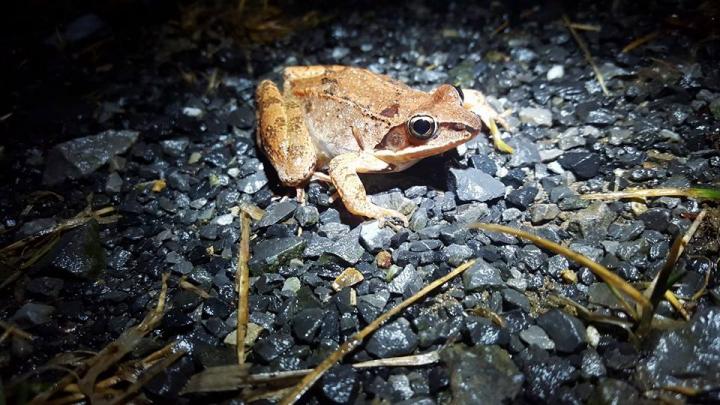
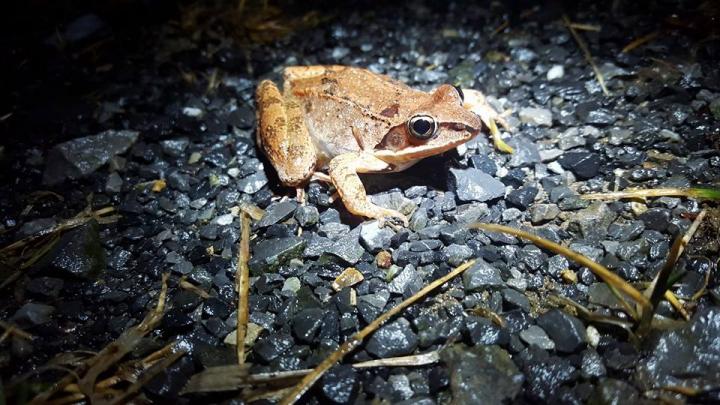
As conditions warm, fish and wildlife living at the southern edge of their species' ranges are most at risk, according to Penn State researchers who led a major collaborative study of how wood frogs are being affected by climate change.
However, determining which species and which populations are in danger of declining or disappearing is not simple or straightforward, according to researcher David Miller, assistant professor of wildlife population ecology, College of Agricultural Sciences. Local and regional precipitation trends are nearly as important as temperature in determining the fate of many animals, he explained, and that's especially true with moisture-sensitive creatures such as amphibians.
Miller's lab spearheaded the study that included 14 universities, the U.S. Geological Survey, and several other state and federal agencies, looking at long-term monitoring data from 746 wood frog populations in 27 study areas, from Tennessee to Canada. The research focused on how climatic variation affected population growth rates and how these relationships varied with respect to long-term climate.
In many of the wood frog populations studied, researchers found evidence of interacting temperature and precipitation influencing population size, such as warmer summers having less of a negative effect in areas that received more precipitation. Some of the findings, which were published early online today (Aug. 19) in Global Change Biology, were expected, but some were counter-intuitive, Miller noted.
As anticipated, researchers saw wood frog populations that seemed to be suffering from warmer than normal summer temperatures in hotter areas in the southern part of the range. Similarly, they found higher than average rainfall in areas that typically experience lower annual rainfall saw positive effects on wood frog population growth.
But other results were contrary to expectations, such as positive effects of higher than normal rainfall in wetter parts of the range and positive responses to winter warming, especially in milder areas. In general, researchers found wood frogs were more sensitive to changes in temperature or temperature interacting with precipitation than to changes in precipitation alone.
Northward shifts in wildlife ranges may be expected in coming years or decades, noted lead researcher Staci Amburgey, a doctoral degree student in ecology, but that trend may depend nearly as much on demographic weather patterns as warming temperatures. And in the case of wood frogs, other factors are also at play.
The study's results suggest that sensitivity to changes in climate cannot be predicted simply by knowing locations within the species' climate envelope, she pointed out. Many climate processes did not affect population growth rates as expected, based on range position. Processes such as species interactions, local adaptation and interactions with the physical landscape likely affect the responses researchers observed.
"Wood frogs are really broadly distributed, so I don't think the species is going to be declining anytime soon," said Amburgey, who started studying amphibians when she was an undergraduate and master's degree student at Colorado State. "But having said that, it appears that populations in the southern portion of the wood frog's range are vulnerable if we have more hot, dry summers. Certainly frogs in the southern part of their range are more sensitive to hot years than frogs farther north, where the conditions will not push their physiological tolerances."
This study was novel because researchers did not simply document where wood frogs exist and where they do not, Amburgey explained. Instead, they analyzed reproduction rates by counting egg masses in spring pools to determine where the amphibian's populations were growing or declining — trying to determine how each population was responding to year-to-year differences in climate.
Wood frogs are an ideal species to study to develop predictions about how animals will respond to warming conditions, Miller believes. They are cold-weather frogs with a range that extends farther north than other amphibians. As such, they have evolved with some amazing adaptations, not the least of which is the ability to survive freezing solid in winters.
"In a warming world, wood frogs at the southern end of their range may be in trouble," he said. "By freezing solid, they thrive as far north as Alaska. They spend winters near the surface, and they are one of the first species to come out when things thaw. Then they head immediately to small wetlands in the forest that tend to dry out during the summer to breed, and their tadpoles develop really quickly and get out into the woods early. They are an important part of our forested ecosystems in the Northeast and a truly unique species."
###
The Amphibian Decline Working Group supported by the U.S. Geological Survey's John Wesley Powell Center for Analysis and Synthesis supported this work.
Media Contact
A'ndrea Elyse Messer
[email protected]
814-865-9481
@penn_state
http://live.psu.edu