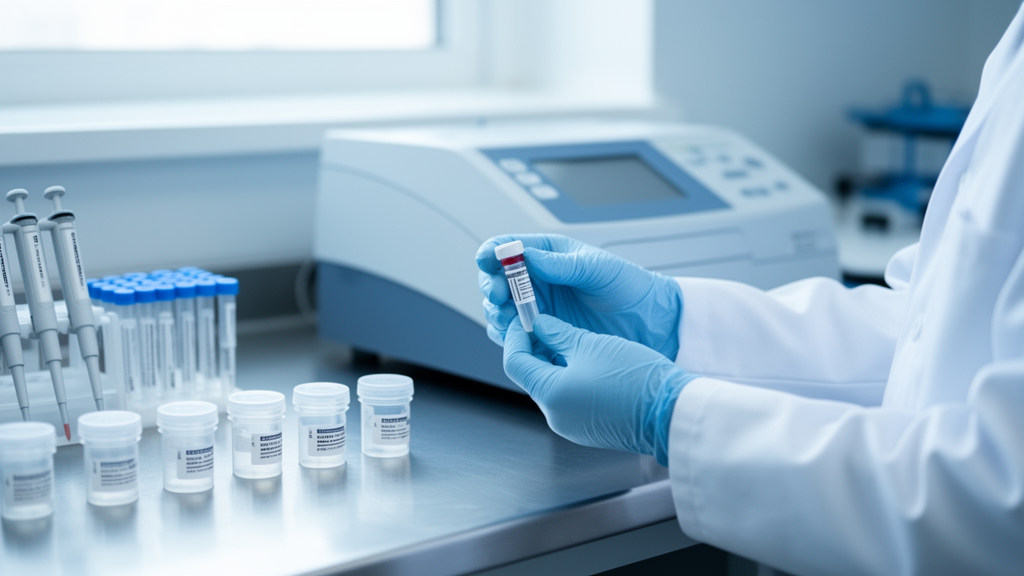
A simple stool test could catch nearly all colorectal cancers before they turn deadly, but only if the cutoff value used to flag a positive result is chosen with care. That is the central message of a large new screening study from Shandong Province, China, where researchers have spent years trying to answer a deceptively technical question: how much hidden blood in a stool sample is enough to justify sending an apparently healthy person for a colonoscopy? The findings, published in BMC Cancer, offer some of the most detailed evidence yet on how to calibrate the fecal immunochemical test, or FIT, for people at average risk of the disease, and they suggest that the answer may differ from one region to another depending on how common colorectal cancer is locally.
The fecal immunochemical test works by detecting hemoglobin, the oxygen-carrying protein of red blood cells, that has leaked into the digestive tract from precancerous growths or tumors. Unlike the older guaiac-based stool tests, FIT does not react with hemoglobin from food, so it can be calibrated to a precise concentration, typically expressed in micrograms of hemoglobin per gram of feces. Lowering the threshold makes the test more sensitive, catching more cancers and precancerous lesions, but it also floods screening programs with false positives, each of which triggers an expensive and invasive colonoscopy. Raising the threshold does the opposite, sparing colonoscopy capacity but missing more early disease. For countries like China, where screening is being rolled out across enormous populations with limited endoscopy resources, that trade-off is not an academic curiosity; it determines whether a program is feasible at all.
To pin down the optimal balance, a team led by Yanxiu Liu and Nan Zhang of Shandong Cancer Hospital and Institute, together with collaborators at Shandong University and other provincial institutions, recruited asymptomatic residents aged 40 to 74 across 13 regions of Shandong Province. All participants were considered average risk, meaning they had no personal or family history suggesting elevated colorectal cancer risk and no symptoms that would already warrant diagnostic investigation. Each volunteer provided a stool sample for FIT analysis and then underwent a full colonoscopy, the gold standard against which the test’s performance could be measured. The researchers tracked three outcomes: colorectal cancer itself, advanced adenomas, which are precancerous polyps with a high potential to turn malignant, and the combined category of advanced colorectal neoplasia, which encompasses both.
The final analysis included 5,918 participants, a cohort in which 378 people, or 6.4 percent, turned out to have advanced adenomas and 28 people, or 0.5 percent, had colorectal cancers. Those numbers illustrate why screening matters: advanced adenomas were more than thirteen times as common as outright cancers, and detecting them early offers the chance to prevent malignancy rather than merely treat it. When the researchers evaluated FIT performance at a threshold of 25 micrograms of hemoglobin per gram of feces, the test detected 96.4 percent of the cancers found at colonoscopy, with a 95 percent confidence interval stretching from 89.3 to 100 percent. Sensitivity for advanced adenomas was considerably lower, at 40.2 percent, and for advanced colorectal neoplasia overall it was 44.1 percent, reflecting the well-known limitation that many precancerous polyps shed too little blood to trip even a low FIT cutoff.
Specificity, the proportion of people without disease who correctly test negative, remained impressively high at the same threshold: 95.6 percent for advanced adenoma, 93.8 percent for cancer, and 96.1 percent for advanced colorectal neoplasia. In practical terms, fewer than one in twenty average-risk residents without neoplasia would be falsely flagged at the 25 microgram cutoff. The researchers also calculated a measure called the number needed to scope, which quantifies the screening burden by counting how many colonoscopies must be performed to find one lesion. If everyone in the population went straight to colonoscopy without any preliminary stool testing, the program would need 211.4 colonoscopies to detect a single cancer and 14.6 to detect one case of advanced colorectal neoplasia. Using FIT at the 25 microgram threshold as a filter, those figures collapsed to 14.6 colonoscopies per cancer and just 2.2 per advanced neoplasia, a reduction of roughly ninety-three percent in the endoscopy burden per cancer detected.
That arithmetic is the heart of the study’s argument. FIT does not outperform colonoscopy in raw detection, but it transforms the economics of screening by concentrating endoscopy resources on the small fraction of people most likely to harbor disease. At a threshold of 25 micrograms per gram, the test misses some advanced adenomas, yet it still identifies the overwhelming majority of cancers while eliminating more than nine out of ten unnecessary colonoscopies. For a screening program, that means a fixed endoscopy budget can cover a vastly larger population, and the study’s authors argue that this balance between detection and resource use is what threshold selection is really about.
The Shandong team then took the analysis a step further by dividing the 13 regions into two groups according to their baseline colorectal cancer incidence, comparing relatively high-incidence areas with relatively low-incidence ones. The subgroup results point toward a strategy that has rarely been articulated so concretely: in regions where colorectal cancer is relatively common, the 25 microgram threshold appeared to provide a more favorable balance between detection and colonoscopy burden, because the higher sensitivity pays off when the underlying prevalence of disease is greater. In regions where the disease is relatively rare, a higher threshold of 50 micrograms per gram mainly improved specificity and screening efficiency, since lowering the cutoff in a low-prevalence population would generate a cascade of false positives that overwhelms endoscopy capacity without proportionally more cancers found.
This prevalence-dependent logic follows directly from the mathematics of predictive values. The positive predictive value of any test rises with disease prevalence, so the same FIT result carries more weight in a high-incidence region than in a low-incidence one. Conversely, when prevalence falls, the cost of each false positive grows relative to the benefit of each true positive, and a stricter threshold conserves resources. The Shandong data suggest that a one-size-fits-all national cutoff may leave efficiency on the table, and that region-specific calibration, informed by local cancer registries, could squeeze more screening value out of the same budget. The authors are careful to note, however, that these subgroup findings require further validation before region-specific strategies can be formally recommended, since the regional division was based on baseline incidence and the cohort, while large, was not designed to test regional strategies head-to-head.
The study arrives at a moment when colorectal cancer screening is expanding across China and other middle-income countries, and when health systems everywhere are grappling with the question of how to screen aging populations without exhausting endoscopy capacity. FIT is already the backbone of organized screening programs in many parts of the world, precisely because it is cheap, noninvasive, and can be administered by mail. But the new results underscore that the test’s value is not fixed; it is a dial that program designers must set according to local disease burden, endoscopy availability, and the goals of the program. A threshold that works well in a high-incidence province may squander resources in a low-incidence one, and the Shandong evidence provides a quantitative anchor for those decisions.
For average-risk residents, the practical takeaway is straightforward: a stool test at a carefully chosen cutoff can identify the great majority of colorectal cancers while sparing more than nine out of ten people an unnecessary colonoscopy, and the cutoff that achieves this balance may depend on where they live. The researchers conclude that a threshold of 25 micrograms of hemoglobin per gram appeared to provide a favorable overall balance in this average-risk population, while their further analyses suggest that optimization may vary across regions with different colorectal cancer incidence. As screening programs scale up, the study offers a template for evidence-based threshold selection, one that could help health systems detect more cancers with the endoscopies they already have, and it adds a compelling data point to the growing science of precision public health, where even a number printed on a stool test kit can shape who lives and who dies.
Subject of Research: Cancer Screening
Article Title: Optimizing thresholds of fecal immunochemical test for colorectal cancer screening in average-risk residents
Article References: Liu, Y., Feng, Y., Gao, Q., Ji, J., Lu, C., Zhang, X., Ma, H., Sun, X., & Zhang, N. (2026). Optimizing thresholds of fecal immunochemical test for colorectal cancer screening in average-risk residents. BMC Cancer. https://doi.org/10.1186/s12885-026-16967-3
Image Credits: AI Generated
DOI: 10.1186/s12885-026-16967-3
Keywords: colorectal cancer, fecal immunochemical test, FIT threshold, colonoscopy, cancer screening, advanced adenoma, screening burden, Shandong Province, BMC Cancer, precision public health, Optimizing, thresholds
News Source: Nathaniel Bowman. (October 17, 2026). New Study Reveals Optimal Fecal Test Threshold for Colorectal Cancer Screening. Scienmag.