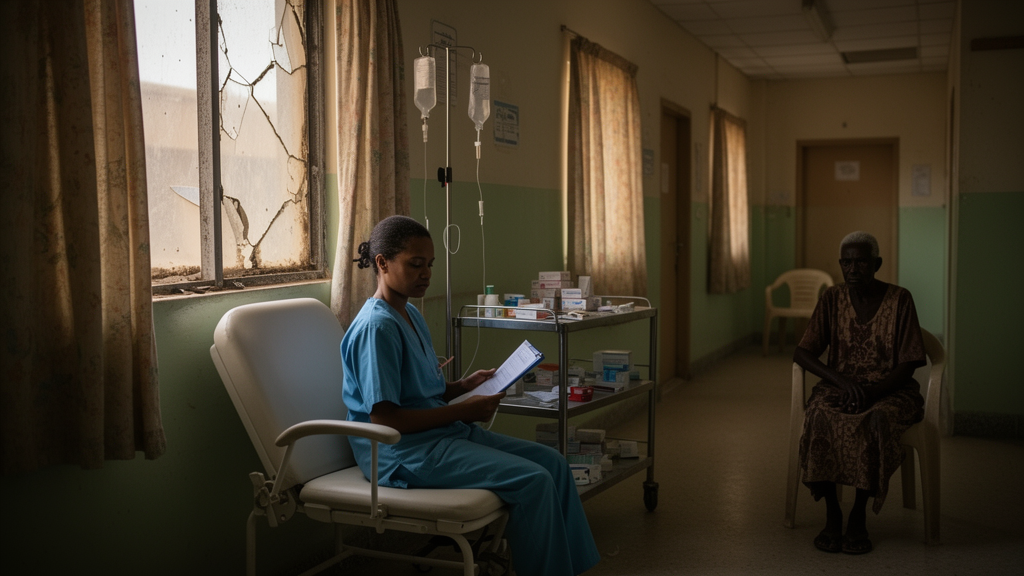
When war erupted in Sudan in April 2023, it did more than shatter cities and displace millions. It quietly dismantled the fragile machinery of cancer care in one of the world’s most vulnerable health systems. A new cross-sectional study published in BMC Cancer offers one of the first empirical portraits of what happens to oncology patients when a health system collapses under armed conflict, and the findings are stark: nearly seven in ten cancer patients could not access treatment because of the war, more than four in ten saw their therapy interrupted, and over a third suffered severe psychological harm.
The research, led by Hiba Abdelmunim Suliman Elsheikh of the National University and Almughtarbeen University in Khartoum, together with colleagues across Sudan and Saudi Arabia, surveyed 384 adult cancer patients between June and August 2025 at two oncology centers in River Nile State. All participants had been diagnosed before April 2023, meaning every person in the cohort was already navigating cancer treatment when the fighting between the Sudanese Armed Forces and the Rapid Support Forces began. Just over half of the respondents, 203 patients or 52.9 percent, were internally displaced by the time they were surveyed, and 233 patients, or 60.7 percent, were female.
The technical design of the study matters for interpreting its results. The team used convenience sampling and a validated questionnaire, then analyzed the data with descriptive statistics and chi-square or Fisher’s exact tests in SPSS version 27, applying a conventional significance threshold of p ≤ 0.05. To untangle which factors independently predicted psychological harm, the researchers turned to multivariable ordinal logistic regression, a statistical approach suited to outcomes ordered from none through mild and moderate to severe. This allowed them to estimate the strength of association between specific war-related exposures and escalating levels of psychological impact, while controlling for other variables in the model.
The headline numbers are grim. Difficulty accessing cancer treatment because of the war was reported by 263 patients, or 68.5 percent of the cohort. When the researchers probed why, the barriers clustered into four dominant categories: financial constraints, cited by 190 patients or 72.2 percent of those reporting access problems; medication shortages, cited by 175 or 66.5 percent; travel difficulties or insecurity, cited by 163 or 62.0 percent; and limited availability of healthcare professionals, cited by 129 or 49.0 percent. Treatment interruptions, the clinical consequence of these barriers, were reported by 161 patients, or 41.9 percent. In oncology, where radiotherapy and chemotherapy schedules are calibrated to tumor biology and cell-cycle kinetics, interruptions of even a few weeks can compromise local control and survival, making this figure a proxy for measurable clinical risk rather than mere inconvenience.
The psychological toll was equally severe. A total of 138 patients, or 35.9 percent, reported severe psychological impacts, with additional patients experiencing moderate or mild levels. The regression analysis revealed which exposures independently drove this escalation. Difficulty accessing treatment carried a coefficient of B = 0.961 (95% CI: 0.385–1.536, p = 0.001), meaning patients facing access barriers were significantly more likely to slide toward severe psychological outcomes. Skipping or postponing treatment sessions was similarly predictive, with B = 1.035 (95% CI: 0.258–1.811, p = 0.009). Exposure to security threats independently predicted psychological harm as well, with B = 0.610 (95% CI: 0.093–1.128, p = 0.021).
But the strongest signal in the entire model belonged to family economic difficulty. Patients whose families faced moderate economic strain showed a coefficient of B = 2.283 (95% CI: 1.425–3.142, p < 0.001), and those facing severe economic hardship showed B = 3.666 (95% CI: 2.768–4.564, p < 0.001). In practical terms, financial collapse within a household was the single most powerful predictor of psychological deterioration among Sudanese cancer patients in the study, outstripping even direct exposure to violence. This finding reframes the crisis: the war’s most corrosive effect on mental health in this population may operate through economic destruction rather than through the sound of gunfire alone.
The study’s authors identified limited access to health professionals and security-related travel barriers as the most important challenges overall, a ranking that reflects the structural anatomy of a health system in freefall. Sudan’s oncology infrastructure was already thin before the conflict; the National Cancer Institute in Wad Medani, referenced in the study’s abbreviations, was among the facilities affected as fighting spread. When oncologists, pharmacists, and radiotherapy technicians flee or are displaced, and when supply chains for cytotoxic drugs and supportive medications fracture, the remaining patients face a cascade: no professional to prescribe, no pharmacy to dispense, no road safe enough to travel.
What makes this research particularly valuable is its timing and its specificity. Empirical evidence on cancer care during armed conflict in low- and middle-income countries remains scarce, and most of what exists is anecdotal or drawn from facility-level reports. By surveying patients directly and applying formal statistical modeling, the Sudanese team converted lived experience into quantifiable associations. The convenience sampling design and the restriction to two centers in River Nile State, a relatively accessible region that absorbed large numbers of displaced people, do impose limits on generalizability, and the authors acknowledge that the findings describe patients who managed to reach care at all. The true population-level picture is likely worse, since patients unable to reach any facility were by definition excluded from the sample.
The clinical implications extend beyond Sudan. Cancer care depends on continuity in a way few other medical specialties do: a surgical resection cannot be postponed indefinitely, a radiotherapy course cannot be paused without consequence, and a chemotherapy protocol cannot be improvised from whatever drugs happen to be available. The study’s conclusion calls for urgent implementation of conflict-adapted strategies, including safe and flexible care delivery, maintenance of treatment continuity, and essential psychosocial support in resource-limited settings. Translated into practice, this could mean decentralized chemotherapy administration, telemedicine consultations for patients in insecure areas, buffer stocks of essential cytotoxic agents, and routine psychological screening embedded within oncology follow-up.
For the 384 patients who participated, the study is a documentation of a catastrophe in progress. For the global health community, it is a warning about what happens when cancer care is left out of humanitarian planning. The war in Sudan has severely disrupted oncology services, limited access to treatment, interrupted continuity of care, and worsened psychological and economic burdens, and the associations identified in this research, between financial hardship, medication shortages, insecurity, and poorer mental health outcomes, offer a roadmap for intervention. Whether that roadmap is followed before more patients lose both their treatment and their psychological resilience remains an open question, one that the answers to this study can no longer defer.
Subject of Research: Health & Medicine
Article Title: Cancer care in a fragile health system: effects of armed conflict on access, continuity, and mental health in Sudan
Article References: Elsheikh, H. A. S., Hamadalneel, Y. B., Hamed, M. M. O., Taha, L. G. M., Suliman, Y. A., Hamid, A., Taifor, T. A., Mohamed, R. M. A., & Al Zamel, A. M. (2026). Cancer care in a fragile health system: effects of armed conflict on access, continuity, and mental health in Sudan. BMC Cancer. https://doi.org/10.1186/s12885-026-17189-3
Image Credits: AI Generated
DOI: 10.1186/s12885-026-17189-3
Keywords: Sudan, armed conflict, cancer care, oncology, treatment disruption, psychological impact, healthcare access, BMC Cancer, global health, humanitarian crisis, Cancer, care
News Source: Nathaniel Bowman. (October 17, 2026). War in Sudan Leaves Cancer Patients Without Treatment or Hope, Study Finds. Scienmag.