Credit: University of Stirling
Scientists at the University of Stirling have discovered a new type of plant growing in Shetland – with its evolution only having occurred in the last 200 years.
The new plant is a descendant of a non-native species, the yellow monkeyflower (Mimulus guttatus), which colonised the United Kingdom in Victorian times. It has evolved through the doubling of the number of chromosomes, known as genome duplication or polyploidy.
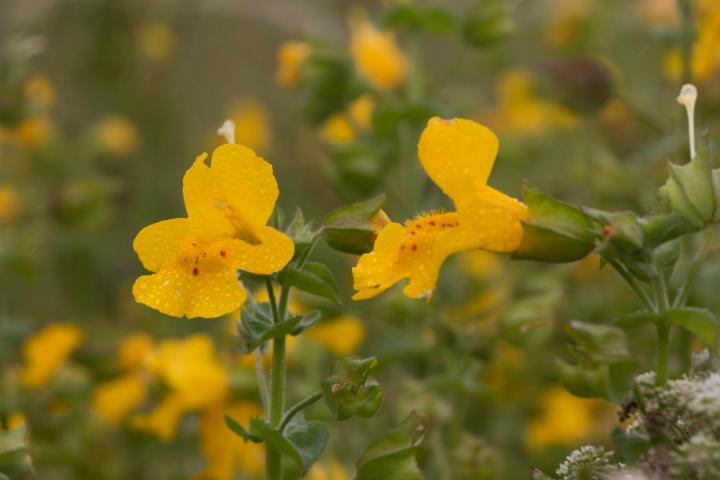
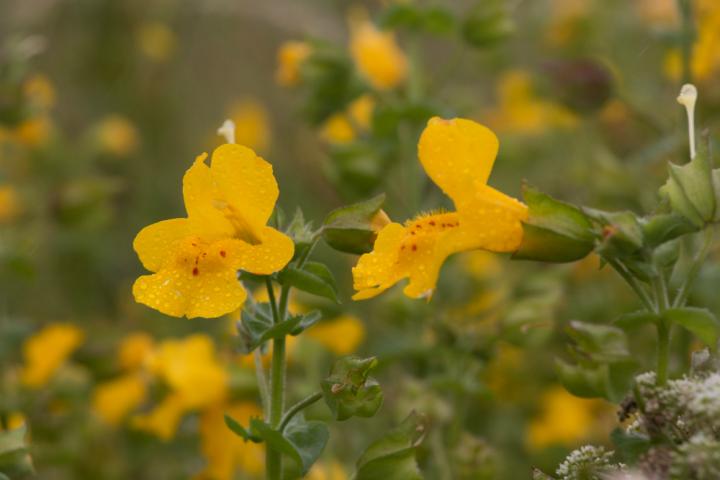
The plant, referred to as 'Shetland's monkeyflower', produces yellow flowers with small red spots. It is larger than the typical monkeyflower and its flowers are more open.
Researchers say the finding is significant as it shows that a major evolutionary step can occur in non-native species over a short period of time, rather than over thousands of years.
Associate Professor Dr Mario Vallejo-Marin said: "Evolution is often thought to be a slow process taking thousands or millions of years. Yet we show that a major evolutionary step can occur in a couple hundred years."
A team from Stirling's Biological and Environmental Sciences, working with Dr James Higgins at the University of Leicester, carried out tests after a "chance encounter" with the plant while conducting fieldwork near Quarff, Shetland.
Led by postdoctoral researcher Dr Violeta Simon-Porcar, they measured the plant's genome size and surveyed 30 populations of monkeyflowers from Shetland and across the United Kingdom.
The plants were then grown under controlled conditions and their floral and vegetative characteristics were measured to compare the effect of genome duplication in morphology and flowering time.
The team also conducted genetic analyses to investigate the relationship between the new polyploid plant and other populations in the Shetland Isles.
Genome duplication is common in the evolutionary history of flowering plants and many crops – such as potatoes, tobacco and coffee – are polyploids. However, it is rare to witness the phenomenon in recent history.
While genome duplication seems to be particularly common in hybrids between different species, the new plant has doubled its genome without hybridisation and has the same species as both its father and mother.
The Stirling team say that young polyploids, such as the new plant, provide an opportunity to investigate the early stages of an important evolutionary process.
Dr Vallejo-Marin said: "The fact that the new polyploid involves a non-native plant is poignant, given the fact that human activities are transporting all sorts of animal and plant species well beyond their native habitats. This raises the possibility that non-native species may increasingly participate in major biological processes, including the formation of new types pf plants and animals."
He continued: "We found that genome duplication has immediate effects on the morphology and life strategy of this plant. Plants with double the DNA in their cells produce larger flowers, larger leaves, thicker stems, but they also take longer to flower.
"Although these type of changes are predicted by theory, demonstrating them is complicated as in older polyploids the parental species may be missing or may have evolved since the separation of the polyploid and non-polyploid lineages."
The paper, Recent autopolyploidisation in a wild population of Mimulus guttatus (Phrymaceae), has been published in the Botanical Journal of the Linnean Society.
###
Dr Simon-Porcar was funded through a postdoctoral fellowship from Plant Fellows.
Media Contact
Greg Christison
[email protected]
01-786-466-687
http://www.stir.ac.uk
Related Journal Article
http://dx.doi.org/10.1093/botlinnean/box052