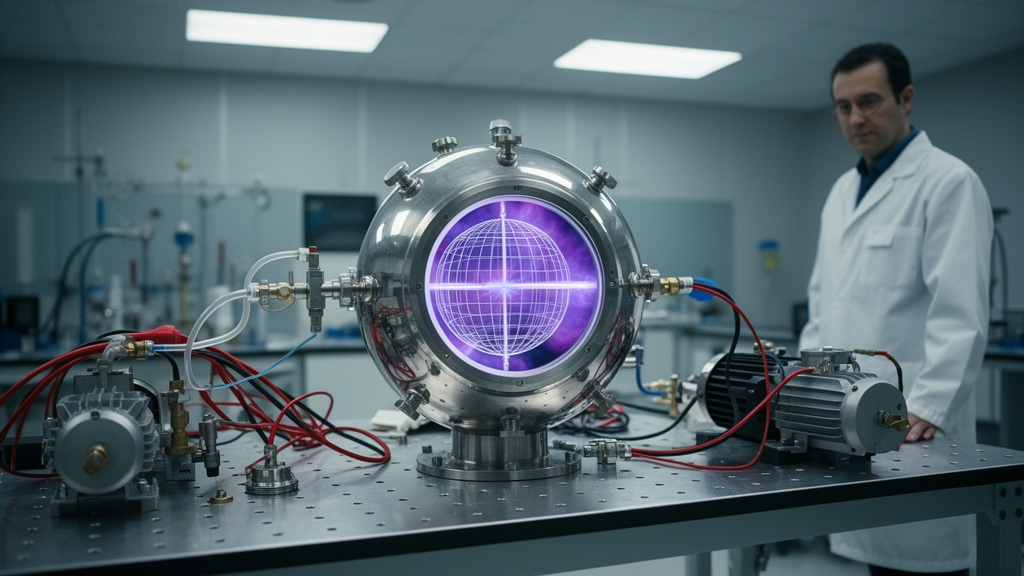
Fusors are having a moment. These small, cheap fusion devices—formally known as inertial electrostatic confinement (IEC) fusion devices—have quietly multiplied in basements, classrooms, and university labs around the world, and they are increasingly attractive as compact neutron sources with humanitarian benefits ranging from neutron activation analysis to medical radioisotope production. But neutrons are agnostic to the user’s intent. A team of researchers at the University of Bristol has now run the numbers on a question that sounds like the plot of a techno-thriller: could a rogue actor use these tabletop fusion devices to convert fertile thorium-232 or uranium-238 into the fissile isotopes needed for a nuclear weapon? Their answer, published in Frontiers in Nuclear Engineering, is a resounding no—at least not without breakthroughs that would transform the entire field.
The physics of the concern is straightforward. IEC devices confine plasma with electric fields rather than the magnetic fields used in tokamaks and stellarators. In their simplest form, they consist of a vacuum chamber containing two concentric electrodes with several kilovolts applied between them. When a gas mixture of hydrogen or helium isotopes is fed in at low pressure and ionised, positive ions accelerate toward the central cathode from all directions. If ions arriving from opposing directions collide with sufficient kinetic energy, they can fuse. The concept was demonstrated in the 1960s by Farnsworth and Hirsch, and its elegant simplicity—combined with low construction cost—has spawned an internet community of ‘fusioneers’, dozens of peer-reviewed home-built devices, and at least one built by a 12-year-old.
For a device operated as a particle source, the dominant metric is the neutron production rate. Here the fusor’s simplicity becomes its limitation: there is a fundamental trade-off between collision probability and the mean free path of ions. Raising the gas pressure increases the number of ions in a given volume and thus the chance of collisions, but ions are then more likely to scatter before reaching the energy threshold needed to fuse. This conundrum has historically capped the neutron output of conventional Farnsworth-Hirsch fusors, sufficient for fundamental experiments and transmutation studies but far short of what industrial applications would demand. One promising workaround is ‘solid state fusion’, in which fusion fuel is immobilised in the metal electrode itself, giving a fuel density drastically higher than gas-phase operation. Pioneered for the deuterium-helium-3 reaction in 2003 and extended to deuterium-deuterium fusion at Kyoto University in 2007, the approach has attracted interest from NASA, which experimented with deuterated erbium targets, and from research groups in Eindhoven, Sydney, and Portland.
It is precisely this progress that raises security questions. Fast neutrons at high flux, produced by devices that are small, cheap, and built subtly outside regulatory control, could in theory generate radioisotopes of general nuclear security hazard—with fissile plutonium-239 chief among them. The authors note that the ‘knowledge’ barrier to proliferation has been significantly reduced by the internet and AI tools, meaning that limiting access to materials and monitoring technology development matters more than ever. Reactor technology for plutonium production and uranium enrichment has been in the public domain for nearly 70 years, but those are elaborate industrial facilities; an IEC device can be assembled from widely available components at marginal cost, and researchers have even demonstrated fusors with home-made aluminium vacuum chambers, eliminating the need for specialised ultra-high-vacuum parts.
To assess the risk quantitatively, the Bristol team took a first-principles approach using deliberately conservative assumptions. They imagined a feed of pure fertile precursor—100 percent uranium-238 or thorium-232—and assumed that every neutron produced by the source is of appropriate energy to cause transmutation, with 100 percent neutron efficiency: each neutron converts exactly one fertile nucleus into one fissile atom, with no parasitic absorptions. Under these idealised conditions, they calculated the mass production rate for a given neutron source intensity, targeting the International Atomic Energy Agency’s ‘significant quantity’—the amount of uranium-233 or plutonium that a new proliferator could use to build a first weapon, accounting for manufacture losses.
The results are stark. The record D-D IEC fusor, which may achieve somewhat higher rates in D-T mode, would yield only minuscule masses of fissile material per unit time. Producing a significant quantity of plutonium-239 or uranium-233 with a single such device would take vastly longer than the half-lives of the isotopes themselves—meaning it would be physically impossible, since the fissile material decays as fast as it accumulates. Even the record neutron production rate for any electrically driven fusion system, reported by SHINE Technologies with a beam-gas target device, would require roughly 17,700 years of continuous operation to accumulate a significant quantity of plutonium-239, or about 14,700 years for uranium-233. As a rough feasibility limit, the authors calculate that a neutron source or array of sources would need to exceed 10^16 neutrons per second to make a significant quantity of fissile material within 10 years—a rate out of range of contemporary device technologies.
The ideal case is unrealistic in any event, and the team’s neutron energy analysis reveals why. Fusion neutrons emerge at approximately 2.5 MeV for D-D fusion or 14 MeV for D-T fusion, and at these energies they have a much greater chance of fissioning a fertile nucleus than of being captured to transmute it. For D-T neutrons striking uranium-238, the capture-to-fission cross-section ratio is so unfavourable that the capture efficiency falls to 0.00075, and the fissile product would almost immediately be fissioned before building up. D-D neutrons perform somewhat better, with a capture efficiency of 0.054 for uranium-238, and can accumulate relatively high product concentrations—making them the best unmoderated choice despite D-T’s higher neutron intensities. Thermal neutrons, by contrast, are captured very efficiently and require little material to interact, but the fissile products also capture and fission readily at thermal energies, meaning the product would need regular chemical extraction at very low concentrations before it is lost. Intermediate spectra offer the best compromise, with close to no fissions of either fertile or fissile isotopes, but the cross sections are small enough that meters-thick blocks of uranium or thorium would be needed to avoid terrible geometric efficiency. Moderation, meanwhile, introduces its own losses through parasitic absorption, and fusion neutron cross sections are small enough that most neutrons fail to scatter at all through a moderator that does not over-moderate.
The engineering practicalities are equally damning. IEC fusors need high-power electrical supplies, and one of the best-reported devices runs at high voltage for comparatively modest neutron output. A conservative linear scaling of power to neutron production rate—for instance by operating a vast array in parallel—would demand a continuous gigawatt-scale electrical supply, likely an excessive undertaking even for the largest economies, and the resulting heat release would be challenging to hide from remote observers. The authors offer a historic comparator: the two Windscale piles at Sellafield, each of which was designed to produce a combined annual plutonium output from natural metallic uranium fuel. Pile technology is well proven, requires no fusor and power-supply design complexity, is roughly a thousand-fold less conspicuous going by thermal release, and does not need a large electrical supply. While single IEC devices are much smaller and easier to hide than a pile or enrichment facility, an array capable of fueling a weapons program would most likely be at least as large as conventional facilities once shielding requirements are counted—including gamma shielding and sky-shine protection against detection from above. If D-T fusion were used, the tritium supply required over the duration of operations would itself be non-trivial to obtain, and tritium safeguards should be maintained.
The conclusion is unambiguous: even the highest-intensity IEC fusion neutron sources are orders of magnitude too weak to produce kilogram quantities of fissile material on any meaningful timescale. Even 1,000 current IEC fusors operated in tandem would take millennia to accumulate a significant quantity. A rogue entity with the capability to acquire or fabricate the hundreds or thousands of devices required would almost certainly find it far more attractive to simply build a uranium enrichment plant or a basic nuclear pile. The authors note that only small incremental gains have been made since solid-state fusion concepts were first applied to IEC fusors in 2003, over a quarter of a century ago, and an orders-of-magnitude increase in neutron production without a similar increase in power demand is unlikely. In the remarkable case of such a breakthrough, there would be a security motivation to regulate sources capable of exceeding perhaps 10^16 neutrons per second—but that threshold would be highly context-dependent. For now, the assertion is clear: IEC fusor technology does not pose a proliferation risk as a low-cost route to fissile materials, and it is well placed as a candidate technology for sharing with non-nuclear-weapon states to support fundamental nuclear research, especially fusion, as well as a particle source for producing certain medical radioisotopes. The neutrons from these little machines, it turns out, are best spent saving lives rather than threatening them.
Subject of Research: On the feasibility of fissile material production with inertial electrostatic confinement fusion devices
Article Title: On the feasibility of fissile material production with inertial electrostatic confinement fusion devices
Article References: Little, A., Verbelen, Y., Bakr Arby, M., & Scott, T. B. (2026). On the feasibility of fissile material production with inertial electrostatic confinement fusion devices. Frontiers in Nuclear Engineering, 5, Article 1758465. https://doi.org/10.3389/fnuen.2026.1758465
Image Credits: AI Generated
DOI: 10.3389/fnuen.2026.1758465
Keywords: feasibility, fissile, material, production, inertial, electrostatic, confinement, fusion, devices, scientific research
News Source: Denise Maddox. (October 17, 2026). On the feasibility of fissile material production with inertial electrostatic confinement fusion devices. Scienmag.