Deep inside a cave in southern Albania, where a thermal stream warmed to 26 degrees Celsius flows through passages laced with hydrogen sulfide, scientists have discovered a tiny crustacean that thrives where most animal life would quickly perish. The creature, a minute bivalved crustacean known as an ostracod, has been formally described as a species new to science: Pseudocandona sulphurella. Its name, derived from the Latin word for sulfur with a diminutive suffix, is a direct nod to the hostile, sulfide-saturated waters it calls home. The discovery, published in the journal Subterranean Biology, represents the first record of a stygobiont, or groundwater-restricted, ostracod in Albania, and adds a remarkable new player to the growing roster of life sustained not by sunlight, but by the chemistry of the deep subsurface.
Ostracods are a class of small crustaceans encased in a calcified, hinged carapace that resembles a tiny clam shell. This durable shell has granted them one of the most complete fossil records of any arthropod group, stretching back hundreds of millions of years. While the majority of ostracod species inhabit marine environments and surface freshwaters, several lineages have independently invaded subterranean waters, colonizing alluvial aquifers, karstic fissures, and caves. Life underground imposes a characteristic set of evolutionary pressures: perpetual darkness, scarce and patchy food resources, and remarkably stable environmental conditions. In response, subterranean ostracods often lose their eyes and body pigment, elongate sensory hairs to better detect chemical and mechanical cues, and slow their metabolisms to a crawl, growing slowly, reproducing late, and producing few offspring. These adaptations make them fascinating models for studying how evolution sculpts organisms under energetic constraint, and useful indicators of groundwater quality and hydrological connectivity.
Sulfidic caves, however, raise the difficulty of subterranean life to another level entirely. Hydrogen sulfide, which can seep into caves from geothermal sources, the oxidation of sulfide-bearing minerals, or microbial sulfate reduction, is toxic to most animals even at moderate concentrations. Yet where sulfide-rich water meets oxygenated water or cave air, steep chemical gradients form, and these gradients become the engine of an entire ecosystem. Sulfur-oxidizing bacteria flourish along these boundaries, converting hydrogen sulfide into other sulfur compounds to harvest energy. Because these microbes can build organic matter from inorganic chemicals, a process called chemoautotrophy, they form the base of a food web that requires essentially no photosynthetic input. The famous Movile Cave in Romania and its hydrogen sulfide-rich waters, for example, host an entire endemic fauna sustained this way. Only a handful of non-marine ostracod species have ever been documented from such environments, which makes the Albanian find especially significant.
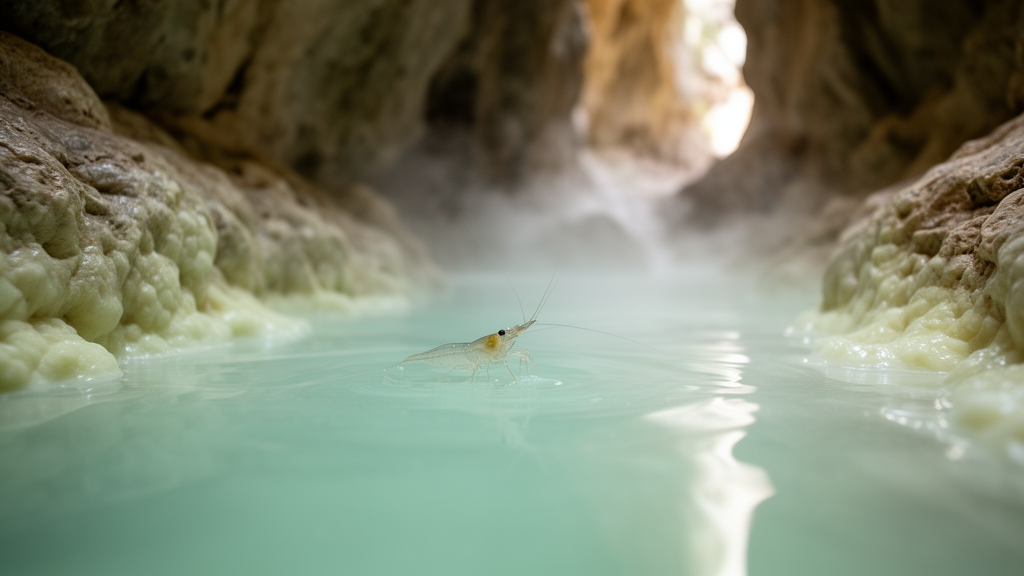
The new species was collected in the evocatively named Breath of the Dragon Cave, located in the Langarica Canyon of Albania. This extensive hypogene karst system comprises more than ten kilometres of passages, and its lower section holds a large thermal sulfidic stream along with several stagnant sulfidic lakes. The streambed is coated with a thick layer of bat guano, a rich external food resource for the cave’s stygobitic invertebrates, which include amphipods and both cyclopoid and harpacticoid copepods. Even more importantly for the new ostracod, chemoautotrophic sulfur-oxidizing bacteria abound in the stream, both as free-living bacterioplankton and as structured microbial biofilms covering the streambed. Researchers collected specimens during two surveys in April and October 2025 using a fine 180-micrometre hand net, preserving the animals in ethanol for later analysis.
Describing the species required an integrative taxonomic approach, combining meticulous morphological study with molecular sequencing. The specimens are strikingly small: males measure between 1.09 and 1.13 millimetres in carapace length, and females slightly less. Under light microscopy and scanning electron microscopy, the team documented the smooth, brownish valves bearing long, stiff setae, the intricate segmentation and setal patterns of the antennules, antennae, mouthparts, and three pairs of thoracic limbs, and the detailed architecture of the male and female reproductive structures, which in ostracods are often decisive for species identification. Notably, all collected individuals had decalcified, fragile shells, which were frequently damaged during dissection. The researchers attribute this decalcification to the acidic conditions typical of sulfidic environments, a chemical reality the animals apparently tolerate even at the cost of their own protective armour.
Molecular work on six specimens yielded mitochondrial COI sequences and nuclear 28S ribosomal DNA sequences, all belonging to single haplotypes for each marker. Phylogenetic analyses built with Bayesian inference placed Pseudocandona sulphurella firmly within the rostrata group of the genus Pseudocandona, alongside Western Palearctic relatives including Pseudocandona marchica from Norway, Pseudocandona movilaensis from Romania’s sulfidic Movile Cave, and Pseudocandona hartwigi from Poland. COI p-distances to the closest species, roughly 0.150 and 0.151, are consistent with clear species-level separation. Three independent species delimitation methods, the distance-based ASAP and the tree-based bPTP and GMYC approaches, all confirmed the new species as distinct. Intriguingly, the analyses also revealed that members of the genus Pseudocandona do not all form a single evolutionary lineage, pointing to the likely polyphyly of this taxonomically tangled genus and reinforcing calls for future revision.
That the new species belongs to the rostrata group is itself noteworthy. This clade, comprising more than a dozen known species, is otherwise dominated by animals living in ordinary surface waters, with only one previous stygobiont representative, Pseudocandona movilaensis of Movile Cave. The rostrata group is Palearctic in distribution, and only a few species have also been recorded in North America. Most members live in lakes, ponds, and streams, although several, including Pseudocandona stagnalis, Pseudocandona semicognita, and Pseudocandona tenuirostris, are known to tolerate acidic conditions, a possible pre-adaptation that may have eased the evolutionary transition into acidified sulfidic caves. With two strict stygobionts now known from sulfidic caves, the group appears to have independently produced cave-restricted sulfide specialists more than once, hinting at a recurring evolutionary pathway into these extreme habitats.
Perhaps the most visually arresting finding came from the scanning electron microscope: the valve surfaces and bodies of Pseudocandona sulphurella are extensively coated with bacteria, including small undetermined bacilli and filamentous, Thiothrix-like sulfur oxidizers. These bacteria convert hydrogen sulfide into other sulfur compounds to gain energy, and they are frequently found as epibionts on crustaceans in sulfidic habitats, from amphipods in Romanian groundwaters to ostracods at methane seeps in Lake Baikal. Such associations can benefit the bacteria, which gain transport and access to host-derived nutrients, and potentially the host as well, since the microbial coat may serve as a browsable food resource. Whether the relationship in Pseudocandona sulphurella is mutualistic, commensal, or something more complicated remains an open question, but it places the new species squarely within a recurring ecological theme of sulfidic ecosystems worldwide.
The discovery carries significance well beyond the description of a single animal. Albania’s living ostracod fauna has been studied mainly around the ancient, biodiverse lakes Prespa and Ohrid, which host exceptionally rich and endemic assemblages, but no stygobiont ostracod had ever been documented in the country until now. More broadly, the find underscores the value of sulfidic caves as natural laboratories for studying adaptation, speciation, and the ecology of chemoautotrophic communities, systems where life is fuelled by geochemistry rather than sunlight. Because subterranean species typically have small, localized ranges and narrow physiological tolerances, they are also acutely vulnerable to environmental change and groundwater disturbance. Each new species documented from these hidden ecosystems, whether a dragon-breath cave in Albania or a sealed sulfur cave in Romania, expands our understanding of where and how life can persist on Earth, and offers a preview of the kinds of chemically driven biology that astrobiologists suspect might operate on other worlds.
Subject of Research: Discovery and integrative taxonomic description of a new sulfide-tolerant cave-dwelling ostracod crustacean from Albania
Article Title: A new extremophile species of Pseudocandona ( Crustacea , Ostracoda ) from a sulfidic cave in Albania
Article References: Rossetti, G., Ștefan, A., Motoc, R., Sarbu, S. M., & Mazzini, I. (2026). A new extremophile species of Pseudocandona (Crustacea, Ostracoda) from a sulfidic cave in Albania. Subterranean Biology, 56, 137-159. https://doi.org/10.3897/subtbiol.56.188589
Image Credits: AI Generated
DOI: 10.3897/subtbiol.56.188589
Keywords: ostracod, extremophile, sulfidic cave, Albania, stygobiont, Pseudocandona, groundwater biodiversity, chemoautotrophy, integrative taxonomy, phylogenetics, epibiotic bacteria, karst
News Source: Gavin Prescott. (October 17, 2026). Sulfur-loving shrimp relative discovered in Albania’s Breath of the Dragon Cave. Scienmag.