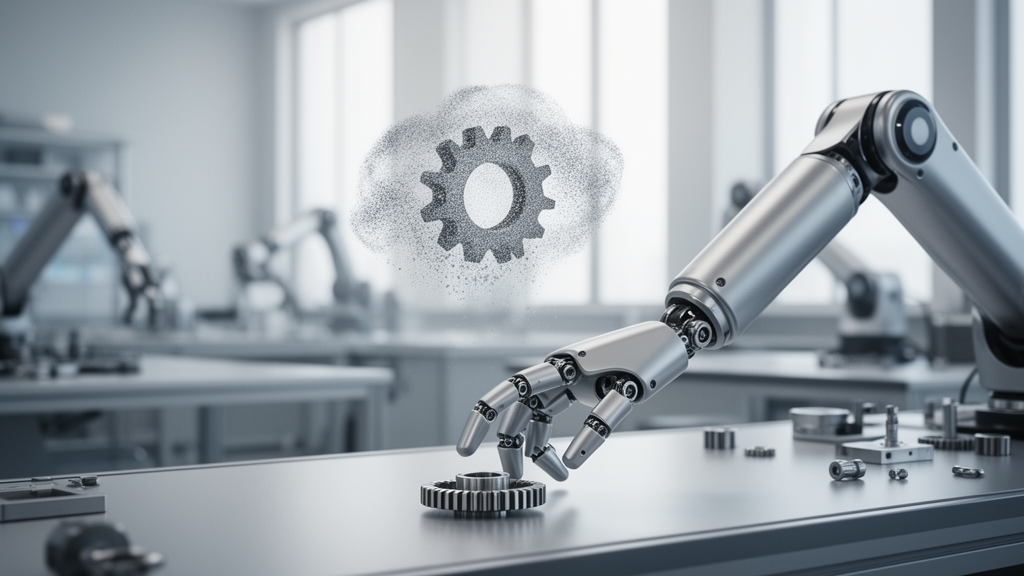
The same mathematical machinery that conjures photorealistic images from random noise is now quietly transforming how robots move, plan, and think. A comprehensive review published in Frontiers in Robotics and AI maps the explosive collision between diffusion models—the generative engines behind tools like Stable Diffusion—and the field of robotics, documenting a research wave that has grown from a handful of papers to hundreds in just a few years. According to the authors, publications applying diffusion models to robotics rose from three in 2022 to 39 in 2023, 87 in 2024, and 397 in 2025, a curve so steep that the field has effectively been rebuilt around generative principles in under half a decade.
Diffusion models work by learning to reverse a gradual corruption process. During training, clean data is progressively degraded with Gaussian noise over many steps; a neural network is then trained to predict the noise that was added at each stage, guided by a mean squared error loss. At generation time, the model starts from pure noise and iteratively denoises it, step by step, until a coherent sample of the target distribution emerges. The foundational framework, the Denoising Diffusion Probabilistic Model introduced by Ho and colleagues in 2020, formulates this as a parameterized Markov chain with a forward noising process and a learnable reverse process. Score-based generative models, which estimate the gradient of the log-density of perturbed data, provide the theoretical underpinning and were later extended into continuous-time stochastic differential equations, allowing finer control over the trade-off between sample quality and diversity.
What makes this mathematics so valuable for robots is a property that earlier generative approaches lacked: the capacity to represent complex, multimodal distributions without collapsing them into a single averaged answer. Traditional Gaussian policies used in reinforcement and imitation learning struggle when multiple valid actions exist for the same situation—if a robot can reach around an obstacle to the left or the right, a Gaussian model may blend the two and steer straight into the obstruction. Diffusion models sidestep this by capturing the entire manifold of plausible behaviors. They also offer flexible conditioning, through classifier guidance or the now-standard classifier-free guidance, which lets researchers steer generation with text, images, reward signals, or safety constraints. Their known weakness, however, is speed: iterative denoising requires many sequential inferences, which clashes with the high-frequency feedback loops real hardware demands.
The review organizes the field along four macro dimensions, beginning with environmental data preparation—arguably the most practical bottleneck in robot learning. Real-world robot data is expensive, gathered through kinesthetic teaching, teleoperation, or passive observation, all of which require experts and time. Simple augmentation techniques like cropping or color shifts add no semantic information, and domain randomization remains limited by the gap between simulated and real worlds. Diffusion models enable semantic-level augmentation instead. The CACTI system, the first to use diffusion models for robot dataset generation, replays demonstrations while manually masking and regenerating obstacles with Stable Diffusion, allowing a single policy to achieve a 62 percent success rate across 18 semantic tasks and 100 layout variations, with the semantic in-painting providing a 15 to 20 percentage point gain over standard image augmentations. GenAug refined this pipeline by rendering geometric placeholders from mesh datasets and using depth-aware generation to prevent physically impossible objects, while ROSIE automated the entire process by combining a segmentation model with a large language model that writes the text prompts.
The data-scaling frontier has since extended to robots and viewpoints themselves. RoVi-Aug uses the Segment Anything Model to isolate robots in images and generates new embodiments and camera perspectives with fine-tuned diffusion and 3D-aware models, decoupling learned skills from specific hardware. On the reinforcement learning side, frameworks like SYNTHER fuse experience replay with diffusion-based data expansion to increase sample efficiency, and Gen2Sim and RoboGen combine GPT-4 reasoning with diffusion generation to build complete simulation environments, tasks, and reward functions automatically. The review notes candid limitations: these pipelines generate objects, backgrounds, and viewpoints but not new skills, cascaded models can propagate errors, frame-by-frame generation lacks temporal consistency, and inference remains slow.
In decision-making, diffusion models have redefined both offline reinforcement learning and imitation learning. Diffuser pioneered planning as a non-autoregressive denoising process over entire trajectories, avoiding the compounding errors of recursive prediction and proving its worth in long-horizon tasks like block stacking. Decision Diffuser steers generation toward high-reward outcomes with classifier-free guidance, Diffusion-QL balances behavioral cloning with Q-value maximization, and AdaptDiffuser fine-tunes itself on reward-guided synthetic data, achieving strong results on a physical KUKA arm without extra real demonstrations. On the imitation side, Diffusion Policy has become the field’s reference point, representing visuomotor control as a conditional denoising process with a Transformer backbone and receding-horizon control, successfully deployed on real Franka arms for precise manipulation. Equivariant Diffusion Policy then showed that enforcing geometric symmetries lets robots master cluttered picking tasks from fewer than 50 demonstrations.
Speed remains the central obsession of follow-up work. Consistency Policy compresses a teacher model into a student that acts in one to three denoising steps; VDD distills models into a mixture of experts; SDP maintains a rolling buffer of partially denoised trajectories so each cycle finishes instantly; BRIDGER warm-starts the reverse process from an existing policy instead of pure noise. More radical departures replace denoising altogether: Flow Guided Policies model a continuous vector field for smoother, high-frequency steering, and DiffuseLoco demonstrates that optimized diffusion models can hit 100 Hz torque-level inference for terrain-adaptive quadrupedal and bipedal locomotion. Meanwhile, the representation frontier has moved from 2D pixels to 3D point clouds with DP3, to NeRF-pretrained semantic encodings with 3D Diffuser Actor and DNAct, and most recently to dynamic four-dimensional Gaussian world models in DP4, which let robots anticipate how scenes will change over time.
Above the control loop, diffusion models are emerging as reasoning engines. StructDiffusion rearranges unseen objects from point clouds and language instructions; DALL-E-Bot uses web-scale image generation to visualize goal states before manipulating them; and Diffusion-CCSP composes per-constraint diffusion models into factor graphs that jointly satisfy stacking, stability, and connectivity requirements. Video-generation approaches such as UniPi and HiP turn planning into text-conditioned video synthesis, with AVDC extracting actions from synthetic videos via optical flow and depth. Safety-focused work embeds Control Barrier Functions into the denoising process—SafeDiffuser enforces probabilistic guarantees across diffusion timesteps, and LTLDoG ensures trajectories satisfy linear temporal logic specifications. Yet the challenges are formidable: foundation-scale models demand gigabytes of memory and struggle to exceed one to five hertz on embedded hardware, while stable contact control requires at least 50 Hz. The review highlights proposed solutions including consistency distillation, FP8 and INT8 quantization, adaptive denoising budgets, and slow-fast architectures that decouple deliberate reasoning from reactive control.
The authors close with a sober assessment of what stands between today’s demonstrations and general-purpose embodied intelligence. The simulation-to-reality gap persists despite generative domain adaptation and the promising ‘digital cousins’ concept of the ACDC framework, which trades exact replication for distributional density. Datasets like Open X-embodiment and AgiBot World remain fragmented in format and modality, and no unified benchmark exists for measuring cross-environment adaptability, viewpoint generalization, or safety. Embodied foundation models such as RDT—a Diffusion Transformer pretrained on over a million trajectories that runs real dual-arm chores in residential settings—and DiffusionVLA, which pairs autoregressive reasoning with continuous action generation, point toward the destination, but their manually constructed action mappings struggle to scale across radically different bodies. The field’s trajectory is nonetheless unmistakable: from data factories to policies to planners, denoising has become the connective tissue of robot learning, and the review argues that safety-constrained, hardware-aware, and physics-grounded diffusion frameworks will determine whether this generative revolution finally steps out of the simulator.
Subject of Research: Applications of diffusion generative models across robot learning, control, planning, and embodied AI
Article Title: Diffusion models in robotics: a comprehensive review
Article References: Bai, L., Du, C., Wang, J., & Chen, X. (2026). Diffusion models in robotics: a comprehensive review. Frontiers in Robotics and AI, 13, Article 1905499. https://doi.org/10.3389/frobt.2026.1905499
Image Credits: AI Generated
DOI: 10.3389/frobt.2026.1905499
Keywords: diffusion models, robotics, generative AI, reinforcement learning, imitation learning, Diffusion Policy, motion planning, data augmentation, sim-to-real, embodied foundation models, trajectory optimization, control barrier functions
News Source: Denise Maddox. (October 17, 2026). Robots Learn by Denoising: How Diffusion Models Are Rewiring Machine Control. Scienmag.