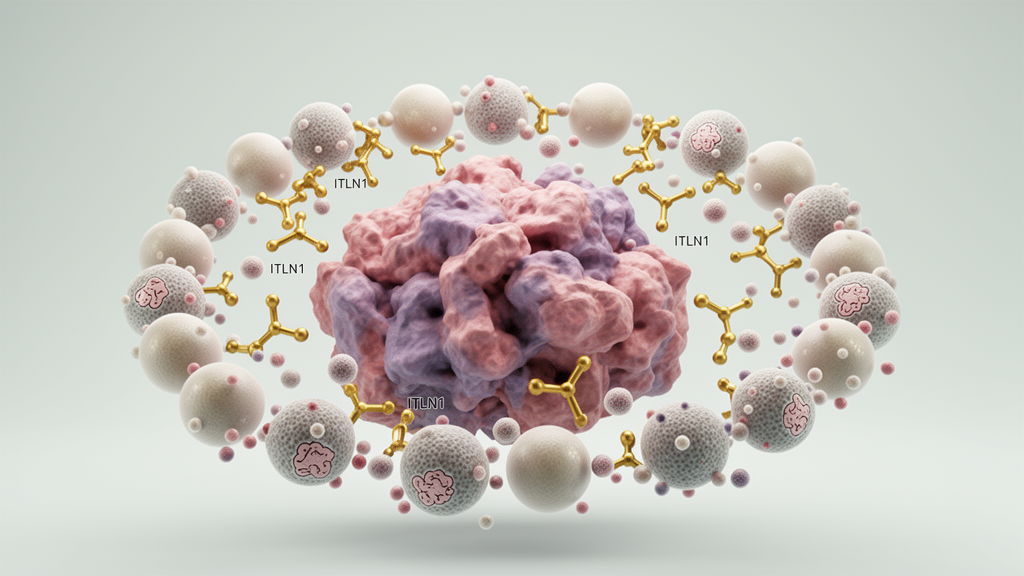
Deep inside colorectal tumors, a quiet molecular choreography may decide who lives and who dies. A new study published in Nature Communications has identified intelectin-1 (ITLN1), a protein secreted by the intestinal epithelial lining, as a long-overlooked conductor of the immune response against colorectal cancer. According to the research team led by Li Chen, Zheng Hu, Dan Xie, and Qizhou Lian, ITLN1 does not simply disappear from tumors as an innocent bystander of malignant transformation. Instead, its loss actively dismantles a critical anti-cancer defense by disrupting how neutrophils — the most abundant white blood cells in the human body — mature, travel, and position themselves within the tumor microenvironment.
The findings emerge from an unusually comprehensive technical arsenal. The researchers combined multiplex immunohistochemistry, which stains multiple proteins simultaneously on tissue sections, with spatial analysis algorithms that map the physical distances between different cell types. They layered on top of this single-cell transcriptomics, which reads the gene expression profiles of individual cells, and chromatin-accessibility profiling, which reveals which genes are poised for activation in each cell. Perturbation models in mice, including genetic silencing of Itln1, allowed the team to test whether the correlations they observed in human tissue reflected true causal mechanisms rather than mere statistical associations.
In treatment-naïve human colorectal cancer samples, the researchers found that patients whose tumors expressed higher levels of ITLN1 had a distinctly different immune landscape. These tumors harbored greater numbers of infiltrating neutrophils, and critically, the mature neutrophils — identified by the co-expression of S100A9 and CXCR2 — sat significantly closer to ITLN1-positive tumor epithelial cells. This spatial intimacy was not incidental. Patients with this pattern of dense, well-positioned mature neutrophils survived longer than those whose tumors lacked ITLN1 expression and the accompanying neutrophil organization.
The mouse experiments transformed these human correlations into a mechanistic narrative. When the researchers silenced Itln1 in colorectal cancer models, tumors grew faster and spread more aggressively to distant sites. The silencing impaired the generation of mature CXCR2-positive, CD101-positive neutrophils in the bone marrow and reduced their recruitment into the tumor. In their place, immature neutrophils marked by LTF and S100A9 accumulated preferentially in hypoxic regions — the oxygen-starved zones within tumors where immature myeloid cells often suppress rather than support immune attack.
The mechanism the team uncovered reads like a molecular relay race spanning multiple organs. ITLN1, produced by epithelial cells in the gut, activates a JAK1/STAT3 signaling pathway that subsequently engages C/EBPδ, a transcription factor that governs the final stages of granulopoiesis — the process by which neutrophils mature from precursor cells in the bone marrow. This ITLN1–STAT3/C/EBPδ axis drives terminal granulopoiesis and upregulates CXCR2, the chemokine receptor that mature neutrophils use to home toward tumors. The result is a cross-tissue communication system in which an epithelial signal from the gut reaches the bone marrow and instructs it to produce and dispatch fully armed, tumor-killing neutrophils.
Perhaps the most therapeutically exciting result came from the team’s rescue experiments. When the researchers administered recombinant ITLN1 — the purified protein produced in the laboratory — to mice with silenced Itln1, neutrophil maturation was restored and the tumor-killing activity of these cells returned. This suggests that ITLN1 is not merely a biomarker that correlates with better outcomes but a functional agent that, if delivered, could reprogram the immune environment of colorectal tumors.
The study challenges a long-standing oversimplification in tumor immunology. Neutrophils have historically been cast as villains in cancer biology — suppressive cells that promote metastasis and dampen effective anti-tumor responses. This work adds crucial nuance by demonstrating that the same cell type can be a potent anti-cancer weapon when it reaches full maturity and is positioned correctly within the tumor architecture. The distinction between helpful and harmful neutrophils, the researchers suggest, may hinge on their maturation state and spatial relationship to tumor cells rather than on their mere presence or absence.
The spatial dimension of the findings carries particular weight in the era of cancer immunotherapy. Checkpoint inhibitors, which unleash T cells against tumors, have transformed treatment for melanoma and lung cancer but have shown limited efficacy in colorectal cancer, particularly in the microsatellite-stable subtype that accounts for the majority of cases. The identification of an epithelial-derived signal that governs neutrophil positioning opens a parallel therapeutic avenue that does not rely on T cells. If mature neutrophils can be recruited and organized within tumors through ITLN1 or drugs that mimic its downstream effects, this could complement existing immunotherapies or offer an alternative for patients whose tumors do not respond to checkpoint blockade.
The researchers acknowledge that the work was performed in treatment-naïve samples and mouse models, and that translating these findings into clinical practice will require further validation. Nonetheless, the identification of a cross-tissue axis linking gut epithelial ITLN1 to bone marrow granulopoiesis and tumor neutrophil organization represents a conceptual advance in understanding how the body’s first-line immune cells are mobilized against cancer. As the field moves toward spatially resolved, multi-omic profiling of tumors, studies like this one demonstrate that where a cell sits — not just what it is — may be the key to unlocking the next generation of cancer treatments.
Subject of Research: ITLN1, a gut epithelial protein, suppresses colorectal cancer by orchestrating neutrophil maturation and spatial anti-tumor immunity via a JAK1/STAT3–C/EBPδ–CXCR2 axis.
Article Title: ITLN1 suppresses colorectal cancer progression by orchestrating neutrophil maturation and spatial organization
Article References: Chen, L., Zhai, X., Chen, S., Luo, J., Sun, J., Qiao, G., Yang, C., Zhang, Y., Lou, X., Kou, M., Guo, L., Li, Z., Xie, D., Hu, Z., & Lian, Q. (2026). ITLN1 suppresses colorectal cancer progression by orchestrating neutrophil maturation and spatial organization. Nature Communications. https://doi.org/10.1038/s41467-026-78599-2
Image Credits: AI Generated
DOI: 10.1038/s41467-026-78599-2
Keywords: colorectal cancer, ITLN1, intelectin-1, neutrophils, tumor immunology, cancer microenvironment, granulopoiesis, JAK-STAT signaling, C/EBPδ, CXCR2, spatial biology, single-cell transcriptomics
News Source: Nathaniel Bowman. (October 17, 2026). ITLN1 suppresses colorectal cancer progression by orchestrating neutrophil maturation and spatial organization. Scienmag.