A humble molecule first pulled from ergot fungus more than a century ago is now commanding attention across food science, dermatology, and pharmacology. Ergothioneine, a sulfur-containing derivative of the amino acid histidine, has been the subject of a comprehensive new review published in Food Chemistry: X, which synthesizes evidence on its unusual chemistry, its health-promoting potential, and the industrial hurdles standing between laboratory promise and supermarket shelves. The review, authored by Salma H. Katary and Maha Nasr, positions ergothioneine as what some researchers have dubbed a “longevity vitamin”—a compound so biologically distinctive that neither humans, animals, nor plants can make it, yet one that our bodies actively hoard through a dedicated molecular transporter.
What makes ergothioneine chemically remarkable is its thione–thiol tautomerism. In aqueous solution, the molecule exists predominantly in the thione form, stabilized by resonance within its 2-thioimidazole ring. Unlike classical thiols such as glutathione, ergothioneine does not behave as a rapid, indiscriminate chain-breaking antioxidant. Instead, its sulfur atom participates in extensive charge delocalization, producing selective reactivity: the compound preferentially neutralizes highly aggressive oxidants—hydroxyl radicals, hypochlorous acid, singlet oxygen, and peroxynitrite—while reacting slowly with hydrogen peroxide and essentially ignoring superoxide and molecular oxygen. This chemically restrained yet targeted behavior allows ergothioneine to blunt severe oxidative insults without disturbing the basal redox balance that healthy cells depend on.
Beyond direct radical scavenging, ergothioneine modulates redox-active metal ions, particularly copper and iron, which catalyze the formation of reactive oxygen species. By coordinating these metals, the molecule may suppress copper-mediated DNA and protein oxidation and iron-driven Fenton chemistry—processes especially relevant in iron-rich tissues such as liver and kidney. Ergothioneine also accumulates preferentially in metabolically active tissues via the organic cation transporter novel type 1, or OCTN1, encoded by the SLC22A4 gene. There it mitigates mitochondrial oxidative damage, reduces lipid peroxidation, and preserves cellular energy metabolism. Preclinical studies further indicate that the compound activates Nrf2-mediated gene expression, boosting cytoprotective enzymes such as quinone oxidoreductase 1 and heme oxygenase-1, while attenuating NF-κB-driven inflammation and lowering pro-inflammatory cytokines including TNF-α, IL-1β, and IL-6 in experimental models.
The health evidence spans an unusually broad canvas. Observational studies have linked lower plasma and brain ergothioneine levels to greater cognitive impairment, hippocampal atrophy, and increased incidence of Alzheimer’s and Parkinson’s disease. In preclinical models, the compound has attenuated amyloid-β-induced neuronal apoptosis and improved memory performance. Cardiovascular research suggests protection against ischemia–reperfusion injury through scavenging of reactive oxygen and nitrogen species and preservation of nitric oxide bioavailability. In diet-induced non-alcoholic steatohepatitis models, supplementation reduced hepatic steatosis, inflammation, and fibrosis with effects comparable to silymarin. Additional findings point to roles in diabetic oxidative stress, pre-eclampsia, ocular disorders including cataract, skin photoaging, and even supportive care during chemotherapy, where experimental studies suggest ergothioneine may reduce oxaliplatin accumulation in dorsal root ganglia and protect against anthracycline-associated cardiotoxicity without compromising antitumor activity.
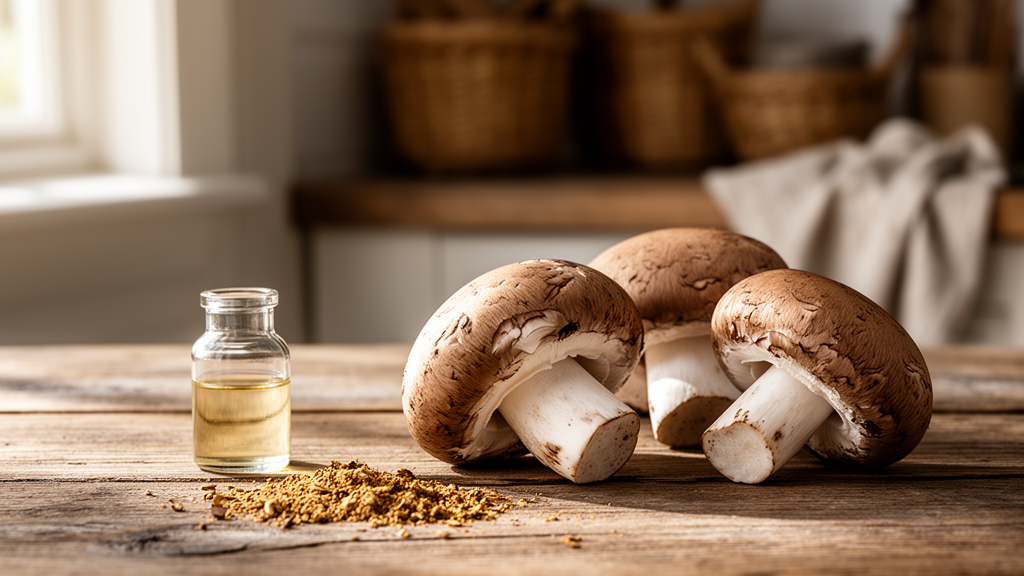
Turning promise into product requires sustainable production, and here the review lays out three competing routes. Natural extraction from mushrooms—particularly Flammulina velutipes, with porcini (Boletus edulis) holding one of the highest recorded yields at up to 7,000 milligrams per kilogram dry weight—is simple but constrained by variable raw material supply. A circular-bioeconomy variant recovers ergothioneine from spent mushroom substrate, stems, and culls using green extraction techniques coupled with membrane separation, converting a waste stream into feedstock. Chemical synthesis builds the imidazole–thiol scaffold from histidine or glyoxal/thiourea precursors, enabling scalable high-purity output but requiring potentially hazardous reagents and heavy-metal catalysts. The most promising industrial path, however, is microbial fermentation, which combines renewable feedstocks with controlled production.
Fermentation engineering is where the molecular biology gets intricate. Ergothioneine is not made by one universal pathway: the bacterial aerobic route in Mycobacterium smegmatis uses a five-enzyme egtABCDE cluster, while the fungal route in Neurospora crassa and edible fungi condenses the chemistry into just two enzymes, Egt1 and Egt2, bypassing the gamma-glutamyl cysteine intermediate entirely. Researchers engineering hosts such as Escherichia coli, Saccharomyces cerevisiae, and Corynebacterium glutamicum must balance precursor supply—histidine, cysteine, methionine, and S-adenosylmethionine—alongside pathway expression. A hybrid strategy combining fungal and bacterial modules in E. coli improved intermediate conversion efficiency by 3.8-fold. Transport engineering matters too: introducing the transporter gene mfsT1 raised the extracellular fraction of ergothioneine from 18.7 percent to 44.9 percent, easing recovery and reducing intracellular stress. Scale-up remains the bottleneck, with oxygen transfer limitations and downstream purification costs capable of erasing fermentation’s economic edge.
In the food industry, ergothioneine’s preservation credentials are already well documented. Studies in Kuruma shrimp, black tiger shrimp, Pacific white shrimp, and Red Queen crab showed that ergothioneine-rich mushroom extracts, delivered through feed or immersion, significantly inhibited phenoloxidase activity and reduced melanosis during ice storage—outcomes comparable to synthetic melanosis inhibitors. In minced bigeye tuna and beef, Flammulina velutipes extract suppressed hydroperoxide formation and preserved bright red color for up to seven and twelve days respectively. Dietary supplementation of catfish with ergothioneine-enriched feed produced firmer fillets with improved color stability during frozen storage, while emulsified sausage treated with mushroom extract matched the antioxidant performance of butylated hydroxyanisole with better sensory scores. On the plant side, ergothioneine treatment reduced browning enzymes in white button mushrooms and fresh-cut potatoes, delayed senescence in arugula and broccoli, and extended the marketable life of litchi fruit by modulating antioxidant enzyme activity, membrane integrity, and energy metabolism gene expression.
Nanotechnology is now being deployed to overcome ergothioneine’s formulation challenges. The molecule is highly water-soluble and zwitterionic, with a molecular weight of 229.30 grams per mole and low lipophilicity—properties that generate a strong hydration shell and limit passive diffusion across biological membranes. Its uptake depends almost entirely on OCTN1, which shows high affinity with a reported Km of approximately 20 micromolar, but saturable transport means higher doses do not necessarily translate into proportionally higher tissue levels. Nanoencapsulation offers a workaround. EGT-loaded chitosan nanoparticles averaging 139.6 nanometers reduced lipid oxidation and metmyoglobin formation in frozen yellowfin tuna, outperforming free ergothioneine. Chitosan-coated liposomes delayed browning in Lanzhou lily bulbs for twelve days. A self-emulsifying oral nanoemulsion produced a 3.7-fold higher peak plasma concentration in rats compared with conventional powder, indicating faster absorption kinetics.
Cosmetic and pharmaceutical applications are advancing in parallel. Hyaluronic acid-modified nanoliposomes increased ergothioneine skin retention by 225.92 percent after 24 hours in Franz diffusion experiments, while ultra-small ginsenoside-based nanoliposomes co-delivering ergothioneine with coenzyme Q10 achieved 88.6 percent encapsulation efficiency and a 16-fold increase in cumulative skin permeation, reaching the viable epidermis and dermis. Deformable hyaluronic acid-coated nanoniosomes sustained release for up to 50 hours and enhanced protection against UV-induced damage. On the pharmaceutical front, an oral bioadhesive ergothioneine hyaluronate gel protected irradiated mice against gastroenteritis, lignin nanoparticles released ergothioneine sustainably over 24 hours with pH-responsive behavior against Helicobacter pylori, and virus-biomimetic melanin nanoparticles surface-functionalized with ergothioneine delivered the compound deep into the retina via simple eye drops, preventing photoreceptor degeneration in a rabbit model of dry age-related macular degeneration with efficacy comparable to intravitreal injection of Pegcetacoplan.
Regulatory momentum is building. Synthetic L-ergothioneine has been evaluated by the European Food Safety Authority and permitted as a novel food ingredient at specified intake levels, and it holds Generally Recognized as Safe status from the U.S. Food and Drug Administration for conventional foods and dietary supplements. Toxicological assessments show low cytotoxicity and good biocompatibility, and a one-year pilot human trial using 25 milligrams per capsule three times weekly reported no treatment-related safety concerns. Yet the review’s authors are candid about the gaps: well-designed human clinical trials remain scarce, dosing regimens are unstandardized, pharmacokinetic characterization is incomplete, and much of the food preservation literature concerns Asian food systems—mushrooms, seafood, and rice products—whose findings may not generalize elsewhere. Results obtained with ergothioneine-rich mushroom extracts must also be distinguished from those of purified ergothioneine, since extract components beyond the molecule itself contribute to observed effects. Addressing these limitations through standardized quantification, rigorous clinical trial design, and head-to-head comparisons of delivery systems will determine whether this fungal gift to human health fulfills its considerable potential.
Subject of Research: Ergothioneine as a nutraceutical antioxidant: sustainable production, food applications and nano-delivery systems
Article Title: Ergothioneine as a nutraceutical antioxidant: sustainable production, food applications and delivery systems
Article References: Katary, S. H., & Nasr, M. (2026). Ergothioneine as a nutraceutical antioxidant: sustainable production, food applications and delivery systems. Food Chemistry: X, 40, Article 104638. https://doi.org/10.1016/j.fochx.2026.104638
Image Credits: AI Generated
DOI: 10.1016/j.fochx.2026.104638
Keywords: ergothioneine, antioxidant, nutraceutical, mushrooms, food preservation, nanoencapsulation, microbial fermentation, OCTN1 transporter, functional foods, cosmeceuticals, oxidative stress, sustainable production
News Source: Bethany Barker. (October 16, 2026). Mushroom-Derived Antioxidant Ergothioneine Emerges as a Sustainable Nutraceutical Powerhouse. Scienmag.