In one of the most detailed virtual accident rehearsals ever attempted for a boiling water reactor, researchers at Oak Ridge National Laboratory, together with colleagues at Idaho National Laboratory, Constellation Energy, and Global Nuclear Fuel, have simulated a large-break loss-of-coolant accident at the Limerick Unit 1 nuclear power plant in Pennsylvania, tracking the fate of 945 individual fuel rods through three full irradiation cycles and into the heart of the emergency. The verdict from this unprecedented computational campaign: not a single fuel rod would have ruptured. The work, published in Frontiers in Nuclear Engineering, marks the first time a suite of newly developed boiling-water-reactor-specific fuel models has been exercised at full-core scale under realistic operating conditions, and it offers the nuclear industry its highest-fidelity picture yet of how an entire reactor core behaves when disaster strikes.
The accident scenario in question is among the most consequential in nuclear safety analysis. During a large-break loss-of-coolant accident, or LBLOCA, a major pipe rupture drains coolant from the reactor vessel, the reactor scrams, and the fuel rods heat up as their cooling water flashes away. If cladding temperatures climb high enough, the zirconium alloy tubes surrounding the uranium dioxide pellets can balloon and burst, releasing radioactive fission products and, in the worst case, shattering the brittle, high-burnup fuel inside them. That fragmentation, relocation, and dispersal of fuel—known in the trade as FFRD—shot to prominence after the 2011 Fukushima accident, when examinations of irradiated fuel revealed that pellets can crumble into fragments during refueling, raising concerns that hot, embrittled cladding could fail catastrophically during an accident and scatter fuel debris. Regulatory agencies in the United States and abroad have since demanded ever-more-rigorous assessments of this phenomenon, particularly for fuel discharged at high burnup.
What makes the new study unusual is its sheer scope. Traditional fuel performance analyses pick out a handful of the most punishing rods—those with the highest burnup or the hottest operating temperatures—and model them in isolation. That approach identifies limiting cases but says nothing about the reactor as a whole. The team behind the new work, led by Ian Greenquist of Oak Ridge National Laboratory under the Department of Energy’s Nuclear Energy Advanced Modeling and Simulation program, instead built a multiphysics pipeline that resolves the entire 764-assembly core of Limerick Unit 1 rod by rod. The framework chains together three codes: VERA, the Virtual Environment for Reactor Applications, which computes the neutron physics and fuel depletion across the core; TRACE, the Nuclear Regulatory Commission’s thermal-hydraulics code, which simulates the two-phase flow of boiling water and steam during the accident; and BISON, Idaho National Laboratory’s finite-element fuel performance code, which calculates the temperatures, stresses, strains, and fission gas behavior inside each individual rod.
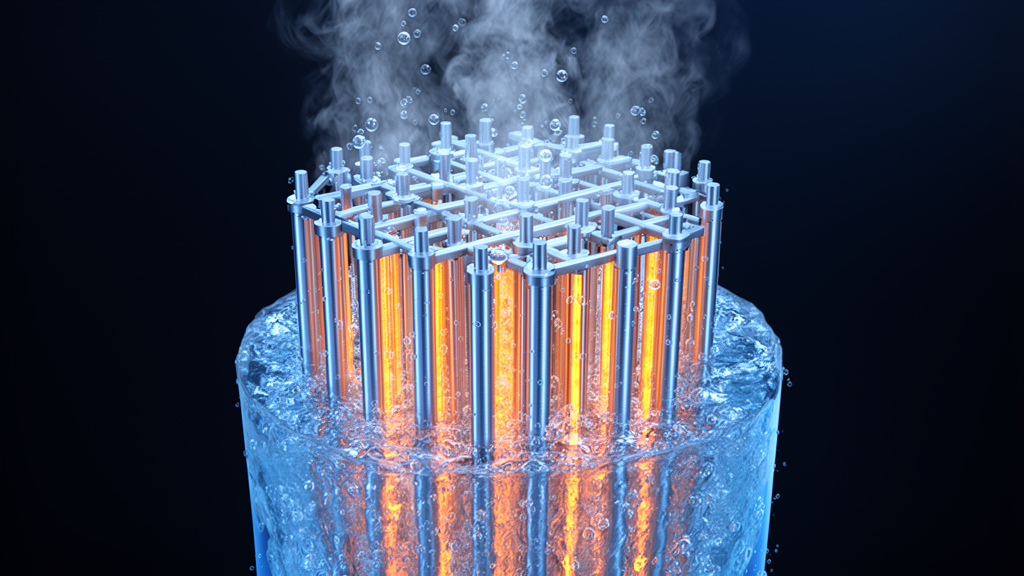
Limerick Unit 1 itself provided a demanding test case. The reactor, a General Electric design operated by Constellation Energy since 1984, runs at 3,515 megawatts thermal on a 24-month fuel cycle, with assemblies typically remaining in the core for up to three cycles. Its core is a lattice of 10-by-10 fuel assemblies, each holding 92 fuel rods plus two internal water rods, and it mixes full-length rods with short and long partial-length rods and even unenriched rods placed near control blades to soften the neutron flux gradient. To push the analysis into the high-burnup regime where FFRD concerns are sharpest, the team also folded in eight high-burnup lead use assemblies that had been irradiated in the plant’s twin unit, Limerick Unit 2, for a third cycle beyond their normal exposure limits under the Nuclear Regulatory Commission’s lead test assembly program. Real plant data—actual loading patterns, control blade positions, and coolant conditions—anchored the simulations to physical reality.
The computational choreography unfolded in stages. VERA first simulated three complete irradiation cycles, tracking the burnup, power history, and isotopic composition of every rod in a quarter of the core, then handed those histories to BISON, which modeled 945 rods—five sampled from each of 191 modeled assemblies—through normal operation. The rod selection used orthogonal sampling to ensure that no two rods came from the same row or column of any assembly, capturing the full diversity of fuel types and exposures. Meanwhile, TRACE was calibrated against BISON’s fuel centerline temperature predictions during steady-state operation, a code-to-code benchmark that showed reasonable agreement given the uncertainties involved. Once satisfied, the team ran the LBLOCA transient in TRACE, extracting time-dependent cladding surface temperatures, coolant pressures, and linear heat generation rates, and stitched these boundary conditions directly into the BISON simulations in place of the final shutdown step of the cycle. Each BISON run thus carried a rod from fresh fuel through its entire irradiation history and straight into the accident without interruption.
The BISON models themselves received a substantial upgrade for this campaign. In 2025, the code gained a set of boiling-water-reactor-specific capabilities: treatment of burnable gadolinium-oxide absorbers in the pellets and their effects on burnup and thermal conductivity, models for modern BWR cladding materials, meshing options for cladding liners, two-phase flow heat transfer, and hydrogen pickup with hydride formation. This study represents the first time these features have been exercised in a core-scale simulation set. The team incorporated gadolinium into the fuel composition and added the hydrogen pickup and hydride models, while the fuel rods were re-meshed so that axial variations in density, enrichment, and gadolinium concentration—previously averaged away—were represented block by block. The cladding secondary creep model was swapped for the LOCA-specific Erbacher formulation, fuel creep was added, and the uranium dioxide thermal conductivity correlation was updated to one better suited to the burnup and temperature range of the analysis. Not every new feature made the cut: because Limerick uses conventional Zircaloy-2 cladding, the modern cladding materials were unnecessary, and the cladding liner meshing option was left out after it triggered numerical instabilities.
Cladding integrity was judged by two independent burst criteria built into BISON. The Chapman correlation, drawn from classic LOCA experiments, computes a burst temperature from the cladding’s hoop stress and heating rate, declaring failure if the metal exceeds that threshold; the team added a minimum burst temperature of 700 degrees Celsius to keep the empirical correlation within its validated range. The strain rate criterion, by contrast, predicts rupture when the cladding’s hoop strain rate exceeds 100 per hour. The results were unambiguous. During the transient, the linear heat generation rate collapsed by roughly 99 percent as the reactor scrammed, and peak cladding temperatures reached only about 540 degrees Celsius—well below the 700-degree floor of the Chapman correlation and far below the 700-to-1,000-degree peaks reported in earlier single-code studies of comparable accidents. Neither burst model predicted a single rod failure anywhere in the core, and because the outcome was uniform across all 945 rods, no fragmentation or statistical analysis was needed to bound the FFRD susceptibility: for this reactor, under these modeled conditions, it was zero.
The detailed predictions revealed rich structure in how the core behaves. Rod-average burnup spanned 14.2 to 66.1 megawatt-days per kilogram of uranium, and the rods sorted cleanly into behavioral families. Fresh and once-burned rods, sitting in the hotter central core, ran higher powers and temperatures, while twice-burned rods on the periphery ran cooler. Peak cladding hoop strain during normal operation reached 1.1 percent, driven by the familiar cycle of thermal expansion, creep-down under coolant pressure, and renewed expansion as the cladding contacts swelling fuel. Plenum pressures climbed from 2 to 3 megapascals in fresh rods to as much as 8.9 megapascals in aggressively burned once-burned rods, propelled by fission gas release that peaked at 12.7 percent. During the accident itself, fuel temperatures spiked to 240 to 560 degrees Celsius at 100 seconds before emergency core cooling brought the core down to a stable 75 to 280 degrees, fission gas release stayed negligible because the fuel never got hot enough to activate the transient microcracking model, and the cladding cooled too quickly for hydrides to reprecipitate. Comparing against a previous version of the analysis without the new BISON features showed that individual rod predictions shifted—notably, gadolinium-bearing rods ran hotter—but the whole-core distributions changed only minimally.
The authors are careful to frame the result honestly. The findings are theoretical: no comparison to actual or experimental LOCA data has been made, and the conclusions apply specifically to Limerick Unit 1 as modeled, with its particular fuel designs, operating conditions, and safety system response—they cannot be generalized to other reactors. Nor is the framework finished. Models for fuel relocation due to fracture and for the high-burnup structure that forms in heavily irradiated pellets are still being developed and validated, the cladding liner meshing awaits a fix for its numerical instabilities, and the same updates will be applied to pressurized water reactor simulations to see whether they shift FFRD predictions there as well. Most importantly, uncertainty propagation across the three coupled codes has yet to be quantified; understanding how uncertainties in reactor conditions and input values cascade through the framework is flagged as a critical next step for establishing the accuracy of these predictions.
Still, the study signals a shift in how nuclear safety can be argued. Rather than extrapolating from a handful of worst-case rods, regulators and operators can now contemplate whole-core, rod-resolved accident analyses that capture the staggering diversity of fuel histories inside a working reactor—rods that vary in burnup by a factor of nearly five, in plenum pressure by a factor of three, and in irradiation history in ways that single-rod techniques simply cannot capture. As extended power uprates and longer fuel cycles push the existing light water reactor fleet to record capacity factors, tools like this multiphysics pipeline may become the standard by which the industry demonstrates that its fuel can survive even its worst imagined day.
Subject of Research: Multiphysics simulation of fuel fragmentation, relocation, and dispersal susceptibility during a large-break loss-of-coolant accident in a boiling water reactor
Article Title: Full-core high-burnup BWR LOCA fuel performance analysis and FFRD susceptibility
Article References: Greenquist, I., Wysocki, A., Simon, P.-C. A., Sweet, R., Gamble, K., Asgari, M., Hansen, A., Sarikaya, B., Porter, I., Tusar, J., Capps, N., & Salko, R., Jr. (2026). Full-core high-burnup BWR LOCA fuel performance analysis and FFRD susceptibility. Frontiers in Nuclear Engineering, 5, Article 1822290. https://doi.org/10.3389/fnuen.2026.1822290
Image Credits: AI Generated
DOI: 10.3389/fnuen.2026.1822290
Keywords: boiling water reactor, loss-of-coolant accident, fuel fragmentation relocation and dispersal, BISON, VERA, TRACE, fuel performance, cladding burst, high burnup fuel, Limerick Unit 1, nuclear safety, multiphysics simulation
News Source: Denise Maddox. (October 16, 2026). Simulating a Worst-Case Nuclear Accident Rod by Rod: No Fuel Cladding Bursts Predicted at a Real Boiling Water Reactor. Scienmag.