Deep beneath the karst landscapes of Yunnan Province in southwestern China, an international team of mycologists has brought to light a hidden kingdom of fungi that thrives in perpetual darkness. In a survey of six accessible karst caves spanning the eastern, western, and southeastern regions of the province, researchers isolated 34 fungal strains representing 17 species, among them one entirely new genus, 12 novel species, and five new records for caves in China. The findings, published in the journal IMA Fungus, dramatically expand the known fungal diversity of one of the world’s most complex karst regions and include the first comprehensive global checklist of cave-associated fungi, now totaling 2,240 species from 66 countries and regions.
Caves are among the most distinctive ecosystems on Earth. Characterized by strong light limitation, relatively stable temperatures, high humidity, and scarce nutrients, these subterranean environments create isolated habitats that favor the evolution of specialized microbial life. The enclosed nature of cave systems significantly reduces external disturbances, resulting in ecological networks that harbor distinct biological communities. This makes caves valuable natural laboratories for studies in ecology, microbiology, geology, and evolutionary biology. China is among the world’s leading karst regions, with carbonate rock covering approximately 3.44 million square kilometers, and its abundant cave resources are concentrated primarily in Yunnan, Guizhou, Guangxi, Hunan, Sichuan, Hubei, and Guangdong provinces. Yunnan alone houses the country’s highest cave density, with more than 200 documented caves, yet only a handful of microbial surveys had ever been conducted there.
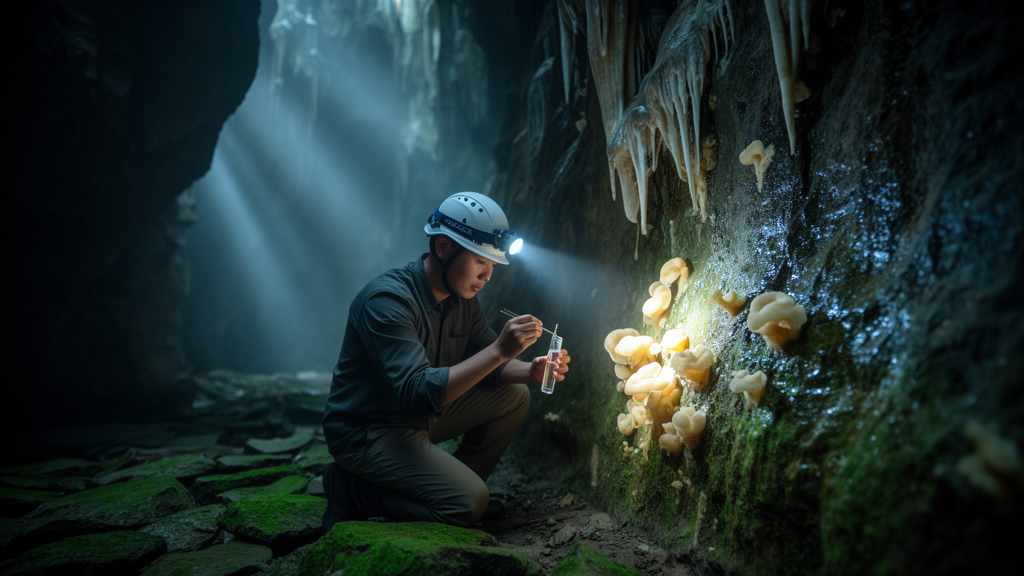
The research team, led by Xiangfu Liu and colleagues working with Qujing Normal University and partner institutions, selected six caves for sampling: two caves named Swallow Cave in Jianshui County and Fumin County, Walaya Cave in Nujiang, Xianren Cave in Yingjiang County, Sanxian Cave in Mangshi City, and Longyangxian Cave in Qujing. Elevations of the sites ranged from roughly 816 to 1,925 meters above sea level, and collections took place between December 2020 and April 2024. The researchers collected samples of air, rock, soil, twigs, feathers, and bat guano using sterile tweezers, placing each sample into sterile centrifuge tubes. Sampling sites were established at regular intervals from each cave entrance, with equal distances between adjacent stations depending on the total length of the cave.
Back in the mycology laboratory, the team employed a serial dilution plating method using potato dextrose agar and malt agar supplemented with the antibiotic amoxicillin to suppress bacterial growth. Each sample was plated in triplicate, and plates were incubated at room temperature until single fungal colonies developed. Individual colonies were then subcultured onto fresh plates and incubated at 25 degrees Celsius. The resulting cultures were deposited in herbaria and culture collections at Guizhou Medical University and the Kunming Institute of Botany, with novel species registered in Index Fungorum according to international guidelines for introducing new fungal taxa.
Identifying the isolates required a combination of classical morphology and modern molecular systematics. The researchers examined sporulating cultures under stereomicroscopes after 20 to 60 days, measuring microscopic structures such as conidiophores, phialides, conidia, asci, and ascospores. For DNA analysis, fresh mycelia grown on plates were harvested, genomic DNA was extracted with a commercial fungal DNA kit, and polymerase chain reactions targeted a suite of genetic loci including the internal transcribed spacer region, the large subunit ribosomal RNA gene, beta-tubulin, calmodulin, RNA polymerase II subunits, and translation elongation factor 1-alpha. Sequenced amplicons were assembled, aligned with MAFFT, trimmed, and concatenated into multi-locus datasets for maximum likelihood and Bayesian inference analyses run on the CIPRES Science Gateway platform.
The results were striking. Seven of the new species belong to the genus Trichoderma, a group of fungi famous as biological control agents and enzyme producers: Trichoderma dehongense, T. hongheense, T. mangshiense, T. neogongcheniae, T. neopyramidale, T. nujiangense, and T. yingjiangense. The genus Trichoderma now counts more than 500 accepted species worldwide and ranks among the most common fungi found in caves, following Aspergillus and Penicillium. The team also described a new species of the economically important genus Aspergillus, named Aspergillus dehongensis after its type locality, along with Cosmospora cavernicola, Pithoascus cavernicola, and Trichocladium cavernicola. Five known species, including Aspergillus baeticus, Chaetomium subaffine, Daldinia eschscholtzii, Mucor phayaoensis, and Trichoderma obovatum, were recorded for the first time from caves in China or from entirely new substrates within cave habitats.
Perhaps the most remarkable discovery was an entirely new genus, Neoachaetomiella, typified by the new species Neoachaetomiella cavernicola, isolated from a rock surface in Sanxian Cave. Phylogenetic analyses based on combined ITS, LSU, rpb2, and tub2 sequences showed that the new genus forms an independent lineage well separated from its relatives Achaetomiella and Collariella within the family Chaetomiaceae. Morphologically, Neoachaetomiella can be distinguished by its olivaceous to olivaceous-brown, limoniform to fusiform, bilaterally flattened ascospores bearing an apical germ pore, typically measuring between 7 and 15 micrometers in length. Megablast searches of GenBank reinforced the distinctiveness of the genus, with ITS sequences showing only about 93.8 percent similarity to their closest hits. To guard against over-splitting species, the team also applied the genealogical concordance phylogenetic species recognition approach, using the pairwise homoplasy index test to detect significant recombination among closely related taxa; results below the 0.05 threshold would have indicated recombination, but none of the new species showed such signals.
The study’s global checklist elevates the census of cave-associated fungi to 2,240 species across 647 genera. Ascomycota dominates with 76.5 percent of recorded species, followed by Basidiomycota at 17.6 percent and Mucoromycota at 5.2 percent. The most frequently reported genera from caves worldwide are Penicillium with 130 species, Aspergillus with 90, and Trichoderma with 40. This inventory has grown substantially since the emergence of white-nose syndrome in North American bat populations in 2006, a devastating disease caused by the fungus Pseudogymnoascus destructans that triggered a surge in systematic cave mycology research. Notably, although P. destructans has been detected in northeast China, its prevalence and infection load appear relatively low there, suggesting that Chinese bats may exhibit strong resistance to the pathogen.
Cave fungi matter far beyond taxonomy. They play indispensable roles in cave ecosystems, contributing to organic matter decomposition, nutrient recycling, and biomineralization, and serving as food sources or symbionts for cave fauna. Some are pathogens that threaten native cave dwellers and even human visitors, while certain cave fungi may act as sources of airborne pollutants affecting the respiratory health of tourists and cave staff. On the beneficial side, many cave-derived fungi produce unique secondary metabolites with antimicrobial, enzymatic, or cytotoxic properties, highlighting their potential for pharmaceutical and biotechnological applications. Species such as Aspergillus cavernicola, A. fumigatus, Penicillium expansum, and P. panissanguineum have demonstrated strong antimicrobial or antitumor activities, while Trichoderma harzianum and T. polysporum rank among the most widely used biological control agents in the world.
The authors caution that cave ecosystems face mounting pressure from expanding tourism and human activity, threatening fragile habitats and their endemic microbial communities. Many newly discovered fungal species are confined to small, localized habitats that are highly susceptible to disturbance or destruction. The team calls for establishing a comprehensive database of cave microbial resources, implementing long-term ecological monitoring in representative caves, and adopting minimal-disturbance sampling strategies, especially in undeveloped caves. They also note that current research relies heavily on culture-based methods, which often fail to recover slow-growing or fastidious taxa, and advocate incorporating metagenomics and next-generation sequencing to capture unculturable organisms. With most of Yunnan’s more than 200 caves still unexplored, the true fungal diversity of these subterranean realms almost certainly remains underestimated, and each new expedition may yet yield genera no one has ever named.
Subject of Research: Fungal diversity and taxonomy in karst caves of Yunnan Province, China
Article Title: Culturable mycota from Karst caves in Yunnan Province, China
Article References: Liu, X.-F., Tibpromma, S., Chethana, K. W. T., Lu, L., Hyde, K. D., Lu, W.-H., Xu, R.-F., Chen, X.-M., Zhang, X., Chen, M.-X., Xiao, X.-J., Zhao, C.-L., Du, T.-Y., Dai, D.-Q., Al-Arjani, A.-B. F., Elgorban, A. M., Suwannarach, N., Kumla, J., Yu, F.-Q., … Karunarathna, S. C. (2026). Culturable mycota from Karst caves in Yunnan Province, China. IMA Fungus, 17, Article e190343. https://doi.org/10.3897/imafungus.17.190343
Image Credits: AI Generated
DOI: 10.3897/imafungus.17.190343
Keywords: mycology, cave fungi, Yunnan, karst caves, new species, Trichoderma, Aspergillus, Neoachaetomiella, biodiversity, fungal taxonomy, China, subterranean ecosystems
News Source: Roger Howard. (October 16, 2026). Hidden Kingdoms: New Fungal Genus and 12 Novel Species Discovered in Yunnan’s Karst Caves. Scienmag.