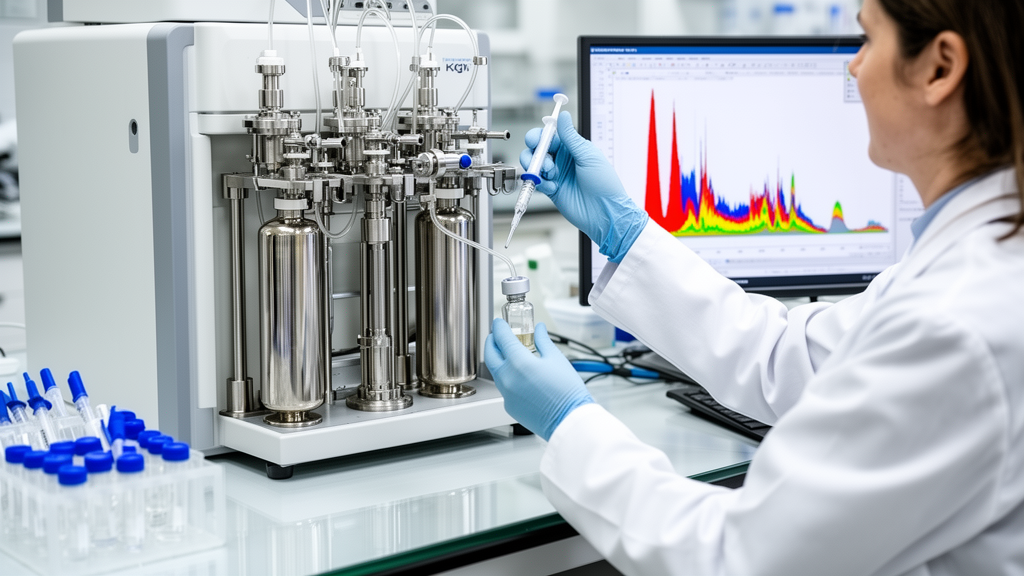
Cholesterol-lowering drugs are among the most widely prescribed medicines in the world, and bempedoic acid has quickly become an important option for patients who cannot tolerate statins. Yet behind every tablet that reaches a pharmacy shelf lies a quieter scientific challenge: how do quality-control laboratories prove, quickly and reliably, that each pill contains exactly the right amount of active ingredient? A new study published in Discover Chemistry offers a striking answer, combining statistical design, chromatographic science, and environmental accounting into a single analytical method for measuring bempedoic acid in pharmaceutical dosage forms.
The research, led by Jagdish V. Manwar of the Takshashila Institute of Pharmaceutical Education and Research in Washim, India, applies an approach known as Analytical Quality by Design, or AQbD. Rather than relying on trial-and-error tinkering to find workable chromatographic conditions, AQbD treats the analytical method itself like a manufactured product. The scientist first defines what the method must achieve, identifies the variables that most strongly influence performance, and then uses structured experiments and statistical models to map out a design space in which the method is guaranteed to work. This philosophy mirrors the Quality by Design principles that regulators already expect in pharmaceutical manufacturing, and it is increasingly being extended to the laboratory procedures that verify drug quality.
Bempedoic acid presents a genuinely interesting analytical puzzle. The molecule is an ATP-citrate lyase inhibitor, blocking a key enzyme in hepatic cholesterol biosynthesis, and its chemical structure includes a substituted aromatic ring with a tert-butyl group and a terminal carboxylic acid. That carboxylic acid has a pKa of roughly 4.5, which means its ionization state, and therefore its chromatographic behavior, changes dramatically with pH. In reversed-phase high-performance liquid chromatography on a C18 column, the drug is retained mainly through hydrophobic interactions between its aromatic portion and the alkyl chains of the stationary phase. When the mobile phase is acidic, at pH 2.5, the carboxyl group remains protonated and non-ionized, strengthening those hydrophobic interactions, sharpening the peak, and suppressing troublesome secondary interactions with residual silanol groups on the silica support. At higher pH, the molecule becomes ionized, retention drops, and peak tailing can appear.
To exploit this chemistry systematically, Manwar designed a 3² full factorial experiment examining two critical method parameters: the percentage of acetonitrile in the mobile phase, ranging from 30 to 40 percent, and the flow rate, ranging from 0.8 to 1.2 milliliters per minute. Three critical quality attributes were tracked across nine experimental runs: retention time, the number of theoretical plates as a measure of column efficiency, and the tailing factor as a measure of peak symmetry. The resulting data were fitted with second-order quadratic models using response surface methodology, allowing the researcher to visualize how each variable, and their interactions, shaped chromatographic performance across the entire experimental space rather than at a single arbitrary point.
The statistics told a clear story. The retention time model achieved a coefficient of determination of 0.97446, with an F-value of 48.31 and a p-value of 0.00158, confirming that flow rate was the dominant lever on how quickly the drug eluted. The theoretical plate model was even more impressive, explaining 99.7 percent of the variance in column efficiency with an F-value of 564.38. The tailing factor model was weaker, at R² of 0.78467, but this turned out to be good news rather than bad: peak symmetry stayed within acceptable limits, between 1.0 and 1.2, across all nine runs, meaning the method was inherently robust to small fluctuations in operating conditions. Pareto analysis confirmed that acetonitrile composition had the largest positive effect on column efficiency, while both variables had only minor influence on peak shape.
From this statistical landscape, one experimental run emerged as the winner. Batch BMP.1, corresponding to 30 percent acetonitrile in water adjusted to pH 2.5 with orthophosphoric acid, delivered at 0.8 milliliters per minute through a C18 column with ultraviolet detection at 276 nanometers, produced a retention time of approximately 3.42 minutes with nearly 7,900 theoretical plates and a tailing factor of about 1.20. The choice of 276 nanometers was itself deliberate: it matches the drug’s absorption maximum from aromatic π–π* transitions while avoiding interference from mobile phase components and degradation products that absorb more strongly at lower wavelengths. Notably, the 30 percent organic content is far below the 60 to 70 percent used in many reported methods, a choice that pays dividends later in the environmental assessment.
Validation followed the ICH Q2(R1) guidelines that govern analytical procedure testing worldwide, and the numbers are impressive. Linearity held across the range of 5 to 25 micrograms per milliliter with a correlation coefficient of 0.9993. Precision was tight, with relative standard deviations below 1.5 percent for both intra-day and inter-day measurements. Accuracy, confirmed by standard addition recovery studies at three concentration levels, ranged from 101.21 to 101.52 percent. The limits of detection and quantitation came in at 0.81 and 2.07 micrograms per milliliter respectively, sensitive enough for trace-level work. When the method was applied to a commercial tablet formulation, Bemdac 20 milligrams, it measured a drug content of 100.41 percent of the label claim with a relative standard deviation of just 0.71 percent, with no interference from tablet excipients.
Perhaps most compelling for regulators and manufacturers is the method’s stability-indicating capability. Forced degradation studies exposed bempedoic acid to oxidative stress with 3 percent hydrogen peroxide, acidic hydrolysis with 0.01 normal hydrochloric acid, and alkaline hydrolysis with 0.01 normal sodium hydroxide. The drug proved most vulnerable to oxidation, degrading by 93.30 percent, while acidic conditions caused 78.43 percent degradation and alkaline conditions only 18.83 percent. Crucially, in every case the chromatographic method cleanly resolved the remaining parent drug peak from the degradation products, which appeared at distinct retention times. This ability to distinguish intact drug from its breakdown products is exactly what stability testing under ICH guidelines demands, and it means the method can serve not just for routine quality control but for assessing how formulations age over time.
The final layer of the study is its environmental accounting, an increasingly important dimension of analytical chemistry. Using the Analytical Eco-Scale, which subtracts penalty points for solvent hazards, consumption, energy demand, and waste from a perfect score of 100, the method earned an 82, well above the threshold of 75 that signifies an excellent green procedure. The AGREEprep metric, which evaluates sample preparation against ten criteria derived from the principles of green analytical chemistry, returned a score of 0.38, reflecting moderate greenness typical of conventional reversed-phase methods that rely on organic solvents. The National Environmental Method Index pictogram confirmed that the method uses no persistent, bioaccumulative, or toxic chemicals, operates at a non-corrosive pH, and generates less than 50 grams of waste per analysis, with acetonitrile’s hazardous classification being the main deduction.
Taken together, the study demonstrates that rigorous statistics and environmental responsibility need not be competing goals. By systematically mapping the design space rather than guessing at optimal conditions, the method achieves fast, precise, stability-indicating analysis in under four minutes per run while keeping organic solvent use deliberately low. The author notes that photolytic and thermal degradation studies were outside the present scope and could extend the stability profile in future work, but the framework is ready for routine quality control of bempedoic acid tablets and adaptable to other formulations after appropriate validation. As green analytical chemistry moves from aspiration to expectation in pharmaceutical laboratories, this AQbD-guided approach offers a template for how the next generation of quality-control methods might be built: statistically grounded, regulatorily compliant, and environmentally self-aware.
Subject of Research: Development and greenness evaluation of an AQbD-optimized RP-HPLC method for quantifying bempedoic acid in pharmaceutical dosage forms
Article Title: AQbD-guided statistical optimization and multi-metric greenness evaluation of liquid chromatographic method for analysis of bempedoic acid in pharmaceutical dosage forms
Article References: Manwar, J. V. (2026). AQbD-guided statistical optimization and multi-metric greenness evaluation of liquid chromatographic method for analysis of bempedoic acid in pharmaceutical dosage forms. Discover Chemistry, 3(1), Article 580. https://doi.org/10.1007/s44371-026-01026-4
Image Credits: AI Generated
DOI: 10.1007/s44371-026-01026-4
Keywords: bempedoic acid, AQbD, RP-HPLC, factorial design, green analytical chemistry, stability-indicating method, forced degradation, pharmaceutical analysis, Analytical Eco-Scale, AGREEprep, method validation, cholesterol
News Source: Bethany Barker. (October 16, 2026). Statistically Tuned Green HPLC Method Delivers Fast, Reliable Testing of Cholesterol Drug Bempedoic Acid. Scienmag.