…
The appearance of a poem in the pages of Pediatric Research is itself a small event worth pausing over. Journals devoted to child health overwhelmingly publish clinical trials, cohort studies, laboratory investigations, and systematic reviews, and their pages rarely make room for the literary voice. Yet the decision to publish “A child’s quiet revolution” by Azhar Ilham Haliwungan signals something important about the field’s self-understanding. Pediatrics has always been more than applied biology; it is a discipline constituted by a relationship between vulnerable patients, anxious families, and clinicians who must translate scientific knowledge into care. A poem that sits alongside the data of pediatric research reminds readers that the numbers in every paper ultimately describe children whose lives, and whose families’ lives, are transformed by what medicine can and cannot do.
The author’s position is notable in this respect. Haliwungan is affiliated with the Department of Islamic Studies at Selamat Sri University in Kendal, Indonesia, rather than with a medical school or children’s hospital. That disciplinary distance may be precisely what allows the poem to frame pediatric medicine in moral and even theological terms. The abstract speaks of compassion, dignity, and collective responsibility as the true measures of civilization, language that belongs more naturally to ethics and religious thought than to biostatistics. The inclusion of such a voice in a research journal suggests an editorial willingness to treat the humanities not as decoration but as a parallel mode of inquiry into the same questions that science addresses with instruments and protocols.
The central paradox the poem identifies deserves careful articulation. Children are, in a strictly biological sense, the most vulnerable members of any human population. Their immune systems are immature, their organs are still developing, their capacity to communicate symptoms is limited, and their futures depend entirely on the decisions of adults. Every pediatrician works daily inside this asymmetry of power and capability. And yet, as the poem insists, children are simultaneously the deepest reservoir of hope that humanity possesses. They embody possibility in a way no adult can; they are the future tense made flesh. To hold both truths at once, that a child is maximally at risk and maximally promising, is the emotional and ethical burden of pediatric care, and it is a burden that clinical literature seldom names directly.
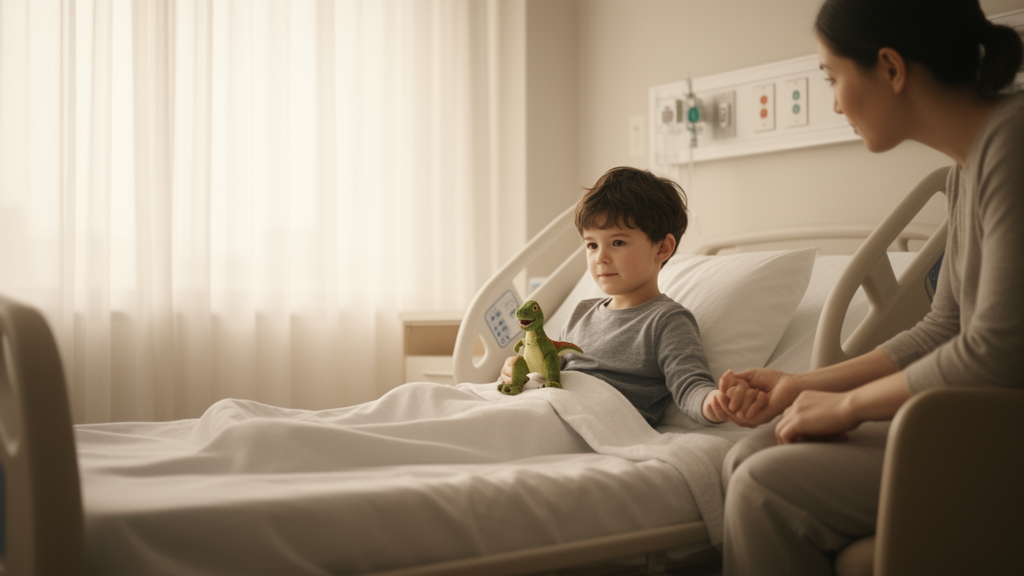
The images the abstract enumerates, neonatal wards, parental devotion, and life-sustaining technologies, map onto the actual geography of modern pediatric medicine. The neonatal intensive care unit is perhaps the most vivid setting in which this paradox plays out. There, infants born at the very edge of viability are sustained by ventilators, incubators, and infusion systems that represent decades of accumulated scientific progress. A generation ago, many of these infants would not have survived their first hours. The technology is genuinely revolutionary, and yet the outcome of any single stay in such a unit remains profoundly uncertain. Parents keep vigil at incubator sides, unable to hold their children, negotiating hope against fear in ways that no monitor can quantify. The poem’s juxtaposition of medical progress with enduring uncertainty captures this lived reality with an economy that a research report cannot achieve.
Parental devotion, the second image named in the abstract, is a subject that pediatric research encounters constantly but rarely theorizes. Studies of family-centered care, parental stress in intensive care settings, and the long-term psychological effects of a child’s hospitalization all document the intensity of the parent-child bond under medical duress. What the poem adds is an acknowledgment that this devotion is not merely a variable affecting outcomes but a moral force in its own right. The parent who keeps watch over a fragile newborn is performing an act of love that predates and exceeds any clinical intervention. Medicine depends on this devotion, cooperates with it, and is often humbled by it. A discipline that treats the family as context can learn something from a poem that treats the family as co-author of the child’s survival.
The poem’s most philosophically ambitious claim is its reframing of survival as a moral achievement rather than a clinical outcome. In the language of research, survival is an endpoint: a child is discharged, a follow-up visit is scheduled, a Kaplan-Meier curve extends a little further. The poem asks readers to see the same event differently. When a child who might have died instead lives, something has been achieved not only by the technology and the clinicians but by a whole civilizational arrangement, the allocation of resources, the training of specialists, the social willingness to spend enormous effort on its smallest members. Survival, in this view, is evidence about who we are, not merely about what our machines can do. This is a claim that resonates with long traditions in moral philosophy, which have often used the treatment of the weakest as a test of a society’s character.
It is worth considering why such a message arrives in poetic form rather than as an editorial or a commentary. Poetry operates by juxtaposition and image rather than by argument and evidence, and this makes it suited to expressing tensions that prose analysis tends to resolve prematurely. The tension between progress and uncertainty, between vulnerability and hope, is not a problem to be solved but a condition to be inhabited. Clinicians inhabit it daily; researchers encounter it whenever a promising therapy produces mixed results; parents live inside it for the duration of a child’s illness. A poem can hold these opposites in suspension without pretending that one will eventually cancel the other. That capacity may be why the genre has historically accompanied medicine, from ancient healing rituals to contemporary narrative medicine programs that train clinicians to read literature as a way of deepening their attention to patients.
The poem’s insistence that every child’s heartbeat quietly reshapes our collective future also invites reflection on the demographics and economics of child health. Globally, the majority of childhood deaths occur in settings with limited resources, from preventable causes that affluent countries largely eliminated decades ago. The moral achievement the poem describes is therefore unevenly distributed: whether a child’s survival counts as a routine clinical outcome or a small miracle depends heavily on where that child is born. Pediatric research as a field has increasingly attended to these inequities, and a poem published in an international journal, written by an Indonesian scholar, quietly underscores that the questions of dignity and responsibility it raises are global ones. The heartbeat that reshapes the future belongs to children in Kendal and in Kansas City alike, and civilization is measured, the poem suggests, by how all of them are cared for.
There is also something instructive in the poem’s restraint. It does not celebrate scientific achievement alone, as the abstract explicitly states. This restraint distinguishes it from a triumphalist narrative in which the history of pediatrics is a story of steady conquest over disease. The reality is more complicated. Advances in neonatology have created categories of survivors with ongoing medical and developmental needs; technologies that sustain life raise questions about the quality and meaning of the lives sustained; and every intervention occurs within finite systems that must ration attention and resources. A mature account of pediatric progress holds gratitude and ambivalence together. The poem models that maturity, honoring the ventilators and the wards while refusing to let them exhaust the meaning of what happens in those spaces.
The publication details of the piece, received in late July, accepted in mid-August, and published in early September of 2026, indicate a swift editorial path, suggesting that the journal recognized the piece as timely rather than treating it as a curiosity. The author declares no competing interests and received no specific funding, which is unremarkable for a poem but worth noting as a reminder that some contributions to medical literature arise from vocation rather than from the grant economy that shapes most research. The work stands outside the usual incentive structures, and perhaps for that reason it can say things that funded studies cannot.
For readers of the journal, the practical significance of such a publication may lie in what it offers clinicians and researchers as they return to their routine work. Burnout and moral distress are well-documented hazards of pediatric practice, particularly in intensive care settings where clinicians repeatedly accompany families through uncertainty and loss. Literature has long served as a resource for meaning-making in such circumstances, and a poem that dignifies the emotional labor of pediatric care can function as a form of professional sustenance. It reminds the researcher poring over datasets that behind every data point is a heartbeat, and it reminds the clinician that the vigil at the incubator is witnessed and understood.
Finally, the poem’s title deserves a last reflection. Revolutions are usually imagined as loud, sudden, and public. A quiet revolution is something else: incremental, cumulative, and easily overlooked. Child survival is exactly such a revolution. Over the past century, the near-miraculous has become routine, so gradually that the miracle is often forgotten. Each discharged newborn, each recovered toddler, each child who grows up to parent children of their own constitutes a small, quiet transformation of the human story. By naming this revolution, the poem performs a service that data alone cannot: it restores to view the moral grandeur of an enterprise that, in its daily practice, can seem merely technical. The heartbeat of a child, the poem insists, is not only a vital sign. It is a sign of what humanity, at its best, chooses to be.
Subject of Research: …
Article Title: A child’s quiet revolution
Article References: Haliwungan, A. I. (2026). A child’s quiet revolution. Pediatric Research. https://doi.org/10.1038/s41390-026-05449-8
Image Credits: AI Generated
DOI: 10.1038/s41390-026-05449-8
Keywords: pediatric care, pediatric research, medical humanities, neonatal intensive care, child health, compassion in medicine, bioethics, survival outcomes, pediatric medicine, healthcare ethics, childhood illness, medical technology
News Source: Harold Sullivan. (October 16, 2026). A Child’s Quiet Revolution: Rethinking Survival in Pediatric Care. Scienmag.