Deep in the tropical rainforests of Asia, a rare and elusive group of insects has just undergone one of the most dramatic taxonomic makeovers in recent entomological history. The antlion genus Nuglerus, known for more than a century from only a handful of specimens scattered across museum drawers, has been comprehensively revised by an international team of researchers. The result is nothing short of spectacular: four brand-new species, one resurrected species, one new combination, one synonym, and the first-ever description of a Nuglerus larva. The genus now comprises eight species, patchily distributed across the tropical rainforests of the Oriental region, from southern India to the islands of Indonesia.
The revision, published in the Deutsche Entomologische Zeitschrift, was led by Yuchen Zheng of China Agricultural University, together with Davide Badano and Xingyue Liu. It represents the first integrative taxonomic treatment of Nuglerus, combining detailed morphological examination of type specimens with DNA barcoding of the mitochondrial cytochrome C oxidase subunit 1 (COI) gene. The work was made possible by the examination of types and additional material held in collections across Europe, North America, and Asia, including the Natural History Museum in London, the Museum of Comparative Zoology at Harvard, the Muséum national d’Histoire naturelle in Paris, and the Naturhistorisches Museum in Vienna.
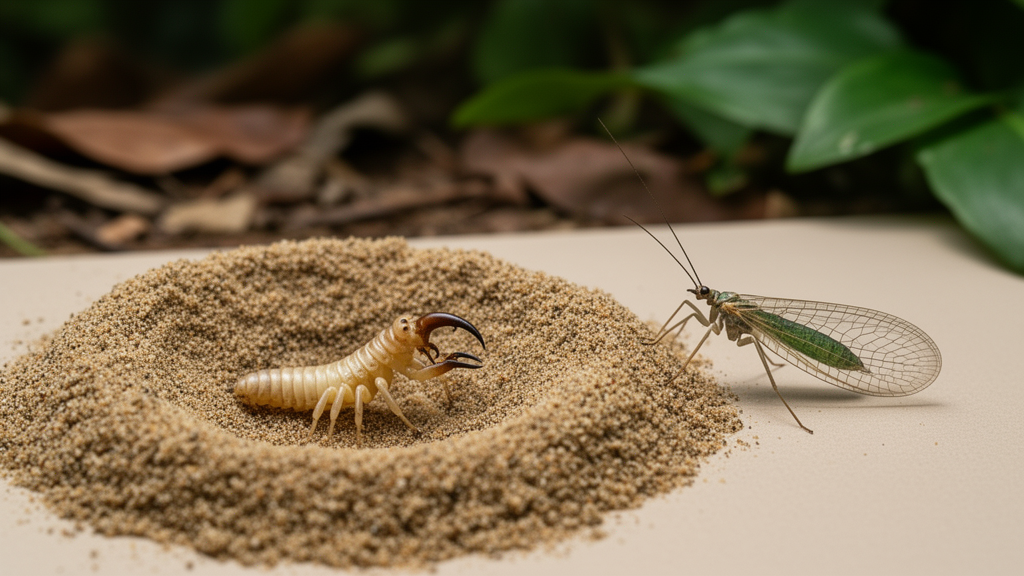
Nuglerus belongs to the antlion family Myrmeleontidae, a neuropteran lineage with a worldwide distribution comprising roughly 303 genera and about 2100 species. Antlions are famous for their larvae, many of which dig into sand or dried debris to hide and ambush prey, sometimes building the iconic sandy pit-shaped traps that have earned them the nickname doodlebugs. While sandy habitats are scarcer in forests than in open environments, forest-dwelling antlions have evolved remarkable alternative habits: some live in wet soil, others under rock overhangs, in leaf litter, on the surface of living plants, in tree holes, or on rock surfaces. The subfamily Dendroleontinae, to which Nuglerus belongs, is a lineage adapted to forest environments, with its present center of diversity in the humid forests of the Oriental and Australian regions, where more than 170 species are known.
Before this revision, Nuglerus included only three valid species: N. maculatus from Indochina, N. pustulatus from Sri Lanka, and N. scalaris, described in 1912 with a type locality erroneously recorded as Brazil. All three were described from single specimens, and additional material has rarely been reported. The systematic position of the genus has long been debated, having been treated as a monogeneric subtribe within Dendroleontini or as a separate tribe based exclusively on morphological characters. Because of the lack of specimens, Nuglerus was not included in the phylogenomic analysis of Machado and colleagues in 2019 and was only provisionally placed in Dendroleontini pending further revision.
The new study resolves several long-standing taxonomic puzzles. The team found that N. scalaris, whose type locality was clearly wrong since the species does not occur in the New World, is in fact identical in body and wing markings to the Sri Lankan N. pustulatus and is now treated as a junior synonym of that species. The Philippine species N. insignis, described by Banks in 1939 and previously considered a junior synonym of N. maculatus, has been restored as a valid species based on examination of type material and further specimens from Palawan. The two species are allopatric, with N. insignis distributed in the Philippine Islands and N. maculatus in Indochina, and COI barcode results confirm they are clearly distinct, with interspecific genetic divergence of about 0.144 to 0.146.
Perhaps the most surprising result is the transfer of Acratoleon dispar Banks, 1934, endemic to Borneo in Malaysia, to Nuglerus as a new combination. The examination of the holotype revealed that it displays all the diagnostic characters of Nuglerus, including the gently curved forewing second anal vein, the presence of at most two hindwing presectoral crossveins, and plate-like male gonocoxites 9. By contrast, the type species of Acratoleon, A. flavum from the Solomon Islands, has a forewing second anal vein that bends at a sharp angle toward the third anal vein, confirming it is a member of the subfamily Nemoleontinae. The reassignment of N. dispar underscores how much hidden diversity and misclassification still exists among tropical rainforest insects.
Four new species are described in the revision. Nuglerus guimaraesae, from southern India, is named in honor of Monica Guimaraes Cruz, curator at the Naturalis Biodiversity Center in Leiden, and may be endemic to the tropical rainforests of the Western Ghats. Nuglerus maizuqii, from the Malay Peninsula in Malaysia, is dedicated to Mr. Zuqi Mai, who collected the holotype. Nuglerus ruzzieri, from Sulawesi in Indonesia, is named after the Italian entomologist Enrico Ruzzier, who brought the specimen to the attention of the authors. Nuglerus shihongliangi, from Bali in Indonesia, was collected in coastal tropical rainforest and is named in honor of Dr. Hongliang Shi, a coleopterologist and one of the collectors of the holotype. Each new species is distinguished by a unique combination of characters, including the shape and extent of the thickened brown marking on the wing poststigmal area, the coloration of the vertex, pronotum, and mesonotum, and the structure of the female genitalia.
The molecular analysis sequenced the COI barcode region for six specimens of Nuglerus and two specimens of Layahima chiangi as outgroups. Interspecific genetic divergence among the five species of Nuglerus analyzed ranged from 0.098 to 0.149, while intraspecific divergence between the two specimens of N. insignis was only 0.012. These values are congruent with the morphological species boundaries proposed in the revision. The phylogenetic analyses, performed using maximum likelihood and neighbour-joining methods, produced identical tree topologies, further supporting the distinctness of the newly recognized species.
One of the most important discoveries of the study is the first description of the larval stage of Nuglerus, based on a third-instar larva of N. maizuqii from Malaysia. The larva was found on a karst limestone platform in a tropical rainforest, where it covered itself in a shallow layer of dry sandy debris and ambushed prey. When exposed on the surface, the larva moved relatively quickly, pausing regularly. The adult rests with its wings flattened against the substrate and may prefer wider surfaces such as bark or rocks rather than slender branches. Larval morphology provides key phylogenetic evidence: several characters, including the absence of an odontoid process on abdominal segment 8, the relatively elongate segment 9, and the reduced rastrum and digging setae, are consistent with the tribe Dendroleontini. However, other features, such as the absence of Miller’s organ, the relatively short fore femur, and the non-upturned mandible, are typical of the tribe Acanthoplectrini. The setose plate on the anterior part of female gonocoxites 9 is also present in Australian Acanthoplectrini. These characters suggest that Nuglerus may be a transitional lineage between Acanthoplectrini and Dendroleontini, a hypothesis that a comprehensive molecular phylogeny of Dendroleontinae will help test.
The discovery of the larval habitat also has important conservation implications. Karst limestone habitats, which likely provide stable shade, temperature, and humidity, as well as moss, lichens, and salts that attract invertebrate prey, have been extensively quarried from Indochina to the Malay Peninsula in recent decades. As with many species endemic to karst habitats, Nuglerus probably faces similar ecological threats. The distribution pattern of the genus, with only two species recorded from South Asia, divergence between Indochina and the Malay Peninsula possibly related to the Isthmus of Kra, and the highest species richness on Southeast Asian islands, may reflect the restriction of Nuglerus to karst limestone habitats within tropical rainforests. Island isolation and fragmented karst habitats likely facilitated divergence among insular Southeast Asian species. Future sampling of fresh material will be essential for reconstructing the historical biogeography of this rare rainforest antlion genus and for providing baseline data for the conservation of karst fauna.
Subject of Research: Taxonomy and biodiversity of tropical rainforest antlions
Article Title: A revision of the antlion genus Nuglerus Navás, 1912 ( Neuroptera , Myrmeleontidae , Dendroleontinae ) from the Oriental region, including four new species and the first larval record of the genus
Article References: Zheng, Y., Badano, D., & Liu, X. (2026). A revision of the antlion genus Nuglerus Navás, 1912 (Neuroptera, Myrmeleontidae, Dendroleontinae) from the Oriental region, including four new species and the first larval record of the genus. Deutsche Entomologische Zeitschrift, 73(2), 333-362. https://doi.org/10.3897/dez.73.188790
Image Credits: AI Generated
Keywords: antlions, Nuglerus, Neuroptera, Myrmeleontidae, Dendroleontinae, new species, taxonomy, DNA barcoding, tropical rainforest, karst limestone, Oriental region, larval morphology
News Source: Drew Townsend. (October 16, 2026). Four new antlion species reveal hidden rainforest diversity and first larval record of rare genus Nuglerus. Scienmag.