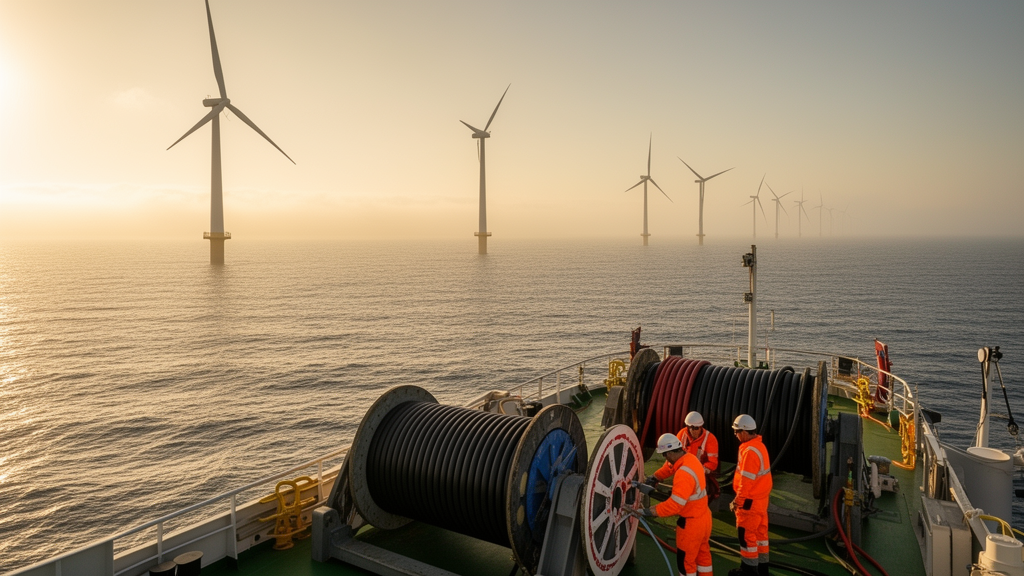
Beneath every offshore wind farm lies a hidden network…
The new study arrives at a moment when the economics of cable layout have become harder to ignore. As wind farms grow in capacity and are pushed into increasingly congested waters, the share of total expenditure tied up in the inter-array network rises accordingly. The authors point to figures suggesting that, in bottom-fixed offshore projects, the collection cables can represent on the order of eight to nine percent of the levelised cost of energy, a proportion large enough that even modest percentage savings in trenching and conductor expenditure translate into meaningful reductions in the overall cost of electricity delivered. That economic weight is precisely what motivates the multi-stage structure of the methodology, which treats the cable network not as an afterthought to turbine placement but as an optimisation problem in its own right, with its own distinct layers of spatial, topological, and electrical decision-making.
One of the more instructive aspects of the work is the way it separates the problem into stages that mirror how real projects are actually engineered. Before any routing algorithm can run, the physical site must be translated into a mathematical graph: nodes for turbines, substations, and candidate waypoints; edges for the corridors in which cable may plausibly be laid. The paper is careful about this preparatory step, distinguishing between hard-exclusion zones, where cable installation is simply prohibited, and soft-exclusion zones, where routing is possible but undesirable and therefore carries a cost. This distinction, the authors argue, is often glossed over in the literature, where spatial restrictions are either penalised loosely or handled only after a topology has already been fixed. By embedding terrain profiles and clearance requirements around fixed structures directly into the graph-construction stage, the methodology ensures that the routes considered by the optimiser are ones that could plausibly be built, rather than straight-line connections that later prove impossible.
The routing stage itself is formulated as a mixed-integer linear programme, a choice that brings both rigour and practical limitations. Mixed-integer formulations can guarantee optimality for the model as stated, which is a significant advantage over purely heuristic approaches such as genetic algorithms or ant colony methods that have featured prominently in earlier collector-system studies. Yet the combinatorial explosion inherent in network design means that the formulation must be carefully scoped. The authors restrict attention to radial topologies, in which turbines are arranged in string-like chains without bifurcations at turbine nodes, and they impose constraints on the maximum number of turbines per string. These restrictions reflect common industry practice, where radial strings simplify protection coordination, installation logistics, and maintenance planning, even though alternative topologies such as single loops or star configurations can offer higher redundancy at additional cost.
A notable contribution is the treatment of balance. In irregular sites, particularly onshore projects or offshore farms constrained by shipping lanes and other maritime activities, turbine positions are rarely uniform, and the natural clustering of turbines can produce strings of very different lengths feeding substations unevenly. The methodology includes a procedure for determining the minimum number of substation connections required under such irregular distributions, along with the ability to enforce a minimum number of turbines per string when the user requires it. This kind of balancing matters for reasons that go beyond aesthetics: uneven loading across substations affects transformer specification, installation sequencing, and the flexibility available to operators when individual strings must be taken offline for repair.
The electrical dimension of the problem is handled through conductor size selection, which the authors approach via a linear approximation of the power flow. Full nonlinear power flow calculations, while accurate, are computationally expensive when embedded inside an integer optimisation loop, so the linear approximation serves as a tractable surrogate that still captures the essential relationship between current loading, losses, and conductor capability. An interesting wrinkle in the formulation is the ability to limit the number of distinct conductor types used across the network. Standardising on fewer cable cross-sections simplifies procurement, reduces spare-part inventories, and eases installation logistics, since a single cable-laying vessel configuration can handle more of the campaign. But the paper shows that this standardisation comes at a hidden price: restricting the palette of conductor types may exclude the larger cross-sections that would otherwise be economically attractive on heavily loaded routes, and this exclusion in turn changes which routing configurations are feasible, ultimately altering the conductor types selected. The optimisation therefore navigates a genuine coupling between electrical standardisation and spatial topology, rather than treating them as separable sub-problems.
This coupling is what gives the comparison between the two solution strategies its analytical interest. In the integrated approach, routing and conductor sizing are solved together, allowing the optimiser to trade a longer trench against a cheaper conductor, or a shorter route against a more expensive cable, in a single coherent objective. In the sequential approach, the routing problem is solved first, and conductor sizes are then chosen for the fixed topology. The sequential decomposition is computationally lighter and, as the authors note, offers greater modelling flexibility when routing problems are heavily constrained, since the routing stage can be solved with techniques suited to difficult feasibility questions before the electrical sizing is layered on top. The evaluation, which uses current turbine ratings and the actual cable routings of existing onshore and offshore projects, finds that the integrated formulation generally achieves lower total costs, which is the expected outcome when a joint search space is explored without decomposition penalties. Yet the sequential approach remains valuable precisely because real projects are rarely free to redesign their topology from scratch; constrained sites, existing infrastructure, and phased development schedules often fix large parts of the layout in advance.
Perhaps the most practically significant finding is that routings which minimise trench length do not necessarily minimise total investment cost. This result cuts against a common simplification in early-stage design, where the shortest total cable length is treated as a reasonable proxy for the cheapest network. Cable cost per kilometre varies substantially with conductor cross-section, and a shorter route that forces higher loading on expensive large-section conductors, or that pushes the design toward more numerous strings with more substation connections, can easily cost more overall than a longer route using smaller cables. The paper’s demonstration that this effect interacts with the number of permitted conductor types adds a further layer: the standardisation constraint does not merely add cost directly, it reshapes the feasible routing space itself, so that the topology chosen under a restricted cable palette may differ fundamentally from the topology chosen when all cross-sections are available. For developers and engineering contractors, this suggests that trench-length minimisation and conductor standardisation should be evaluated jointly rather than sequentially as independent design rules of thumb.
The methodological choices also sit within a broader research landscape that the paper situates carefully. Earlier approaches to collector-system optimisation have drawn on minimum spanning tree and travelling salesman formulations, on metaheuristics of various kinds, and on mixed-integer programming with directed arc-pairs in which the selected direction of each candidate connection follows the flow of energy toward the substation rather than being fixed by geometry. Steiner nodes have been introduced to model detours around exclusion zones, and navigational meshes built from Delaunay triangulations have been used to construct feasible paths around obstacles. The present work distinguishes itself by insisting that the construction of the candidate graph, the enforcement of string-like radial structure, the balancing of turbines across strings and substations, and the clearance requirements around fixed structures be handled simultaneously and explicitly, rather than patched together through post-processing or iterative constraint addition.
For the wind industry, the practical implications are straightforward even if the mathematics is not. As sites move into deeper waters, more crowded sea areas, and terrain-challenging onshore locations, the cost of getting the collection system wrong grows. A methodology that can take a real site, with its real exclusions and its real terrain, and produce a cable network that is simultaneously buildable, electrically compliant, and near-optimal in cost, addresses a genuine gap between academic optimisation studies and the constraints that dominate actual project engineering. The open publication of the work, and its grounding in the routings of existing projects rather than purely synthetic cases, should make it easier for practitioners to assess how the approach would behave on their own site geometries, and to judge where the integrated and sequential strategies each deserve a place in the design workflow.
Subject of Research: Optimisation of wind farm inter-array cable routing and conductor sizing
Article Title: A multi-stage methodology for wind park inter-array cabling: graph preparation, routing, and sizing
Article References: Castro Valerio, B., Gebraad, P. M. O., Cheah-Mane, M., A. Lacerda, V., & Gomis-Bellmunt, O. (2026). A multi-stage methodology for wind park inter-array cabling: graph preparation, routing, and sizing. Wind Energy Science, 11(10), 3887-3917. https://doi.org/10.5194/wes-11-3887-2026
Image Credits: AI Generated
Keywords: wind energy, offshore wind, cable routing, mixed-integer optimisation, conductor sizing, graph theory, wind farm design, levelised cost of energy, inter-array cables, electrical collection system, spatial constraints, optimisation
News Source: Alan Morgan. (October 16, 2026). How Smarter Cable Math Could Trim Millions From Wind Farm Costs. Scienmag.