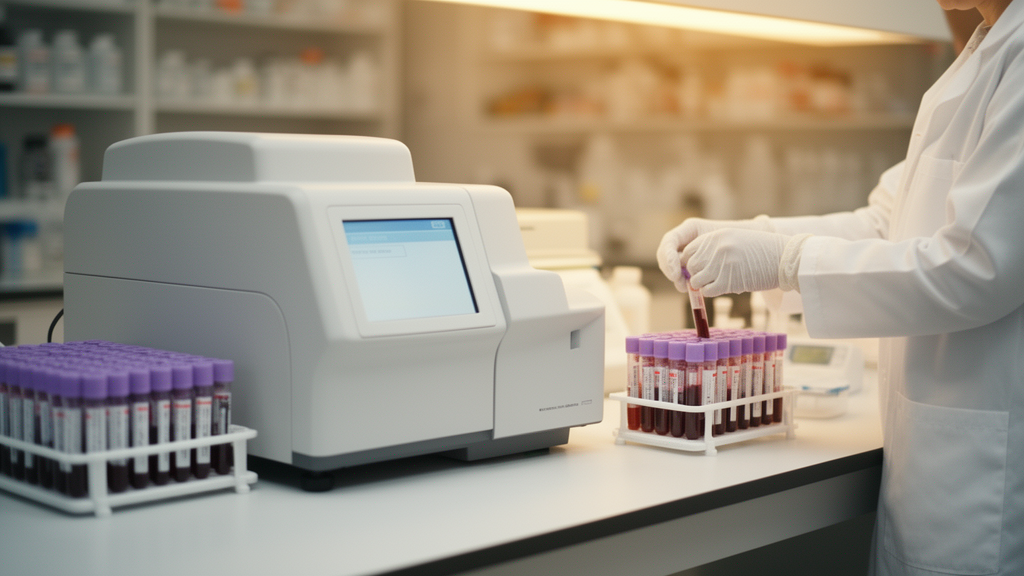
When a hospital laboratory reports a haemoglobin value below 70 grams per litre, the result is treated as critical and traditionally triggers an automatic repeat analysis before the number ever reaches a clinician. The practice dates from an era when automated blood analysers were less reliable, and it persists in many laboratories as a safeguard against random or systematic analytical errors. But a five-year study from a Portuguese public hospital now suggests that this reflexive retesting may be a relic whose time has come to end, and that the very data generated by the practice can be repurposed into a free, continuous quality-control system.
The rationale for repeating critical results before reporting traces back to guidelines issued decades ago, when haematology analysers were mechanically simpler and flagging systems less sophisticated. At that time, a second measurement served as one of the few available checks against instrument drift, sample aspiration problems, or transient electrical noise. As analytical platforms evolved, manufacturers built layered verification into the instruments themselves: hydrodynamic focusing, repeated cell counting within a single aspiration, internal quality-control materials, and real-time decision rules that flag suspicious distributions of cell counts or optical signals. The question facing laboratories today is not whether analytical quality matters, but whether a blanket repetition policy still adds meaningful protection or simply adds cost, delay, and workload without changing clinical decisions.
The Portuguese data speak directly to that question. Across nearly half a million haemograms reviewed over five years, the overwhelming majority of critical haemoglobin repeats returned values essentially identical to the first measurement. Almost half of the paired readings were exactly equal, and fewer than two in every hundred differed by more than two grams per litre. When discrepancies did exceed the clinically relevant threshold of four grams per litre, investigation revealed pre-analytical culprits rather than analytical ones: clotted samples, fibrin strands, or mislabelled tubes that required recollection regardless of any repeat policy. This pattern is important because it locates the residual risk where laboratory medicine has long suspected it resides, in the journey of the specimen before it reaches the analyser, not in the analytical measurement itself.
The distinction between analytical and pre-analytical error carries practical consequences. A repeat measurement on the same tube can detect instrument malfunction, but it cannot detect a clot that formed in the tube before analysis, a sample drawn from the wrong patient, or a label applied to the wrong container. Those failures demand different countermeasures: better phlebotomy practice, tube integrity checks, positive patient identification, and vigilant review of sample quality indicators. When a laboratory discovers, as this one did, that every large discrepancy traced back to pre-analytical problems, the case for automatic repetition weakens further, because repetition is the wrong tool for the failure modes that actually occur.
The study also illustrates a meaningful difference between intra-analyser and inter-analyser agreement. When repeats ran on the same module, nearly ninety-eight percent of pairs agreed within one gram per litre, and the coefficient of variation sat comfortably below the manufacturer’s specification. When repeats ran on a different module, agreement loosened slightly, with roughly eighty percent within one gram per litre and wider limits of agreement. This is expected behaviour for any multi-instrument platform: each analyser carries its own calibration, optical characteristics, and reagent lot interactions, and small between-module differences accumulate. The observed inter-analyser bias of less than a quarter of a gram per litre, and a coefficient of variation well within the manufacturer’s tolerance, nonetheless indicate that the laboratory’s harmonisation practices, including calibration alignment and shared maintenance schedules, were functioning as intended across the fleet.
The small negative bias observed in both comparison types deserves comment. Repeat measurements tended to read marginally lower than initial ones, by roughly a tenth to a fifth of a gram per litre. A bias of this magnitude is far below any threshold of clinical significance for haemoglobin, and it may reflect subtle sample-level changes such as settling of cells within the tube between aspirations, minor evaporation, or slight dilution effects from mixing. Its consistency across hundreds of paired measurements, however, demonstrates the power of large duplicate datasets: effects too small to notice in individual cases become statistically visible and quantifiable when aggregated over years of routine operation.
Methodologically, the study occupies a deliberate middle ground. The authors are careful to state that their retrospective analysis does not replace formal precision protocols such as those published by the Clinical and Laboratory Standards Institute, which prescribe controlled experiments with defined materials, replication schemes, and statistical treatment. Those protocols remain the foundation for verifying manufacturer claims and for regulatory compliance. What the retrospective approach adds is a complementary layer: evidence of how instruments behave under the messier conditions of real practice, with heterogeneous patients, variable sample quality, rotating operators across day, evening, and night shifts, and the full range of clinical demand that a twenty-four-hour hospital laboratory experiences. A analyser that performs beautifully on control material but degrades under routine load would be exposed by longitudinal duplicate data in a way that a bench experiment might not reveal.
The intellectual lineage of this approach is older than modern automation. The idea of using naturally occurring duplicate measurements to estimate analytical imprecision echoes work from the late 1970s, when duplicate patient samples were proposed as a window into hidden analytical variability. What has changed is scale and feasibility. In the era of paper records, assembling thousands of duplicate pairs required laborious manual effort. Today, haematology analysers archive their raw measurement data automatically, and laboratory information systems can be interrogated with scripting tools to extract, pair, and analyse those records with minimal human intervention. The Portuguese team used open-source statistical software to automate sample pairing across nearly half a million records, a task that would have been impractical a generation ago.
This reframing of archived data as a quality asset has implications beyond haemoglobin. Modern analysers generate a rich stream of ancillary signals, including cell population data, flag frequencies, and instrument status parameters, much of which is stored but rarely examined systematically. Periodic mining of these archives could complement traditional internal quality control, which typically relies on control materials run at intervals and may miss intermittent faults or sample-specific problems. Duplicate-based monitoring, by contrast, draws on real patient specimens analysed under genuine operating conditions, and it costs essentially nothing beyond computational effort and analyst time. For laboratories facing budget pressure and workforce shortages, a zero-cost surveillance layer that runs continuously in the background is an attractive proposition.
The economics of reflex repetition deserve scrutiny in their own right. Each automatic repeat consumes reagent, instrument time, and technologist review, and it adds to turnaround time for a result that clinicians are waiting on in urgent clinical situations. Studies cited in the original letter have argued that routine repetition of critical haematology values wastes resources and delays clinical action without improving accuracy. When the measured repetition rate of meaningful error is as low as this study found, the marginal benefit of a universal repeat policy approaches zero, while the marginal cost is paid on every single critical result. A targeted policy, in which repetition is reserved for samples with flags, suspicious histograms, or clinical indications, would preserve the safeguard where it has value while removing it where it does not.
Any change to a long-standing standard operating procedure requires careful governance. Laboratories considering a move away from blanket repetition would need to document their own baseline performance, ideally with longitudinal duplicate analysis of the kind described here, and to establish ongoing monitoring so that any degradation in analytical performance triggers a return to more conservative practices. The override pathway used in the Portuguese laboratory, in which a small fraction of critical results were validated by a clinical pathologist without repetition based on clinical urgency, shows one model for balancing safety with efficiency: a defined, auditable process that concentrates expert judgement where it is most needed rather than applying mechanical rules indiscriminately.
The five-year span of the dataset is itself a strength. Analytical performance is not static: reagent lots change, lamps and optical components age, mechanical parts wear, and software updates alter behaviour. Demonstrating stable agreement across half a decade of continuous operation, with nearly seven thousand measurements from three interconnected modules, provides a level of assurance that a short-term validation study cannot match. It also demonstrates that the monitoring approach is sustainable, since the same pipeline that produced this analysis can be rerun periodically to detect emerging drift or module divergence before it affects patient care.
For the wider laboratory medicine community, the message is twofold. First, the evidence base for questioning universal repetition of critical haemoglobin results continues to grow, and laboratories still enforcing such policies should examine their own duplicate data to determine whether the practice is protecting patients or merely consuming resources. Second, the raw data already flowing through modern analysers represent an underused resource for quality assurance. With modest analytical effort, routinely generated duplicate measurements can be transformed into a continuous, real-world performance monitor, one that complements rather than replaces formal precision studies and that costs almost nothing to maintain. In an era when laboratories are asked to do more with less, turning existing data exhaust into actionable quality intelligence is a strategy whose time has arrived.
Subject of Research: Longitudinal agreement of repeated critical haemoglobin measurements as a measure of analytical quality in a hospital haematology laboratory
Article Title: Longitudinal agreement of repeated critical haemoglobin measurements as evidence of sustained analytical quality
Article References: Simões, V., Magalhães, C., & Eremina, Y. O. (2026). Longitudinal agreement of repeated critical haemoglobin measurements as evidence of sustained analytical quality. British Journal of Biomedical Science, 83, Article 16480. https://doi.org/10.3389/bjbs.2026.16480
Image Credits: AI Generated
Keywords: haemoglobin, critical values, internal quality control, haematology analysers, Bland-Altman analysis, reflex testing, laboratory medicine, coefficient of variation, Sysmex XN-9100, pre-analytical errors, clinical pathology, real-world data
News Source: Ophelia Keating. (October 16, 2026). Five Years of Repeated Critical Haemoglobin Tests Reveal Remarkably Stable Analyser Performance. Scienmag.