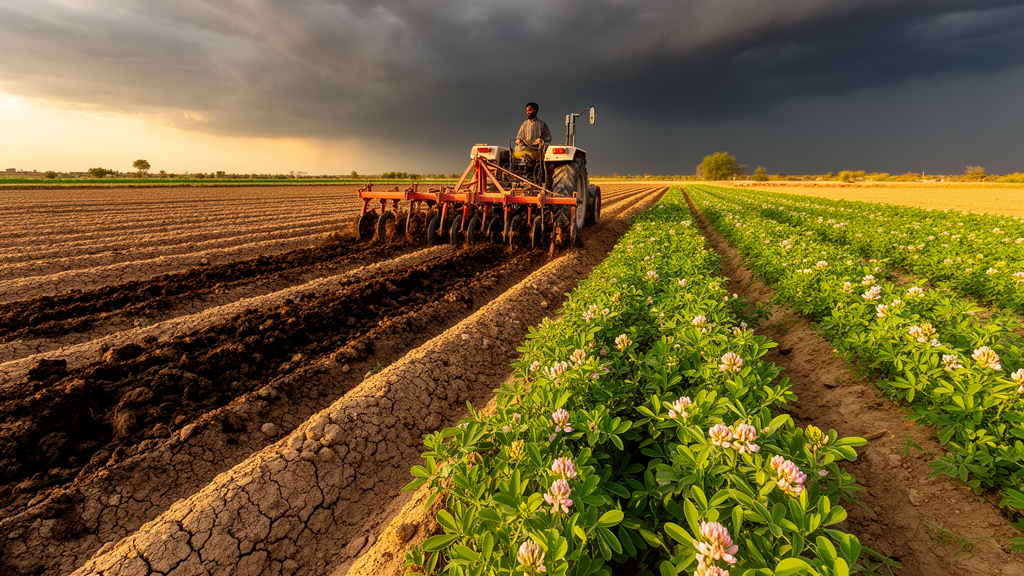
In the arid foothills of Punjab, Pakistan, farmers have long depended on a capricious ally: the flashy, ephemeral streams that roar to life after mountain rains and vanish just as quickly, leaving behind saturated fields and a narrow window for planting. A new field study published in BMC Plant Biology suggests that the secret to squeezing more from these unpredictable flood pulses lies not in what farmers do after the water arrives, but in how they prepare the soil beforehand. Researchers found that deep chisel ploughing carried out before the flood season, followed by light cultivation once the soil reached field capacity, boosted chickpea seed yields by more than 28 percent compared with the traditional practice of leaving land fallow until the flood passed.
The research team, led by Khuram Mubeen of Muhammad Nawaz Shareef University of Agriculture in Multan, conducted field experiments over two winter growing seasons, 2019-20 and 2020-21, at two sites within the Mithawan flashy ephemeral stream-fed area of Punjab. This region belongs to a class of hydrological systems that hydrologists call flashy: flows rise and fall dramatically within hours, delivering pulses of water and fertile sediment that are either captured by fields or lost downstream. Because the water arrives without warning and cannot be stored reliably, farmers in these systems have historically practiced minimal land preparation, waiting for the flood to wet the soil before sowing chickpea, a cool-season legume that anchors food security and soil fertility across South Asia’s drylands.
To test whether pre-flood soil preparation could tip the odds in farmers’ favor, the team set up a randomized complete block design in split plots, replicated three times, comparing five pre-flood tillage treatments: moldboard plough, chisel plough, disc plough, cultivator, and the farmers’ conventional practice of leaving the land fallow. After each flood event, once the soil had drained to field capacity, plots received either a single pass with a cultivator or a combined cultivator and rotavator treatment. The researchers then tracked soil moisture at multiple depths, flood water productivity, chickpea seed yield, and the economic returns of each system across both seasons.
The results pointed unambiguously toward deep, non-inversion tillage. Plots that had been chisel ploughed before the flood and cultivated afterward with a cultivator alone recorded the highest soil moisture content, 23.95 percent in the top 15 centimeters of soil at the flowering stage, the period when chickpea plants are most sensitive to water stress. The same combination delivered the highest flood water productivity, 0.15 kilograms of grain per cubic meter of floodwater in the first year, and the highest seed yield, 1,528 kilograms per hectare, alongside a benefit-cost ratio of 2.2. Across the experiment, fields managed with the chisel plough produced 28.21 percent more chickpea seed than fields under the farmers’ practice.
The mechanism behind these gains is rooted in soil physics. A chisel plough breaks up compacted subsurface layers without inverting the soil profile, creating continuous macropores that act as infiltration highways when floodwater arrives. In contrast, a moldboard plough buries surface residue and creates a smeared plough pan that can impede deep percolation, while shallow cultivator passes leave the surface sealed and prone to crusting. By loosening the soil before the flood pulse, the chisel plough allowed more of the ephemeral flow to infiltrate and be stored within the root zone rather than running off across the field surface. The subsequent post-flood cultivation with a cultivator, or with a cultivator and rotavator combination, then broke the capillary channels near the surface, slowing evaporation and preserving the stored moisture for the developing crop.
Timing proved to be the critical variable. Because the soil was already loosened before the flood, it absorbed water rapidly during the brief window when the stream flowed, reaching field capacity uniformly across the profile. Farmers who waited until after the flood to begin tillage faced a different problem: working wet soil risks compaction and clodding, while delaying cultivation allows moisture to evaporate from an unprepared surface. The study’s split-plot design allowed the researchers to isolate these effects, showing that the pre-flood treatment set the ceiling for how much water the soil could capture, while the post-flood treatment determined how long that water stayed available to the crop.
The economic analysis reinforced the agronomic findings. The chisel plough plus cultivator system achieved a benefit-cost ratio of 2.2 in the first year, meaning every rupee invested returned more than double its value in chickpea grain. For smallholder farmers in semiarid regions, where a single failed crop can push a household into debt, such a margin matters. The researchers also evaluated the marginal rate of return across treatments, confirming that the additional cost of hiring a chisel plough before the flood season was outweighed by the yield gains it unlocked. Notably, the combination of chisel ploughing followed by either a cultivator alone or a cultivator-rotavator sequence produced the maximum chickpea and flood water productivity under the flashy, flood-irrigated conditions of the trial.
Beyond the immediate yield numbers, the authors frame the work as a contribution to climate resilience. Semiarid regions across the Middle East, North Africa, and South Asia face intensifying rainfall variability, with precipitation increasingly concentrated into fewer, more violent events. Ephemeral stream systems, which depend entirely on these sporadic pulses, are among the most vulnerable agricultural niches on Earth. The study suggests that deep tillage paired with strip cropping of legumes such as chickpea could reduce the damage caused by flashy flows, converting what is often a destructive flood event into a productive irrigation event. By improving infiltration, deep tillage also reduces the velocity and erosive energy of floodwater as it crosses a field, offering a secondary benefit for soil conservation.
The findings carry practical weight for extension services and development programs working in flood-fed farming systems from the Sulaiman Range foothills of Pakistan to the wadis of the Arabian Peninsula and the Sahel. Because the recommended practice relies on equipment, a chisel plough and a cultivator, that many smallholders already access through custom-hire services, adoption barriers are relatively low compared with capital-intensive water harvesting infrastructure. The researchers emphasize that the approach fits within the broader framework of climate-smart tillage, a set of practices designed to conserve soil moisture, sustain productivity, and buffer crops against the erratic hydrology that climate change is amplifying across the world’s drylands.
As global demand for chickpea continues to rise and arable water resources grow scarcer, the study offers a reminder that sometimes the most powerful climate adaptation is not a new technology but a change in the order of operations. Preparing the soil before the water arrives, rather than after, transforms a fleeting flood pulse into a season-long water reserve, and turns one of agriculture’s most unpredictable water sources into a more dependable partner for the farmers who depend on it.
Subject of Research: Effect of pre-flood tillage practices on soil water storage and chickpea productivity in ephemeral stream-fed semiarid cropping systems
Article Title: Strategic pre‑flood tillage improves soil water storage and chickpea yield under ephemeral stream influence in semiarid environments
Article References: Mubeen, K., Asif, M., Sarwar, N., Wasaya, A., Yasir, T. A., Ahmad, M., Skalicky, M., Habib-ur-Rahman, M., Al-Ashkar, I., Ahmad, G., Arshad, A., & El Sabagh, A. (2026). Strategic pre‑flood tillage improves soil water storage and chickpea yield under ephemeral stream influence in semiarid environments. BMC Plant Biology. https://doi.org/10.1186/s12870-026-10063-1
Image Credits: AI Generated
DOI: 10.1186/s12870-026-10063-1
Keywords: chickpea, tillage, ephemeral streams, soil water storage, floodwater harvesting, semiarid agriculture, climate-smart agriculture, Pakistan, moisture conservation, flood irrigation, crop yield, drought resilience
News Source: Alan Morgan. (October 16, 2026). Deep Tillage Before Flash Floods Boosts Chickpea Yields in Parched Pakistan. Scienmag.