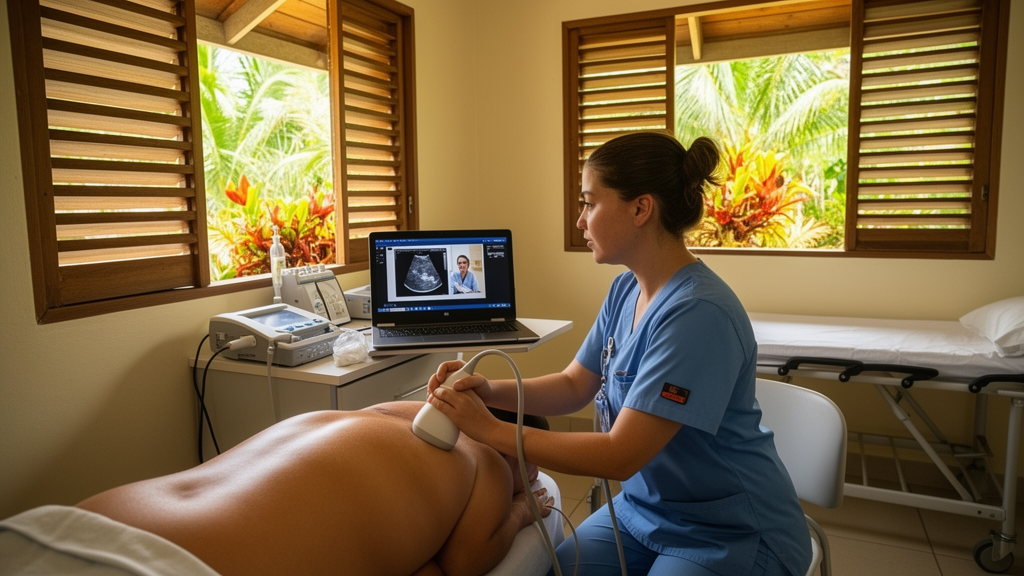
On Fukue Island, a remote island in Japan’s Nagasaki Prefecture, a team of researchers has demonstrated that a carefully structured training program can teach home care nurses to interpret ultrasound images, even when the nurses have never held a probe before. The study, published in BMC Nursing, tested a Tele-POCUS-oriented training course designed to prepare visiting nurses and nurses working in long-term care facilities for a future in which point-of-care ultrasound becomes part of routine home care, guided remotely by physicians who may be hundreds of kilometers away.
Point-of-care ultrasound, commonly abbreviated as POCUS, refers to the use of portable ultrasound devices at the bedside to answer focused clinical questions in real time. Unlike comprehensive diagnostic imaging performed by radiologists, POCUS is designed to be quick, targeted, and immediately actionable. In hospital settings, it has transformed how clinicians assess patients with breathlessness, abdominal pain, or suspected fluid overload. But in home care, particularly in rural and remote regions where physician shortages make timely assessment difficult, the technology has remained largely out of reach for the nurses who actually visit patients in their homes.
The research team, led by Toru Yamada of the Institute of Science Tokyo, recognized this gap. Japan’s rapidly aging population and rising health care costs have intensified demand for home care services, yet the physician workforce is concentrated in urban centers. On islands like Fukue, a physician may not be able to reach a deteriorating patient quickly. If nurses on the ground could acquire ultrasound images and transmit them for remote interpretation, the diagnostic delay that currently plagues rural home care could be substantially reduced. The concept, known as Tele-POCUS, combines bedside ultrasound acquisition by trained nurses with real-time or asynchronous image review by physicians located elsewhere.
To test whether such a model is educationally feasible, the researchers designed a training course consisting of three components: didactic lectures covering ultrasound physics and normal anatomy, hands-on scanning sessions with real equipment, and workflow training that simulated remote collaboration between nurses and physicians. The simulation component was critical, because the ultimate goal is not simply to produce nurses who can operate a probe, but to establish a communication protocol in which image acquisition, transmission, and physician feedback function smoothly across distance. Participants were recruited through an island-wide open call, and 36 nurses from five visiting nursing stations and six long-term care facilities completed the program and were included in the analysis.
The primary outcome measured was the change in image interpretation score, assessed through an examination using ultrasound video clips. The examination included two distinct domains: a basic domain testing recognition of normal anatomy and fundamental findings, and a case-based domain requiring participants to interpret clinically realistic scenarios. Before the course, the overall interpretation score averaged 31.4 out of 100, with a standard deviation of 16.1. After training, the mean rose to 50.8, with a standard deviation of 13.0. The mean difference of 19.4 points carried a 95 percent confidence interval of 14.4 to 24.5 and a p-value below 0.001, indicating a statistically robust improvement.
Breaking the results down by domain revealed a more nuanced picture. The basic domain score increased dramatically, from 14.1 to 31.7, a mean difference of 17.6 points with a confidence interval of 14.3 to 20.9. This suggests that the lectures and hands-on sessions were highly effective at teaching fundamental image recognition skills. However, the case-based domain showed no statistically significant change, moving only from 17.3 to 19.2, with a mean difference of 1.8 points and a confidence interval spanning from negative 1.2 to positive 4.9. The p-value of 0.229 confirmed that this modest gain could easily have occurred by chance.
This dissociation between basic and case-based performance is perhaps the most scientifically interesting finding of the study. It suggests that short-term training can reliably build pattern recognition for normal anatomy and straightforward pathological findings, but that clinical reasoning, the ability to integrate ultrasound findings into a broader diagnostic picture, requires sustained exposure to real patients over time. The authors acknowledge this limitation explicitly, noting that short-term training alone may be insufficient for developing advanced clinical reasoning abilities. This aligns with established educational theory, which distinguishes between declarative knowledge that can be transmitted through lectures and procedural expertise that accumulates only through deliberate practice.
Confidence, a separate but clinically important outcome, told a different story. Measured on a scale where participants rated their self-assessed competence across multiple subdomains, confidence scores rose from a median of 20.0 before the course to 60.0 afterward, with interquartile ranges shifting from 20.0 to 21.5 to 47.5 to 69.5. All subdomains showed statistically significant improvement, with p-values below 0.001. The magnitude of this confidence gain, roughly tripling the median score, suggests that the training succeeded in making nurses feel capable of engaging with ultrasound technology, which is a prerequisite for any future implementation of Tele-POCUS in actual home care practice.
However, the proportion of participants achieving at least 60 percent on the post-course examination was only 27.8 percent for the overall score. This figure is a sobering reminder that improved scores do not necessarily translate into clinical competence. A mean improvement of 19.4 points, while statistically significant, still leaves the average participant below the halfway mark on the interpretation examination. The researchers frame Tele-POCUS education as an introductory approach, suitable for establishing supervised remote collaboration between nurses and physicians, rather than as a standalone pathway to independent diagnostic capability. This framing is important for policy makers considering similar programs in other rural settings.
The study’s implications extend beyond Fukue Island. As populations age across high-income countries and health systems struggle to distribute clinical expertise geographically, the combination of portable ultrasound and telemedicine represents a potentially scalable solution. The technology required, a handheld ultrasound probe and a video connection, is increasingly affordable. The bottleneck is human: building a workforce of nurses who can acquire diagnostically useful images and communicate them effectively to remote physicians. This study provides early evidence that the first step of that workforce development is achievable, while also delineating the boundaries of what a short course can accomplish. Future research, the authors note, must evaluate long-term competency development and practical application in real clinical settings, questions that this pre-post educational design cannot answer on its own.
Subject of Research: Tele-POCUS ultrasound training for home care nurses in remote and rural Japan
Article Title: Educational effectiveness of a Tele-POCUS training program for home care nurses in remote and rural settings
Article References: Educational effectiveness of a Tele-POCUS training program for home care nurses in remote and rural settings. (n.d.). https://doi.org/10.1186/s12912-026-05345-w
Image Credits: AI Generated
DOI: 10.1186/s12912-026-05345-w
Keywords: Tele-POCUS, point-of-care ultrasound, home care nursing, rural health, remote islands, nursing education, ultrasound training, Japan, telemedicine, medical education, physician shortage, clinical competence
News Source: Ophelia Keating. (October 16, 2026). Remote Island Nurses Learn Ultrasound Through Tele-POCUS Training Program. Scienmag.