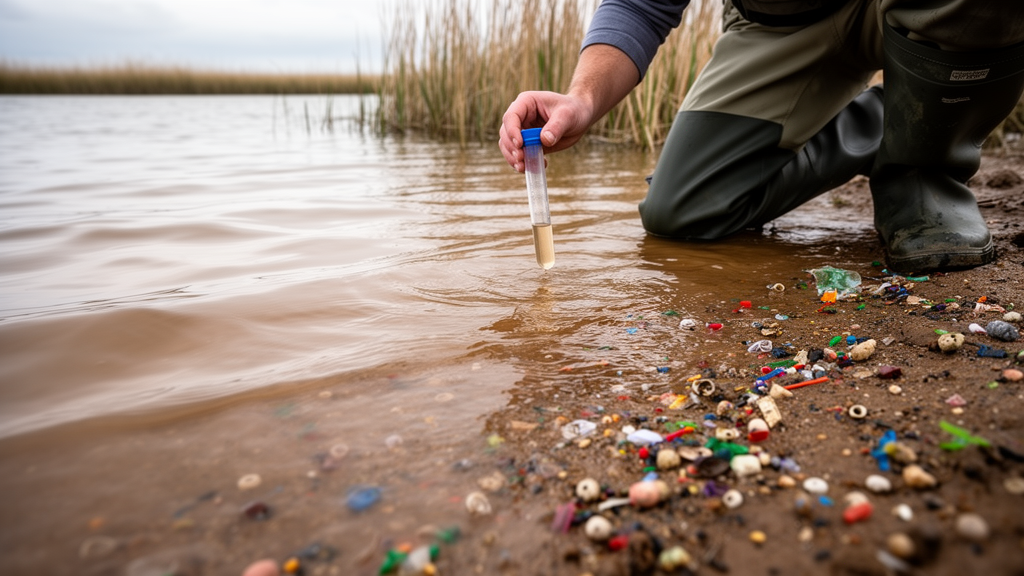
Estuaries, the dynamic transition zones where rivers meet the sea, are emerging as critical hotspots for a class of pollutants that scientists say has been dangerously overlooked: the chemical additives locked inside plastic debris. A new review published in Estuarine Management and Technologies argues that plastic-derived chemicals, ranging from phthalates to flame retardants, can serve as powerful indicators of microplastic contamination across water, sediment, and living organisms, offering researchers a chemical fingerprint for tracking one of the planet’s most pervasive pollution problems.
The review, led by an international team synthesizing studies from Science Direct and Google Scholar using the keywords plastic, microplastic, and additives, examines how these synthetic materials fragment and release their chemical cargo into some of the world’s most productive ecosystems. The authors frame plastic pollution not merely as a visible nuisance but as a vector for endocrine disruptors and mutagens capable of affecting future generations, making systematic scientific approaches essential for remediation and sustainable environmental management.
The scale of the problem is staggering. Roughly 60 percent of all plastics ever produced have been discarded, largely because of limited recyclability and inadequate waste management. Global plastic production has grown explosively since the mid-twentieth century, and the very properties that make thermoplastics and thermosets so useful, their malleability and persistence, also make them permanent contaminants. Once in the environment, plastics are broken down by photo-oxidation, physical abrasion, climatic changes, chemical reactions, and biological interactions, generating microplastics smaller than 0.5 millimeters while simultaneously releasing covalently bonded additives into surrounding water and sediment.
Microplastics pose a dual threat, according to the review. First, they act as vectors, carrying hazardous chemicals attached to their surfaces. Second, they are intrinsic pollution sources in their own right, leaching additives as they weather. The synergistic toxicity is amplified when microplastics interact with pesticides, pharmaceuticals, and trace metals in the same environment. Because many additives are small molecules with low boiling points, they migrate rapidly between environmental phases through chemisorption and physisorption mechanisms, and their release kinetics depend on polymer character, additive content, environmental conditions, and the size and shape of the particles themselves.
The consequences ripple through food webs. The migration of microplastic particles and their additives across trophic levels has been linked to genetic disorders, prenatal effects, and impaired cognitive functions in exposed organisms. Advanced research methodologies, including particle diffusion and aqueous boundary layer diffusion models, are now being deployed to understand how additives detach and travel, though the authors caution that most laboratory findings need to be validated under real-world environmental conditions, where changing contexts complicate predictions.
Estuaries are particularly vulnerable because of their position at the interface of freshwater and marine systems. Riverine inflow, mangrove debris, coastal influx, urban runoff, and dense human activity make these environments highly productive and depositional. Since the majority of the world’s population lives near coasts, estuarine contamination translates directly into human exposure risk. The review documents an extensive catalog of plastic chemicals in coastal systems worldwide, including benzotriazole UV stabilizers in marine products, phthalates and polybrominated diphenyl ethers in the Yangtze estuary, phthalate esters in the Pearl River Delta, tris (butoxy ethyl) phosphate in Nanyang Lake estuary, organophosphate esters in the benthic compartments of the Loire estuary, and phenolic compounds in the Bay of Bengal coastal waters.
Sediments emerge as the critical sink in this pollution story. They serve as the ultimate repository for organic carbon, inorganic particles, and synthetic materials, facilitating the integration of organic matter into the geological carbon cycle. When physical, chemical, and biological processes combine, substantial quantities of external synthetic materials sink through the water column and are retained in bed sediment, where they acquire distinctive biochemical compositions. The concentrations recorded vary enormously across the globe, from 0.04 to 0.99 microplastics per cubic meter in the Tamar River in England to 5,720 plus or minus 2,580 items per kilogram in the Kallar Kahar wetland in Pakistan, with intermediate values such as 851 plus or minus 177 items per kilogram in Pearl River Estuary sediments and 1,260 particles per kilogram in the Azhikkal estuary of the Arabian Sea.
The biological toll in estuarine habitats is already measurable. Fragmented microplastics and their additives interfere with water availability, sediment characteristics, benthos survival rates, and fish health in intertidal ecosystems. The review highlights unresolved questions about sinking capacity in aquaculture systems, changes in biotic metabolism, pore water dynamics, habitat destruction, productivity reduction, and mutation, all of which require more elaborate investigation. In low-lying aquatic systems, contamination is modulated by tidal effects, salinity gradients, acidic content, chlorophyll concentrations, and biotic interactions, factors that vary seasonally and geographically.
The authors propose that the combined signature of microplastics and plastic-derived chemicals could function as an ecological contamination marker for estuarine systems, a diagnostic tool that integrates both the physical particles and their chemical payloads. This dual approach could allow managers to detect pollution earlier and more comprehensively than particle counting alone, since additives persist and accumulate in water, sediment, and biotic material even as plastics fragment into ever smaller, harder-to-detect pieces.
Looking forward, the review calls for long-term environmental monitoring of the interaction between microplastics and plastic additives, standardized conceptual frameworks for assessing individual parametric effects, and better protocols for evaluating nano-plastic particles. Climatic variations, interactive reactions, and the degradation mechanisms of macro-plastics remain major topics of discussion in the global scientific community. Ultimately, the authors argue that effective policy implementation and new legal regulations are essential for sustainable development practices, because without governance changes, the chemical legacy of decades of plastic production will continue to settle into the sediments of the world’s estuaries, where it may persist for generations.
Subject of Research: Plastic-derived chemical additives and microplastic contamination in estuarine ecosystems
Article Title: Review on plastic-derived chemical pollutants in estuarine ecosystems: Assessing the scale of microplastic contamination
Article References: Nisari, A. R., & Renjith, K. R. (2026). Review on plastic-derived chemical pollutants in estuarine ecosystems: Assessing the scale of microplastic contamination. Estuarine Management and Technologies, 3, 113-121. https://doi.org/10.3897/emt.3.183953
Image Credits: AI Generated
DOI: 10.3897/emt.3.183953
Keywords: microplastics, plastic additives, estuaries, endocrine disruptors, sediment contamination, phthalates, flame retardants, marine pollution, food web transfer, environmental monitoring, Review, plastic-derived
News Source: Denise Maddox. (October 16, 2026). Plastic Additives in Estuaries: Microplastic Chemical Pollution Under Review. Scienmag.