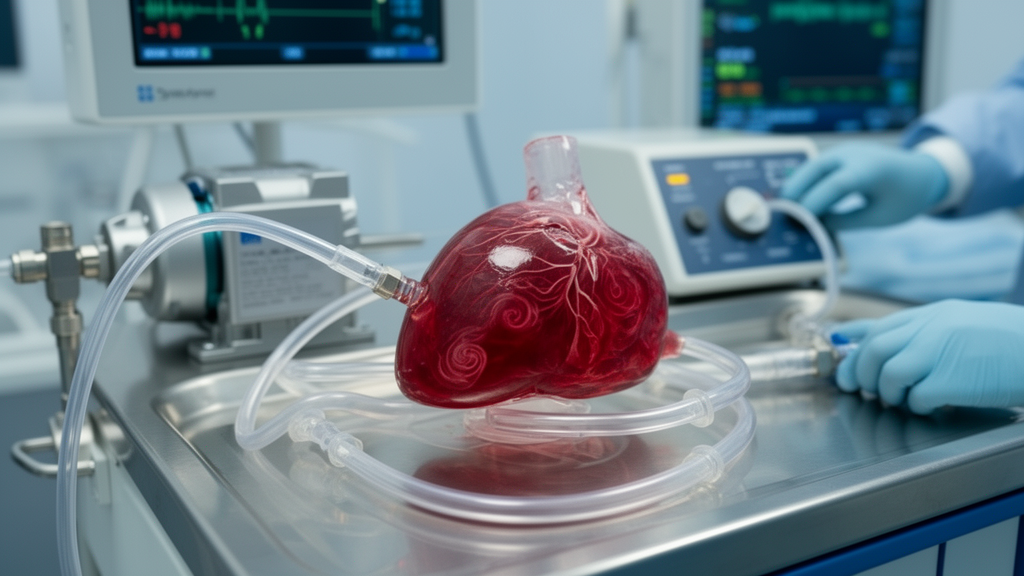
For most of the history of organ transplantation, the clock between donation and transplant was an enemy that could only be slowed, never beaten. Surgeons flushed donated organs with cold preservation solution and packed them on ice, a technique known as static cold storage that buys time by suppressing metabolism but offers no way to know whether the organ is truly viable, let alone to improve it. A new collection of studies and expert commentary published in Frontiers in Transplantation argues that this passive era is ending. Machine perfusion technologies, which circulate oxygenated fluid through organs outside the body, are transforming preservation from a holding pattern into an active platform for assessment, therapy, and even regeneration, with consequences that reach far beyond the operating room into ethics, workforce training, and the economics of transplantation.
The editorial collection, assembled by Aleah L. Brubaker and Gabriel T. Schnickel of the University of California San Diego, frames the central shift of the past decade: clinicians are no longer merely preserving donated organs but resuscitating them, probing their function, and modifying their biology before implantation. Three main techniques anchor this transformation. Hypothermic machine perfusion (HMP) pumps chilled, oxygenated solution through the organ at low temperatures, reducing ischemic injury while allowing continuous delivery of protective agents. Normothermic machine perfusion (NMP) keeps the organ at body temperature with oxygenated blood or blood substitutes, sustaining near-physiologic metabolism so that bile production, lactate clearance, and other real-time markers can be measured. Normothermic regional perfusion (NRP) operates inside the donor, restoring circulation to the abdominal organs after circulatory death while excluding the brain, a strategy that has dramatically expanded the pool of usable organs from donation after circulatory death.
A comprehensive review by Olaso and colleagues lays out the landscape across liver, kidney, pancreas, and intestinal transplantation, and its most important contribution may be its honesty about what the field does not yet know. Machine perfusion clearly offers opportunities for viability assessment, greater use of marginal grafts from older or steatotic donors, and therapeutic intervention during the perfusion interval itself. But the review emphasizes that the technology faces shared obstacles across all abdominal organs: high cost, logistical complexity, lack of standardized protocols, and unresolved questions about which organs and which clinical circumstances actually benefit. A steatotic liver teetering on the edge of usability may gain enormously from hours of normothermic perfusion and metabolic conditioning, while a pristine kidney from a young donor may derive little advantage that justifies the expense and infrastructure. Defining those boundaries is now a central research priority.
The most dramatic illustration of how perfusion is rewriting the rules of organ recovery comes from Assouline and colleagues, who describe a case in which surgeons converted from veno-arterial extracorporeal membrane oxygenation to abdominal NRP after extracorporeal cardiopulmonary resuscitation failed in a patient with a Stanford type A aortic dissection, one of the most catastrophic cardiovascular emergencies in medicine. Despite the extraordinary complexity of the scenario, abdominal NRP enabled successful organ recovery and transplantation, demonstrating how innovative preservation techniques can create donation opportunities that would have been impossible under traditional protocols. The case underscores a broader point: NRP is not simply a preservation tool but a recovery strategy that changes which donors the system can serve.
Yet NRP remains the most ethically contested technology in the field. Because the technique restores circulation after the declaration of death by circulatory criteria, critics and some health systems question whether regional reperfusion constitutes a violation of the dead donor rule, and rigorous safeguards are required to prevent any cerebral reperfusion. Some countries and health systems do not currently permit NRP recovery at all. The editorial authors argue that as adoption expands, transparency, continued engagement with clinicians, ethicists, donor families, and the public, and unambiguous safeguards against brain reperfusion will remain essential. The technology’s clinical promise cannot be separated from the social license that permits its use, and that license must be earned case by case, system by system.
Beyond rescue and assessment, machine perfusion is opening a genuinely new therapeutic frontier: using the perfusate itself as a drug delivery vehicle. Mayoral and colleagues reviewed the pharmacologic supplementation of hypothermic kidney preservation and identified a substantial body of preclinical work targeting the molecular pathways of ischemia-reperfusion injury, the cascade of oxidative and inflammatory damage that occurs when an organ is deprived of blood and then reoxygenated. Clinical translation remains limited, but the conceptual shift is profound. Preservation solutions and perfusates, once inert fluids, are becoming platforms for targeted therapy, allowing drugs, gene therapies, or metabolic modulators to be delivered directly to an organ in a controlled circuit, away from the systemic exposure and side effects that complicate treatment in a living patient.
Tropp and colleagues extend this logic to the ultimate therapeutic ambition: regeneration. Their review maps the complex cellular and molecular networks that govern hepatic regeneration and proposes ex vivo machine perfusion as a bridge between mechanistic biology and clinical transplantation. Because perfusion maintains whole-organ architecture in a controlled environment, regenerative pathways can be measured, manipulated, and augmented before the organ ever reaches a recipient. In this framework, the goal moves beyond preserving the organ that was donated toward improving the organ that will ultimately be transplanted, a distinction that could eventually allow marginal livers to be conditioned into high-quality grafts rather than discarded.
Technological transformation, the collection stresses, cannot occur independently of the people who deliver it. Mullens and colleagues examine machine perfusion from the perspective of the next generation of transplant surgeons, and their analysis reveals a double-edged sword. Perfusion may enable daytime transplantation, replacing the midnight urgency of cold storage with scheduled, physiologically informed decision-making, and it creates new opportunities for assessment and translational research. At the same time, it changes traditional training experiences and introduces new technical and cognitive competencies, from interpreting perfusion parameters to managing complex extracorporeal circuits. The transplant workforce must evolve alongside the technology, with training programs, staffing models, and professional expertise redesigned to match the capabilities of the machines.
Viewed together, the contributions sketch a field in the midst of systemic reorganization. Machine perfusion can expand organ utilization by recovering organs that might otherwise be lost and by providing additional information to guide acceptance decisions. It is transforming the organ from something that is simply preserved into something that can be assessed, treated, and potentially repaired. Technologies such as NRP and ex vivo perfusion are becoming increasingly interconnected within more complex donation pathways, requiring coordination across organ procurement organizations, donor hospitals, recovery teams, transplant centers, and perfusion platforms. Successful integration will depend not only on technological capability but on the infrastructure, ethical frameworks, and systems of care required to deliver these technologies safely and equitably. In this sense, machine perfusion is emerging as an enabling platform across the entire transplantation pathway rather than a single preservation technology.
The editorial closes with questions that will define the next decade. Perfusion requires personnel, infrastructure, expertise, and financial resources that are not uniformly available, and the field must determine not simply whether these technologies improve individual graft outcomes but how they affect organ utilization, access to transplantation, cost, sustainability, workforce demands, and equity. Enhanced data collection and multicenter collaboration will be essential to identify which approaches provide meaningful benefit, for which organs and recipients, and under what circumstances. What began as a strategy for keeping organs cold has become, in the authors’ framing, a catalyst through which transplantation itself can be reimagined, provided the field builds the systems, safeguards, and shared standards to match the ambition of its machines.
Subject of Research: Machine perfusion technologies for abdominal organ preservation, assessment, and transplantation
Article Title: Editorial: Advancing machine perfusion: navigating challenges in abdominal organ transplantation
Article References: Editorial: Advancing machine perfusion: navigating challenges in abdominal organ transplantation. (n.d.). https://doi.org/10.3389/frtra.2026.2001083
Image Credits: AI Generated
DOI: 10.3389/frtra.2026.2001083
Keywords: machine perfusion, organ transplantation, normothermic perfusion, hypothermic machine perfusion, normothermic regional perfusion, liver transplantation, kidney transplantation, organ preservation, ischemia-reperfusion injury, organ donation, transplant surgery, organ viability
News Source: Drew Townsend. (October 16, 2026). Machine Perfusion Is Turning Donated Organs Into Repairable, Assessable Living Systems. Scienmag.